How to control mango weevil disease? Detailed explanation of control methods
1. The mango leaf-cutting weevil is widely distributed. Adults feed on young mango leaves, causing the leaves to dry up; or females lay eggs on young leaves and bite the young leaves off from the base, affecting plant growth. Control methods: ① During the growth period of young shoots, pick up the bitten-off fallen leaves from affected plants once every 3 days, dry them in the sun and burn them to kill the lar...
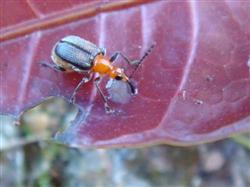 1. The mango leaf-cutting weevil is widely distributed. Adults feed on young mango leaves, causing the leaves to dry up; or females lay eggs on young leaves and bite the young leaves off from the base, affecting plant growth. Control methods:
① During the growth period of young shoots, pick up the bitten-off fallen leaves from affected plants once every 3 days, dry them in the sun and burn them to kill the larvae;
② During the young shoot growth period, spray pesticide once every 7 days. 40% dimethoate emulsifiable concentrate at 1500 times dilution, 90% trichlorfon at 1000 times dilution, 25% bisultap at 500-800 times dilution and 2.5% deltamethrin at 2004-3000 times dilution can all be used.
2. The fruit mango weevil and the flesh mango weevil. The former is a small beetle, about 7 mm long, black. Its larvae bore into and feed on mango seeds, affecting fruit quality; the flesh mango weevil is a smaller yellow-brown small beetle than the fruit mango weevil, and its larvae mine and feed on the flesh, forming tunnels filled with insect frass, making the fruit inedible. These two pests mainly occur in Yunnan, Vietnam, Cambodia and as far as Indonesia, and are quarantine objects. However, according to reports, this pest has been found in recent years in the border area between Guangxi and Yunnan. Because these two pests cause serious damage but occur only in limited areas, quarantine must be strengthened to prevent their spread to new areas. In recent years, the practice of transporting large quantities of mangoes from Vietnam through non-official channels without quarantine is dangerous.
Control methods:
① In areas where this pest has not been found, strictly enforce the quarantine system to strictly prevent its spread to new areas;
② In pest-infested areas, maintain good orchard sanitation, promptly pick up fallen fruit, and poison and kill them in a centralized manner;
③ In autumn and winter, in conjunction with cleaning the orchard, remove all weeds, plow carefully and deeply, and eliminate pests overwintering in cracks in the soil layer;
④ During the young fruit stage 30-45 days after flower drop, spray the tree canopy with a mixture of dimethoate, trichlorfon and water at 1:1:1500, spraying once every 7-10 days, for 3-4 consecutive times, which can achieve significant control effectiveness.