Key Techniques for Ratoon Cultivation of Cherry Tomatoes in Greenhouses
Ratoon cultivation of cherry tomatoes by lowering the vines and pressing soil averaged 4,653.2 kg per mu, an increase of 816.9 kg over conventional cultivation, a gain of more than 20%, while also extending the harvest period by more than 30 days. The main reason for the yield increase is that this cultivation method keeps the fruiting position of cherry tomatoes in the middle and upper part of the greenhouse, and by pressing soil to promote new roots, shortens...
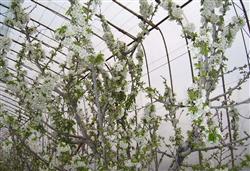
Ratoon cultivation of cherry tomatoes by lowering the vines and pressing soil averaged 4,653.2 kg per mu, an increase of 816.9 kg over conventional cultivation, a gain of more than 20%, while also extending the harvest period by more than 30 days. The main reason for the yield increase is that this cultivation method keeps the fruiting position of cherry tomatoes in the middle and upper part of the greenhouse, and by pressing soil to promote new roots, shortens the nutrient transport distance, which helps the fruit absorb nutrients.
1. Variety selection: Choose high-quality, high-yielding, disease-resistant varieties such as Shengnü, Jinzhu, Ziyu, Huangyangli and Zhuli. Among them, Shengnü and Zhuli are red, Jinzhu and Huangyangli are yellow, and Ziyu is purple. The single fruit weight of each variety is 12.8-15.2 g, with 18-22 fruits per cluster. Shengnü and Ziyu have oval fruit, Jinzhu is round, Huangyangli is pear-shaped, and Zhuli is long cylindrical.
2. Raising strong seedlings: Use plug trays with electric heating wires to protect roots and increase temperature for seedling raising. The best formula for the seedling substrate is mulberry sawdust : wheat straw : chicken manure at 3:3:4. The substrate is crushed, sieved, mixed evenly and composted for 30 days, then filled into plug trays, with electric heating wires laid under the trays. Use a small tunnel plus a medium tunnel plus a greenhouse plus straw mats for insulation. During the seedling stage, keep the daytime temperature at 25-30°C. When low temperatures occur at night, the electric heating wires need to be powered on to raise the temperature so that the seedbed temperature stays above 10°C. Water the seedlings by the principle of dry-wet alternation, and do not water lightly and frequently.
3. Transplanting: Transplant in mid-to-late February, that is, when the seedlings have 7-8 leaves and flower buds are appearing. Cover with film 7-10 days before transplanting to keep warm. Apply 2,000 kg of decomposed chicken manure, 10 kg of urea, 80 kg of superphosphate and 40 kg of potassium sulfate per mu. After broadcasting, plow deeply for 30 cm, then refine and level the soil and build beds. The beds are 90 cm wide and 20 cm high, with a ditch width of 30 cm. Plant 2 rows per bed with a plant spacing of 50 cm.
4. Hanging and lowering vines: Cherry tomatoes are pruned to a single vine. When the plant grows to 30 cm tall, hang the vine with plastic string. After the lower 2-3 fruit clusters are harvested, remove the lower diseased, old and yellow leaves, lower the vines in time, and cover the old vines with soil to promote new roots and plant growth.
5. Fertilizer and water management: From transplanting to fruit set, control fertilizer and water, and keep the temperature at 13-25°C. Starting from the fruit enlargement stage, keep the ground moist. Generally, install drip irrigation under film at the plant roots for watering, and each time apply 200 g each of monopotassium phosphate and urea per mu with the water.
6. Flower spotting: For early spring cultivation in greenhouses, during the full flowering stage, fruit-setting agents such as Zuoguoling and 2,4-D solution can be sprayed on flowers to prevent fruit drop and preserve fruit. When spraying, use cardboard to shield the rear part of the fruit cluster to prevent the solution from falling on the vines and inhibiting growth. Harvesting begins 60-70 days after planting.
7. Pest and disease control: The main insect pests are leafminers and whiteflies. For leafminers, use 20% chlorpyrifos-cypermethrin at 600 times dilution; for whiteflies, use 10% imidacloprid at 1000 times dilution plus 1% abamectin at 600 times dilution. The main diseases are gray mold, leaf mold and viral disease. For gray mold and leaf mold, on the basis of strengthening ventilation to lower temperature and remove moisture for prevention, spray procymidone at 800 times dilution for control; for viral disease, on the basis of eliminating aphids, spray Virus A at 600 times dilution for control.