How to manage sweet cherries in summer? These ten techniques must be mastered
1. Soil, fertilizer and water management. The fruit development period of sweet cherries is short, requiring concentrated nutrients. Pay attention to topdressing before flowering, during fruit development, after harvest and in autumn. The first application is mainly nitrogen fertilizer combined with phosphate and potassium fertilizer; the second is mainly phosphate and potassium fertilizer; after harvest, compound fertilizer is mainly used. Decomposed human manure and urine, decomposed soybean cake water, etc. can also be applied (farmyard manure...
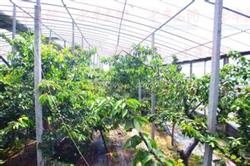 1. Branch bending to open angles. Winter pruning alone cannot solve the tree's ventilation and light conditions in one go. For some large trees, if the angle is too strongly emphasized during winter pruning, cutting them out becomes necessary, causing unnecessary damage to the tree. In summer, branch bending can solve problems that winter pruning cannot, reducing the amount of branch thinning. Generally, branch bending to open angles is carried out after harvest in June; the tree responds relatively mildly, and water sprouts are less likely to emerge on the upper side. The bending angle for main branches and lateral branches is preferably 60-70 degrees, while other branches can be bent to 80-90 degrees.
2. Pinching and short pruning. Pinch the vigorously growing central leader extension shoot; do not pinch if it is not vigorous; heavily pinch competing shoots to control them. When the central leader extension shoot reaches 50 cm, pinch it, removing 10 cm. When the main branch reaches 40 cm, pinch off 10 cm (keeping the lower buds). For upright shoots growing after pinching, leave 10 cm and pinch. From late May to early June, carry out three-leaf pruning on upright shoots or overly vigorous lateral branches (leave 3 large leaves at the base and cut off the rest); individual vigorous shoots can be short-pruned twice in succession.
3. Branch thinning and renewal pruning. Summer branch thinning is generally carried out after harvest from late May to early June (thinning large branches is best done in July). Its purpose is to remove overlapping, upright, overly dense, and overly vigorous perennial large branches that seriously affect light, so as to improve ventilation and light conditions inside the canopy, balance tree vigor. After harvest, thinning wounds heal easily and weaken tree vigor only slightly. For large branches that affect only local light conditions but still have some fruiting capacity, they can be cut back to a weak branch.
4. Shoot twisting and branch bending. From late May to early June, when new shoots have not yet lignified, carry out shoot twisting. For upright shoots, competing shoots and inward-facing temporary branches, gently twist about 5 cm from the base of the shoot by 180 degrees, which helps flower bud formation. In mid-to-late July, carry out branch bending and softening 2-3 times in succession on 1-year-old branches in the middle and upper parts to open the angle, weaken apical dominance, reduce growth vigor, and help flower bud formation.
5. Removing sprouts and girdling. In order to save nutrients and prevent branches from becoming dense and closed, promptly remove latent buds, water sprouts, or useless sprouts and sprouting branches in early summer. At the same time, girdling sweet cherry trees can promote flower bud formation, increase fruit set rate and fruit quality. However, after girdling sweet cherry trees, wounds heal slowly. Note that the girdling width should not exceed 0.5 cm, and because sweet cherry tree vigor varies, especially in trees with little organic fertilizer applied, gumming is likely to occur, so it should be used with caution in production.
6. Timely watering. Sweet cherries are neither drought-resistant nor tolerant of waterlogging. In northern regions, rainfall is also uneven. On the basis of watering well before flowering in early spring, if summer is dry, also water well at the hard-core stage, before harvest and after harvest. According to the rainfall patterns in the north, attention should be paid to drought prevention in late June, and irrigation should be carried out in time according to soil moisture; while July to August is the rainy season, so drainage and waterlogging prevention work in the orchard should be done well.
7. Applying paclobutrazol. For vigorous sweet cherry trees entering their 3rd year, in Shandong, Henan and other places, paclobutrazol is applied in late April and mid-June, 5 grams per tree. According to trials, soil application of paclobutrazol in early May has a better effect; by early-to-mid June most branches stop growing, and the flower formation rate is 95%, while the flower formation rate of trees not treated with paclobutrazol is only 20%.
8. Crack prevention and harvesting. Before sweet cherry harvest, due to watering, rainfall, heavy fog, etc., fruit flesh cells absorb water and expand rapidly, and various physiological activities accelerate, but the physiological activity of fruit skin cells is relatively slow. When the fruit turgor pressure increases beyond the pressure that the fruit skin and flesh cell walls can withstand, fruit cracking occurs. Pre-harvest fruit cracking is also often closely related to calcium deficiency in the fruit, and calcium supplementation is an important measure to prevent pre-harvest fruit cracking in sweet cherries. The calcium supplementation method is: starting about two weeks after flowering, spray once every 10 days or so with 300-500 times amino acid calcium, or 150 times calcium hydroxide solution and 100 times calcium chloride solution, for a total of 2-3 times, which can significantly reduce fruit cracking. The harvest period should be comprehensively determined according to fruit maturity, use and market demand; varieties with uneven ripening should be harvested in stages.
9. Reasonable topdressing. Immediately after harvest, apply quick-acting fertilizer, preferably compound fertilizer, 0.2-0.3 kg per tree, to promote flower bud differentiation.
10. Pest and disease control. The main pests and diseases harming cherries in summer include: gummosis, mulberry white scale, bridge-building caterpillar and peach leaf miner, etc. ① Gummosis: in the early stage of gumming, use a knife to make several longitudinal cuts at the diseased spot and squeeze out the sap, then brush with lime sulfur mixture for a certain effect. Another method is to scrape off the diseased part, then apply plant ash and wrap it with a plastic strip. ② Mulberry white scale: in mid-May during the expansion period of the 1st generation nymphs, spray 48% chlorpyrifos 1500 times solution or 30% wax scale spirit 1000 times solution to control its damage; in early July, spray to control the 2nd generation nymphs. ③ Bridge-building caterpillar and peach leaf miner: spray 2.5% deltamethrin emulsifiable concentrate 3000 times solution + 25% quinalphos emulsifiable concentrate 800-1000 times solution for control.