Detailed Explanation of Key Techniques for Greenhouse Cultivation of Chinese Bayberry
Greenhouse cultivation of Chinese bayberry is a new technique for advancing the ripening of Chinese bayberry, capturing the market early, and obtaining high economic returns. The key points are introduced as follows: (1) Location and method of greenhouse construction. On relatively gentle slopes, select early-maturing Chinese bayberry varieties, about 10-20 years old, with relatively small canopies in high and stable-yielding orchards to build greenhouses...
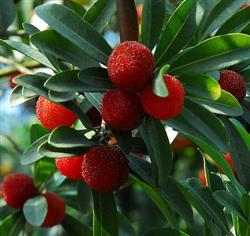
Greenhouse cultivation of Chinese bayberry is a new technique for advancing the ripening of Chinese bayberry, capturing the market early, and obtaining high economic returns. The key points are introduced as follows:
(1) Location and method of greenhouse construction.
On relatively gentle slopes, select early-maturing Chinese bayberry varieties, about 10-20 years old, with relatively small canopies in high and stable-yielding orchards to build greenhouses. Each greenhouse covers about 0.5-0.7 mu, with 12-22 Chinese bayberry trees planted inside; it is best to have one male Chinese bayberry tree in each greenhouse. If there is no male tree, a single male tree can also be covered with a separate greenhouse to force flowering for pollination purposes. The greenhouse frame can be made of round iron frames 1 cm in diameter, or built with moso bamboo frames. The greenhouse height should exceed the canopy by about 1 m to prevent sunscald. The film is ordinary vegetable film with an inner thickness of 0.6-0.7 mm, a width of 8 m, and a transparency of 85%.
(2) Management.
1. Temperature. Chinese bayberry has currently completed flower bud differentiation and development. Film covering can be done soon. Hang 1 thermometer at each of the four corners and the center inside the greenhouse to observe temperature fluctuations. From January to February, the film should be kept sealed over the entire greenhouse to raise the internal air temperature and promote Chinese bayberry sprouting and flowering. From March to April, when the air temperature inside the greenhouse exceeds 30°C, the film should be opened to lower the temperature and prevent sunscald of leaves and fruits. After mid-April, when the outdoor air temperature is already high, the film can be fully removed to reduce the impact of the greenhouse environment on fruit quality.
2. Artificial pollination and fruit thinning. For greenhouse Chinese bayberry, initial flowering begins in early February. At full bloom, collect male flower branches from inside the greenhouse, hold the male flower branches by hand or tie them to a small bamboo pole, and shake them once over each female flower. When the young fruit reaches a diameter of 0.5 cm, begin artificial fruit thinning, and finish thinning by the hard pit stage.
3. Other matters. In years with little rain, the greenhouse needs timely irrigation (watering) to prevent drought and ensure the water requirements for fruit growth and development. Fertilization, disease control, and other operations are the same as conventional management.
(3) Economic benefits.
In Chashan, Wenzhou, greenhouse Chinese bayberry covered with film at the end of December or in early January of the following year begins to mature and be harvested around May 15, and harvesting is completed by May 30, which is 15-20 days earlier than open-field cultivation. At that time, the selling price was generally around 50 yuan per kg, and the income per greenhouse reached 15,000-20,000 yuan.