How to Treat Bayberry Root Rot? Detailed Explanation of Key Prevention and Control Techniques
1. Mounding soil. In conjunction with deep plowing, carry out one round of fertilizing mud and mounding soil around the tree disk. Use locally available materials such as mountain surface soil, plant ash, river mud, pond mud, etc., generally once every two years, each time raising the soil by about 5 cm, in order to increase the cultivated layer of the bayberry orchard, protect the root system, expand the extension range of the roots, and improve the bayberry root system...
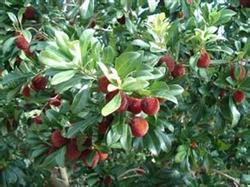 Symptoms: Mainly damages the root system of bayberry. After the tree is affected, the main manifestation is rotting of the underground root mass, while the aboveground branches and leaves rapidly wilt green or turn yellow and die. Root rot can be divided into the acute green-wilt type and the chronic decline type.
Acute green-wilt type: Symptoms in the early stage are difficult to detect, and obvious symptoms appear only about 2 months before death. The leaves lose their luster and turn chlorotic; some leaves in the lower part of the canopy turn brown and fall off. If high temperature and drought occur, the branch tips at the top of the canopy wilt. At first, the wilted branch tips can still recover early the next morning. If the temperature rises sharply before or after fruit harvest, the tree often dies rapidly, and the leaf color gradually changes from pale green to reddish brown before falling. Young and vigorous trees under 30 years old are more commonly affected, accounting for more than 70% of dead trees.
Chronic decline type: In the early stage, spring shoots sprout normally, but after autumn few or no new shoots sprout. Underground, there are fewer root nodules, and the fine roots gradually turn brown and rot. In the later stage, the disease intensifies. On the canopy, the leaves of one branch, half the tree, or the whole tree turn yellow; fruit bearing is sparse, the fruit is small, and quality is poor. In high temperature and drought weather, the leaves gradually turn reddish brown, dry up, and fall off, the branch tips die, and the tree dies on one side or entirely. This type mainly occurs on aging trees after the full fruiting stage. Generally, it takes 2-3 years from the appearance of symptoms to the death of the whole tree, and in some cases less than one year.
Pathogen: It is a globally distributed fungus, Botryosphaeria dothidea of the order Dothideales, with the synonym Botryosphaeria ribis, and its asexual stage is a small pycnidial fungus of the order Sphaeropsidales.
Prevention and control measures: (1) Encourage orchard grass growing, and mow grass for mulching before high temperatures and in spring and autumn to protect the root system. (2) Strengthen cultivation management. For lightly affected plants, carry out soil replacement, soil solarization, or lime disinfection to reduce pathogens. (3) Fertilize rationally, and avoid root damage caused by improper or excessive fertilization. (4) Chemical control. For initially affected plants, the method of spraying on the canopy and applying to the soil can be adopted, that is, on the ground use 0.8% lime double-strength Bordeaux mixture or Dexon 1000 times dilution, applying 40-50 kg of solution per plant, or use 50% carbendazim or 70% thiophanate-methyl at 0.25-0.5 kg per plant mixed with rooting powder and soil and broadcast, while spraying the canopy multiple times with fungicides such as zineb and carbendazim and nutrient solutions such as Fudan Funong to promote recovery of diseased plants, but it is ineffective for severely diseased trees. (5) When severely diseased plants are found, dig them out promptly and burn them in a centralized manner. (6) Do not mixed-plant or place adjacent to fruit trees such as peach, plum, and pear, because peach and plum are intermediate hosts of the pathogen of this disease.