Detailed Explanation of Fertilization and Water Management Techniques for Longan
I. Symptoms Young shoots, leaves and flower panicles can all be affected, and show obvious symptoms. The young leaves on diseased shoots are narrow and small, pale green, with curled leaf margins that cannot unfold, appearing tubular; in severe cases the entire leaf becomes linear and smoke-brown. The leaf surface of mature leaves is uneven, the leaf margins often curl and shrink toward the leaf underside, and the leaf tip bends downward; the leaf...
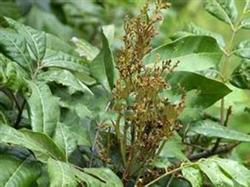 Scientific fertilization according to the growth characteristics of longan and the requirements of its annual growth and fruiting cycle is the foundation for early fruiting, high yield and good quality in longan trees. Experiments have shown that a longan orchard producing 1 ton of fruit per mu should apply 20-25 kg of pure nitrogen per year (of which nitrogen from organic fertilizer accounts for about 40% of the annual nitrogen application). The reasonable ratio of nitrogen, phosphorus pentoxide, potassium oxide, calcium oxide and magnesium oxide is 10:(5-6):(10-11):8:4, from which it can be seen that the demand of longan for potassium, calcium and magnesium fertilizers is noticeably higher than that of other fruit trees. Annual-cycle fertilization of longan is mainly divided into 3 periods.
1. Early flowering stage.
Applied during the flower bud differentiation stage and before flowering, to promote flower bud differentiation, flower panicle development, and reduce flower and fruit drop. Nitrogen and potassium account for 20%-25% of the annual application, and phosphorus accounts for 25%-30% of the annual amount.
2. Young fruit stage.
To promote fruit growth, reduce physiological fruit drop, and promote the emergence of summer shoots, fertilization at this stage should appropriately increase the proportion of nitrogen; nitrogen accounts for about 25%-30% of the annual amount, phosphorus accounts for 40% of the annual amount, and potassium accounts for 40%-50% of the annual amount.
3. Fertilizer before and after fruit harvest.
To quickly restore tree vigor and promote the emergence of sufficient robust autumn shoots, fertilization at this stage should appropriately increase the proportion of nitrogen; nitrogen accounts for 45%-55% of the annual amount, phosphorus accounts for 30%-35% of the annual amount, and potassium accounts for 25%-40% of the annual amount.
In addition, in May-June, apply a foliar fertilizer once every 15-20 days or so together with pesticide spraying. The fertilizers are generally monopotassium phosphate, magnesium sulfate, potassium sulfate, etc., to supplement the tree's demand for nutrients.
Irrigation.
Irrigate together with fertilization. In July, longan fruit enters the period of rapid flesh growth, but in some years a July drought often occurs; if water is not supplied in time, it will affect the normal enlargement of the fruit. When a summer drought occurs, irrigate once every 7-10 days, applying 40-50 liters of water per sq m of tree canopy projection area (equivalent to 40-50 mm of rainfall), to keep the soil moist. This also helps prevent severe fruit cracking before harvest; heavy rain around "Start of Autumn" often causes the fruit skin to burst because the flesh suddenly absorbs a large amount of water. When there is a lot of rain, drain promptly to prevent waterlogging.
Reasonable intercropping.
In longan orchards 1-4 years after planting, the vacant inter-row spaces can be used for reasonable intercropping to increase short-term returns. Intercrops include short-stature crops such as soybean, mung bean and peanut; tall-stature crops such as corn and sorghum, as well as vegetable crops with relatively high water requirements, must not be intercropped. In addition, green manure crops, etc. can also be intercropped to improve the soil environment.