How to control the white moth planthopper and the mealybug in longan orchards
Both the white moth planthopper and the mealybug belong to the order Homoptera, the former to the family Flatidae and the latter to the family Pseudococcidae, and they mainly damage fruit trees such as citrus, longan, lychee and mango. In the past, the populations of these pests were often naturally controlled by large numbers of natural enemies and rarely reached the level of economic loss. In recent years, because some longan orchards in our region have been extensively managed, ...
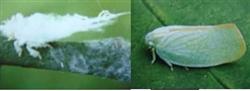
Both the white moth planthopper and the mealybug belong to the order Homoptera, the former to the family Flatidae and the latter to the family Pseudococcidae, and they mainly damage fruit trees such as citrus, longan, lychee and mango. In the past, the populations of these pests were often naturally controlled by large numbers of natural enemies and rarely reached the level of economic loss. In recent years, because some longan orchards in our region have been extensively managed, pesticides have been sprayed indiscriminately and killed the natural enemies, and in addition the climatic and environmental system has changed, the damage caused by these 2 pests has shown a worsening trend, seriously affecting the commercial quality of longan fruit and causing economic losses to fruit growers.
1. Damage characteristics. The damage symptoms of the white moth planthopper and the mealybug on longan are similar; their adults and nymphs feed by piercing and sucking the sap of longan new shoot leaves, tender shoots, flower spikes and fruit with their piercing-sucking mouthparts. The bodies of both the adults and nymphs of the 2 pests are covered with wax powder. Because wax is not hydrophilic, pesticides have difficulty reaching the insect body, and the pests have strong repellence to and resistance against pesticides. When damaging the fruit stalk and fruit, both pests stick wax powder onto the fruit stalk or fruit, and it is hard to remove even by washing with rain. The insect bodies both excrete honeydew, inducing sooty mold. Not only do the damaged fruit become smaller and their appearance damaged, but the flesh also carries a fishy odor and is unfit to eat; the damaged tender leaves, flower spikes and branches wither or the young buds and new shoots become deformed and twisted, growth is hindered, and tree vigor is seriously affected.
2. Living habits. The white moth planthopper has 2 generations a year; the nymphs of the 1st generation are seen in March-April, those of the 2nd generation in July-August, and it overwinters as adults among dense foliage. The mealybug has 5-6 generations a year; the peak period of the 1st generation nymphs is in early April, the 2nd generation in mid-May, the 3rd generation in mid-July, the 4th generation in early September, the 5th generation in early October, and the 6th generation in mid-November, and it overwinters as adults and nymphs in tree trunks, branches, cracks, rolled leaves or ant nests. Both pests begin activity in February-March of the following year when the weather turns warm, and both adults and nymphs are gregarious; the white moth planthopper occurs more seriously under high temperature and high humidity in summer and autumn, while the mealybug has the largest population density and causes the most serious damage in April-May and October-November. Both pests have strong natural reproductive capacity, especially the mealybug, whose males occur very rarely under natural conditions and which basically reproduces by parthenogenesis; each egg sac contains 200-500 eggs, and the hatching rate is high, so both easily cause disasters, and both can parasitize many kinds of plants. The adults of the white moth planthopper have extremely strong migration ability. Therefore complete eradication is extremely difficult, and the damage is very great.
3. Control measures
1) Agricultural control: strengthen orchard cultivation management, and in combination with spring flower and fruit thinning of longan and pruning after fruit harvest until before spring shoot sprouting, cut off overly dense branches and insect-carrying branches and burn them in a centralized manner, so that the canopy is ventilated and light-transmitting, humidity is reduced, insect sources are reduced, and damage is lessened. At the same time, control the sprouting of longan winter shoots, which can not only prevent massive consumption of tree nutrients that would affect flowering and fruiting the next year, but also interrupt the food source of the pests, thereby reducing the population base.
2) Biological control: use orchard-raised pheasants; during the adult and nymph stages of the mealybug, the pests on longan trees can be brushed off by hand to fall to the ground and let the chickens eat them; during the nymph stage of the white moth planthopper, it often jumps to the ground when startled and becomes good feed for chickens, and during the peak emergence period of adults they can be caught with nets. At the same time, attention should be paid to protecting and utilizing predatory natural enemies and parasitic natural enemies, using pesticides rationally, and not using pesticides that are highly harmful to natural enemies.
3) Chemical control: based on the characteristic that the white moth planthopper and the mealybug, at the newly hatched nymph stage before feeding, have no wax powder or secretions on their bodies and are relatively sensitive to pesticides, grasp the peak occurrence period of newly hatched nymphs and spray pesticides at the right time. For the mealybug, the control focus is in the spring shoot period. You may choose 80% dichlorvos 1000-fold solution or 90% trichlorfon crystal 1000-fold solution plus 0.2% washing powder, once every 5-7 days, for a total of 2 sprays; you may also choose 48% chlorpyrifos emulsifiable concentrate 1000-fold solution, 18% bisultap aqueous solution 400-600-fold solution, or 50% monosultap wettable powder 600-fold solution for control.