How should greenhouse grapes be grown to achieve good quality?
How should a greenhouse vineyard be planted for good quality? I would like some advice. Growing grapes in a greenhouse can raise the selling price of grapes. But some fruit growers often fail to pay attention to improving the appearance quality of the grapes during operation, which affects the economic benefits of greenhouse grapes. Through several years of planting observation, we have found that the appearance quality of greenhouse grapes should be improved by starting from the following aspects...
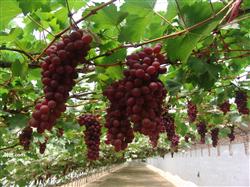
How should a greenhouse vineyard be planted for good quality? I would like some advice.
Growing grapes in a greenhouse can raise the selling price of grapes. But some fruit growers often fail to pay attention to improving the appearance quality of the grapes during operation, which affects the economic benefits of greenhouse grapes. Through several years of planting observation, we have found that the appearance quality of greenhouse grapes should be improved by starting from the following aspects.
I. Reasonable temperature raising
After covering the greenhouse, reasonable temperature raising is the key to improving the fruit-setting rate of greenhouse grapes and is also an important measure for improving the appearance quality of the clusters. However, if the temperature is raised too quickly, it will affect the later differentiation of grape flower buds, increase ineffective differentiation of flower buds, and produce messy clusters. The correct method of raising temperature is to first keep the greenhouse closed with straw curtains for 5-7 days after covering, then slowly lift half of the straw curtains, so that the temperature inside the greenhouse rises to 20°C over about 10 days, prompting normal differentiation of grape flower buds.
II. Inflorescence pruning
Pruning of greenhouse grape inflorescences is generally carried out in 2 rounds. The 1st time is after the inflorescences unfold, when excess or weak inflorescences are promptly thinned according to the load status. The 2nd time is before flowering, when the secondary clusters on the inflorescence and the tip of the inflorescence, 1/5-1/4 of the front end, are pinched off.
III. Cluster treatment
After the grapes bloom, soak the inflorescences in a 15×10E-6 gibberellin (GA3) solution for 3-5 seconds. This can appropriately lengthen the grape pedicels and avoid clusters with especially compact berries, which would affect later coloring of the grapes. The time for cluster tidying should be after physiological fruit drop, removing poorly developed berries and those not fully fertilized, so that the clusters are neat and the berries are uniform.
IV. Spraying rare earth micro-fertilizer and calcium fertilizer
Before grape flowering, during full fruit stage and fruit expansion stage, spray 1 time each with 800-fold rare earth micro-fertilizer solution; 1 month before cluster ripening, spray 1 time every 10 days with 100-fold amino acid calcium solution. This can increase the sugar content of the grapes, make the grapes mature earlier, and also promote thickening of the skin, reducing grape cracking.
V. Timely pruning
15-20 days before the grapes mature, prune the grapes in time. Cut off overly dense branches and leaves in the greenhouse and branches and leaves that affect cluster lighting, improve the light transmittance of the clusters, and promote grape coloring. While pruning, gently turn clusters that do not receive good light so that the clusters are fully exposed to light.
Click to view more grape growing techniques
Click to view more fruit growing techniques