How should strawberries be managed to achieve high yields?
How should strawberries be managed for high yields? Please advise. For high strawberry yields, you can refer to the following strawberry cultivation techniques: 1. Remove the film and harden the seedlings. When the average daily temperature stabilizes at around 10°C, begin removing the covering, and remove it all in mid-to-late March. Before removing it, be sure to do a good job of hardening the seedlings. 2. Cultivate and level the soil. Cult...
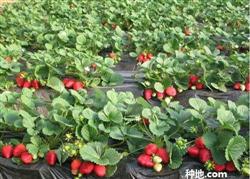
How should strawberries be managed for high yields? Please advise.
For high strawberry yields, you can refer to the following strawberry cultivation techniques:
1. Remove the film and harden the seedlings. When the average daily temperature stabilizes at around 10°C, begin removing the covering, and remove it all in mid-to-late March. Before removing it, be sure to do a good job of hardening the seedlings.
2. Cultivate and level the soil. Cultivate with shallow hoeing to avoid damaging the roots and to prevent clods of soil from burying the crown of the seedlings, and clear the ditches and level the soil to prevent waterlogging damage.
3. Prune off old leaves. After strawberries begin to grow, promptly prune off dry old leaves and diseased leaves, and carry them out of the field and compost them in a concentrated pile to make fertilizer, so as to reduce sources of infection.
4. Apply additional fertilizer in time. In mid-to-late March, apply a fertilizer for plant establishment along with watering, using 10-15 kg of urea or 20-30 kg of compound fertilizer per mu; before flowering and fruiting in mid-April, apply another pre-fertilizer, using 10 kg of compound fertilizer per mu. In addition, during the flowering and fruiting period, foliar spraying of a 0.3% potassium dihydrogen phosphate solution 2-3 times has a very good effect on increasing yield and quality.
5. Irrigate reasonably. It is necessary both to meet the physiological water needs of strawberries and to strictly prevent waterlogging. Generally, irrigate once each before budding, during fruit enlargement, and at the ripening stage, and each irrigation should be appropriate; never use flood irrigation.
6. Thin flowers and buds. After strawberries bud, thin out thin and small flower buds to reduce nutrient consumption, so that nutrients are concentrated in supplying the earlier-opening flower buds, promoting large, uniform fruit that ripens early and has good quality. Generally, when the flower buds on the inflorescence are separated from one another and easy to remove, thin out 20%-25% of the late and weak flower buds.
7. Prevent and control diseases and pests. For fungal diseases such as leaf spot, gray mold, verticillium wilt, bud blight, and powdery mildew, in early spring you may choose agents such as Bordeaux mixture, thiophanate-methyl, and carbendazim for spray control, and especially after disease occurs, apply pesticide promptly to keep the disease controlled at the initial stage. Viral diseases are mainly transmitted by virus-carrying aphids, so aphids must be well controlled. In addition, for underground pests such as cutworms, white grubs, and mole crickets, you can use a 1000-1500 times dilution of phoxim solution to irrigate and poison them; for red spider mites, you can choose agents such as dicofol and propargite for spray killing. Note that chemical pesticides are prohibited during the fruit ripening period.
Click to get more strawberry cultivation techniques
Click to get more fruit cultivation techniques