How are strawberry seedlings propagated? Nursery methods and key technical points
What should be noted in strawberry seedling cultivation? Please introduce. To grow strawberry seedlings, you need to understand that strawberries like cool conditions and cannot tolerate high temperatures and drought. If summer management is poor, the plants will suffer severe physiological disorders and may even die in large numbers. The main measures for summer management of strawberries are as follows: reasonable shading. In summer in Jianghan...
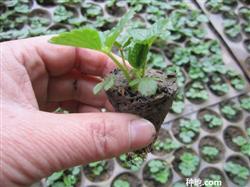 How are strawberry seedlings propagated? Please provide guidance
Strawberry seedlings can be propagated by referring to the following cultivation techniques:
1. Soil selection
Strawberries like light and are also fairly shade-tolerant, with shallow roots. They not only have poor drought resistance, but also have relatively high requirements for soil fertility, and are suitable for planting in fertile, well-aerated sandy loam soil.
2. Variety selection
At present, the high-quality, high-yield, cold-resistant, dry-heat-resistant, and drought-resistant varieties commonly used in production in the Fukang area include Dongdan Daguo, Kinuama, and others.
3. Seedling propagation
The runner division method is simple and easy to operate, and propagation is fast.
4. Nursery preparation
Half a month before nursery cultivation, deeply plow the soil, apply 3000-4000 kg of decomposed organic fertilizer per 667 sq m, plus 10 kg each of diammonium phosphate and potassium sulfate. Spread the fertilizer evenly and plow it into the soil while preparing the land. Prepare the land finely, and make beds according to the terrain. The bed width is 1-1.2 m, and the length depends on the site. The nursery area can also be determined according to the number of seedlings needed for the field. The field uses 8000-10000 seedlings per 667 sq m. On the prepared field surface, apply 80-150 g of trifluralin or acetochlor per 667 sq m, mixed with 40 kg of water, and spray. Then immediately till the soil to carry out pre-emergence weed control.
5. Planting mother plants
Planting begins in mid-April in spring and mid-August in autumn. Select strong mother plants that have the characteristics of the original variety and are free of pests and diseases. With the middle of the bed surface as the center, the row spacing is 80-100 cm and the plant spacing is 30-40 cm. Plant 1600-2800 plants per 667 sq m. Through runner propagation, about 40000 plants can be produced, enough for the seedling requirement of 2688 sq m of greenhouse. When planting, the crown of the seedling should be level with the surface soil, that is, the crown should not be buried and the roots should not be exposed. Concentrate plants of the same variety in one bed, and leave walkways between different varieties to maintain purity.
6. Nursery management
1. Irrigation
Irrigate promptly after planting. In spring planting, irrigate lightly once every 3-4 days; in autumn planting, the temperature is high, so it is best to irrigate lightly once a day or every other day, until the seedlings recover and then carry out routine management. Irrigate 8-10 times throughout the growing period.
2. Cultivation
After the seedlings recover, carry out cultivation, weeding, and moisture conservation along with irrigation. Cultivation should be shallow, with the standard of not damaging the root system. Cultivate 4-5 times in total during the propagation period.
3. Topdressing
Apply urea and potassium sulfate 1-2 times throughout the growing period, with 10-15 kg per 667 sq m, applied in holes or furrows. According to growth vigor, spray 0.2%-0.3% monopotassium phosphate or urea on the leaves 1-2 times.
4. Runner pressing
To reduce nutrient consumption, promptly remove the flower clusters drawn from the mother plants. When runners emerge in large numbers, use the method of artificial soil banking to press the runners, distributing the newly emerged runners evenly in every direction from the main stem to promote early rooting. After the runners cover the bed surface, promptly pinch the growing tips and thin out excess runners.
7. Pest and disease control
In the hot and humid summer season, pests and diseases are easily induced. Powdery mildew can be controlled with wettable powder triadimefon or thiophanate-methyl. Red spider mites can be controlled alternately with pyridaben or liuyangmycin.
8. Seedling lifting and storage
For spring nursery cultivation, lift seedlings in mid-August; for autumn nursery cultivation, lift seedlings in mid-April of the following year. When lifting seedlings, it is best to transplant with soil and avoid damaging the roots as much as possible. After lifting, cut off old leaves and plant immediately after lifting; do not pull up the seedlings. For small seedlings that need to be transported or cannot all be planted at once, remove 2 old leaves, keep petioles more than 5 cm long, retain 2-3 leaves, and place them in a cool place or heel them in sand. When watering, do not spray water on the leaves, and provide shade. Seedlings that need winter storage should be tied into small bundles and stored at 60% humidity and -2-0°C. In winter, pay attention to cold protection, and in the following spring they can be replanted and propagated.
Click to get more strawberry cultivation techniques
Click to get more fruit cultivation techniques