What should you do when deformed fruit appears on strawberries grown in a greenhouse?
What should you do when deformed fruit appears on strawberries grown in a greenhouse? Please advise. The main causes of strawberry deformation are: too low a room temperature is a common cause of deformed fruit. The optimum temperature for strawberry growth and development is 20°C-25°C. During the flowering and fruiting period, the minimum temperature must not be lower than 5°C. If the temperature is below 5°C, it will seriously affect the growth and pollination of strawberries...
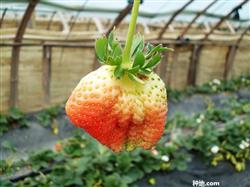
What should you do when deformed fruit appears on strawberries grown in a greenhouse? Please advise.
The main causes of strawberry deformation are:
Too low a room temperature is a common cause of deformed fruit. The optimum temperature for strawberry growth and development is 20°C-25°C. During the flowering and fruiting period, the minimum temperature must not be lower than 5°C. If the temperature is below 5°C, it will seriously affect the growth and pollination of strawberries, easily leading to the appearance of deformed fruit, with a great impact on yield and quality.
The preventive measure is to take corresponding heat preservation measures: before a cold wave arrives, build a small arch frame over the strawberry beds and cover it with a 90-100 cm wide plastic film; add insulation materials such as straw curtains, old agricultural film or double-layer shade nets around the outer skirt of the greenhouse; where conditions permit, install electric lights or heating wires inside the greenhouse for a better warming effect. Taking the above measures can ensure that the indoor temperature stays above 5°C.
Poor pollination is an important cause of deformed fruit. In severe cold seasons, even if the room temperature is above 5°C, strawberries often produce deformed fruit due to poor pollination. The reason is that in the cold season, the outdoor temperature is low, the greenhouse ventilation openings are small and the ventilation time is short, the greenhouse is in a windless state, and the outside world is in the cold season with no insects entering the greenhouse, so strawberries cannot rely on wind and insects for pollination.
The preventive measure is to carry out artificial pollination or bee pollination. Strawberries generally need 4-5 days from flowering to flower drop. During the flowering period, a writing brush can be used for artificial pollination, and blowing air or fanning can also be used to assist pollination. Flowers pollinated artificially drop quickly (dropping within one day), which can reduce nutrient consumption and thus speed up fruit development. Fruit from artificial pollination grows large and yields high, and the maturity period can be advanced by 7-10 days. The bee pollination currently used has a better effect than artificial pollination and can save a large amount of manpower, but under too low temperature conditions, bees are less active.
An imbalance in water and fertilizer supply and demand is another important cause of deformed fruit. If the soil in the greenhouse is too dry, too wet, lacking fertilizer or improperly fertilized, it will cause an imbalance in water and nutrient supply and demand, leading to poor fruit development and the formation of deformed fruit. When soil moisture is insufficient, water lightly in time. If fertilizer is lacking, topdressing should be carried out together with watering. Phosphate and potassium fertilizers should be applied more, ammonium bicarbonate should not be used as topdressing, and a ternary compound fertilizer is suitable for topdressing. After dissolving the chemical fertilizer in water, topdressing through a drip tube or by punching holes has a better effect. If soil moisture is insufficient after topdressing, water in time, so as to promote fertilizer with water, to meet the needs of normal flowering and fruiting of strawberries and prevent the occurrence of deformed fruit.
Click to get more strawberry growing techniques
Click to get more fruit growing techniques