What are the key points of spring management techniques for strawberries?
How to manage strawberries well in spring? Please guide the key points of spring strawberry management: Strengthening spring management of open-field strawberries is the key to promoting early fruiting, good quality, and high yields. The measures are as follows: Remove cold-protection covers. When the daily average temperature stabilizes at around 10°C, you can begin to gradually remove the cold-protection covers from the strawberry plants...
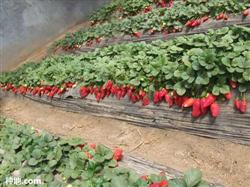
How to manage strawberries well in spring? Please guide
Key points of spring strawberry management:
Strengthening spring management of open-field strawberries is the key to promoting early fruiting, good quality, and high yields. The measures are as follows:
Remove cold-protection covers. When the daily average temperature stabilizes at around 10°C, you can begin to gradually remove the cold-protection covers from the strawberry plants. Be careful to avoid breaking the flower buds. If plastic film is used as cover, do proper hardening-off work when removing the film to prevent a sudden excessive temperature difference from affecting strawberry growth and development.
Timely intertillage and removal of old leaves. After the beginning of spring, timely intertillage and weed control should be carried out, but the intertillage should be shallow, strictly preventing soil clods from burying the crown of the plant, and the drainage ditches should be cleared well. At the same time, remove old leaves, dead leaves, and diseased leaves of strawberries to prevent disease transmission.
Fertilize promptly to promote early growth. After a winter of dormancy, temperatures rise after the beginning of spring, and strawberries begin to grow. Timely topdressing can promote early plant growth, quickly form new leaf surface, increase the number of effective flowers, and improve fruit set rate. Because strawberry roots are shallow and sensitive to fertilizer, fertilizer damage is likely to occur. Avoid using ammonium bicarbonate and ammonium sulfate; mainly use urea, compound fertilizer, or human excrement and urine. For application rates, use 5-6 kg of urea per mu, 1000-1250 kg of human excrement and urine, and 10-15 kg of compound fertilizer, combined with one watering at fertilization. During the flowering and fruiting period, spray 0.2% potassium dihydrogen phosphate solution on the leaves 1-2 times, which has a good effect on improving quality and increasing yield. Watering should be done lightly and frequently to keep the soil moist. After entering the fruit ripening stage, water should be appropriately controlled. During drought, water lightly in the evening after each fruit harvest, and do not flood-irrigate, otherwise it is easy to contract diseases and cause a large number of rotten fruits.
Flower and fruit thinning. After the strawberry new stems produce inflorescences, each inflorescence generally has 10-30 flowers. If there are too many flower buds, nutrient supply is insufficient, growth becomes weak, and small fruits and deformed fruits will increase. Therefore, after bud emergence, thin out the small and weak flower buds, and thin flowers again during full bloom, so that nutrients are concentrated to supply the large flowers, increasing fruit set rate and single fruit weight. For bud and flower thinning, keep 2-3 inflorescences per plant, and it is suitable to keep 3-5 fruits per inflorescence.
Fruit padding and harvesting. After strawberry fruit set, as the fruits enlarge, the fruit clusters droop. Wheat straw should be promptly spread along the rows beneath the fruit clusters to prevent the fruits from contacting the ground and becoming contaminated or rotting. When 2/3 of the fruit surface is colored, harvest promptly. Harvesting should be done after the morning dew has dried. When picking, do not let your hands touch the flesh; gently pinch the fruit stalk and pick with part of the stalk attached, place into clean containers, grade, and sell or process immediately.
Pest and disease control. Strawberry plants are short and grow prostrate on the ground, and their flowering and fruiting period is long. The fruits easily contact the ground and are susceptible to pests and diseases, so comprehensive control measures must be adopted. The main pests and diseases include: viral disease, powdery mildew, gray mold, brown spot disease, as well as aphids and underground pests.
1. Viral disease. The fundamental measures are the use of virus-free seedlings and thorough control of aphids. In the early stage of the disease, spray 1000-fold 1.5% Zhibingling emulsion or 100-fold 83 resistance inducer.
2. Powdery mildew. Use 2000-fold 12.5% myclobutanil emulsifiable concentrate or 1000-fold 20% triadimefon wettable powder.
3. Gray mold. Choose 800-fold 50% vinclozolin wettable powder or 1000-fold 50% procymidone wettable powder.
4. Brown spot disease. Use 200-fold 2% Nongkang 120 aqueous solution or 500-1000-fold 50% thiophanate-methyl.
5. Aphids. Use 2000-fold 50% pirimicarb wettable powder or 1500-2000-fold 10% imidacloprid wettable powder.
6. Underground pests, such as white grubs and mole crickets. Use 200-250 g of 80% trichlorfon wettable powder per mu or 200-300 g of 40% phoxim emulsifiable concentrate, diluted with 500-750 kg of water for root drenching or irrigation control. Note that generally medication should be stopped 15 days before fruit harvest to prevent poisoning.
Click to get more strawberry cultivation techniques
Click to get more fruit cultivation techniques