A Detailed Explanation of Strawberry Fertilization Principles: Master the Key Points of Scientific Fertilization
What should be noted during the flowering and fruiting period of strawberries in greenhouses? Please note the following points during the flowering and fruiting period of strawberries: First, spray gibberellin. After the greenhouse is covered and heated, when the plant grows 1-2 young leaves, spray 10-20×10-6 gibberellin, spraying 5 milliliters of solution per plant, with an interval of 1 week, and spray 2-3 times as appropriate according to the growth vigor, to promote growth and development....
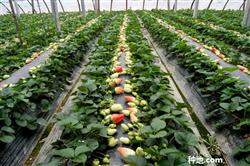 What are the fertilization principles for strawberries? Please explain.
Strawberries are fertilizer-loving plants, and their demand for fertilizer varies with the growth stage, but a one-time base fertilizer application should be the main approach. Quick-acting chemical fertilizers should be applied as a topdressing during the growing season to ensure normal plant growth and development and obtain higher yields. Strawberries absorb slightly more nitrogen and potassium fertilizers than phosphate fertilizer, but phosphate fertilizer is easily fixed by the soil and difficult to absorb, so in the fertilization ratio, phosphate fertilizer should be higher than nitrogen and potassium fertilizers. The base fertilizer should mainly be high-quality organic fertilizer, with a small amount of quick-acting chemical fertilizer, but strawberries are chlorine-sensitive crops, so chlorine-containing chemical fertilizers cannot be used when applying chemical fertilizers.
The fruiting period of protected strawberries lasts as long as half a year. In order to enable greenhouse strawberries to obtain the best nutritional quality during the harvest period, maintain no excessive vegetative growth and no premature aging, and achieve continuous high quality and high yield, the principle of moderate nitrogen and increased phosphorus and potassium should be followed in fertilization.
I. Base fertilizer
In order to improve soil fertility and mature the soil, before strawberry planting, the soil should be deeply plowed 25-35 cm, and combined with plowing, apply 450-500 kg of commercial organic fertilizer or 3500-4000 kg of high-quality farmyard manure, 5-6 kg of urea, 15-20 kg of diammonium phosphate, and 5-6 kg of potassium sulfate per mu.
II. Topdressing
In order to meet the various nutritional needs for flowering, generally from after strawberries begin to grow until before the flowering period, apply 9-10 kg of urea and 4-6 kg of potassium sulfate per mu; topdressing during the berry enlargement period: generally apply 11-13 kg of urea and 7-8 kg of potassium sulfate per mu. After strawberries bear a large amount of fruit, the nutrients in the plant body are deficient. In order to restore plant growth as soon as possible and form more new leaves and new roots, topdressing can be carried out as needed.
III. Foliar topdressing
According to the growth condition of strawberries, the method of foliar topdressing (that is, leaf surface spraying) can be used for supplementary fertilization. Spraying 0.3% potassium dihydrogen phosphate 3-4 times or 0.3% borax on the leaf surface before and after the flowering period can increase the fruit-setting rate, improve fruit quality, and increase single fruit weight. Spraying 0.2% calcium sulfate plus 0.05% manganese sulfate at the initial flowering stage and full flowering stage can increase yield and fruit storage performance. In addition, foliar fertilizer spraying should be carried out on cloudy days or in the evening of sunny days, because evaporation is large at noon and can easily cause fertilizer damage to strawberries.
Click to get more strawberry cultivation techniques
Click to get more fruit cultivation techniques