What are the key technical points for post-harvest management of Chinese bayberry (Myrica rubra)?
How should Chinese bayberry be managed during the harvest period? Please guide. June coincides with the plum rain season, with relatively concentrated rainfall across the province. June is also the season when Chinese bayberry ripens, so the following work is recommended: 1. Seize the fine weather and promptly harvest the ripe Chinese bayberry. As the saying goes: "At the Summer Solstice, Chinese bayberry turns the hills red; at Minor Heat, the Chinese bayberry needs..."
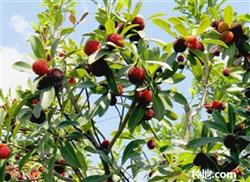 How should Chinese bayberry be managed after harvest? Please guide and introduce.
After harvest, Chinese bayberry should be managed as follows:
1. Scientific fertilization. Because of the growth of two flushes of shoots in spring and summer and flowering and fruiting, the Chinese bayberry tree consumes a large amount of nutrients. July-August is also the period of flower bud differentiation and autumn shoot growth, and the growth quality of autumn shoots directly affects the yield of the following year. The amount of fertilizer applied should be determined by tree vigor and fruit load. Generally, for a tree yielding more than 50 kg, apply 40-50 kg of organic fertilizer mixed with 1 kg of phosphate fertilizer and 0.5 kg of urea. Chinese bayberry should not be fertilized with phosphate fertilizer alone, so as not to reduce the quality of the Chinese bayberry.
Fertilization methods:
(1) Ring-shaped fertilization: With the main trunk as the center, dig ring-shaped trenches according to the size of the canopy. Trenches for organic fertilizer should be deep. Cover with soil after fertilization. This method can be used for fertilizing large trees.
(2) Hole fertilization or radial fertilization: With the trunk as the center, parallel to the arc lines around the canopy, dig 5-6 trenches or holes. The length and depth of the trenches depend on the amount of fertilizer used and the size of the canopy. Alternatively, with the main trunk as the center, perpendicular to the tangent lines around the canopy, dig 5-7 radial trenches, each 70-80 cm long, 30-40 cm wide and 30 cm deep, and cover with soil after fertilization.
2. Timely spraying. To prevent and control the occurrence of Chinese bayberry brown spot disease, spray 200-fold Bordeaux mixture, or 800-fold 70% thiophanate-methyl, or 1000-fold 50% carbendazim after fruit harvest.
3. Proper plowing. After the Chinese bayberry harvest, because trampling in the orchard during harvesting and leaching by spring rain and plum rain cause soil compaction, plowing and loosening the soil can cut off capillary action, improve the tree's drought resistance in July-August, and help flower bud differentiation and fruiting the following year. A plowing depth of about 15M is required, and it can be done together with fertilization.
4. Reasonable pruning. Summer pruning of Chinese bayberry can moderate tree vigor, so while applying topdressing, the Chinese bayberry trees can be reasonably pruned by removing diseased and pest-infested branches, dead branches, weak branches and shaded branches, and appropriately opening windows in the canopy, so that the canopy is ventilated and lets in light, produces more autumn shoots, and increases the yield of autumn shoots.
Click to get more Chinese bayberry cultivation techniques
Click to get more fruit cultivation techniques