How should young bayberry (Chinese bayberry, Morella rubra) trees be managed to bear fruit earlier?
How can young bayberry trees be made to fruit early? Please advise and explain. To make young bayberry trees fruit early, you can refer to the following cultivation techniques: 1. Planting. Choose sandy mountain land where broadleaf trees such as ferns and rhododendrons dominate; planting there makes early fruiting and high yield easy. Build contour terraces, dig planting holes 1.2 x 0.8 m, and apply 50 kg of rotted barn manure plus...
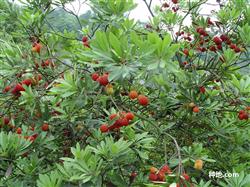
How can young bayberry trees be made to fruit early? Please advise and explain.
To make young bayberry trees fruit early, you can refer to the following cultivation techniques:
I. Planting
Choose sandy mountain land where broadleaf trees such as ferns and rhododendrons dominate; planting there makes early fruiting and high yield easy. Build contour terraces, dig planting holes 1.2 x 0.8 m, and apply 50 kg of rotted barn manure plus 1-2 kg of superphosphate in each hole. Select strong seedlings with a thickness of more than 0.7 cm and 3-4 branches, plant them suitably deep, and mound soil up to the branching point. After planting, only water, do not fertilize. In the year of planting, use branches and other materials for shade to increase the survival rate.
II. Fertilization
In August of the planting year, apply 0.1 kg of urea and 0.05 kg of potash fertilizer per tree; in October-November, apply 0.25 kg of compound fertilizer (N:P:K:7:8:15) and 0.5-1 kg of plant ash; in May-June of the second to third years, apply 0.5-1 kg of compound fertilizer per tree, and in October, along with deep digging and hole expansion, apply 25 kg of barn manure as base fertilizer; from the fourth to fifth years, after fruiting begins, apply 0.25 kg of superphosphate and 1-1.5 kg of potash fertilizer per tree in May-June, and in October-November apply 25 kg of barn manure plus 2.5 kg of plant ash. If the tree vigor is excessively strong, which easily causes flower and fruit drop, then apply no nitrogen fertilizer in either the base fertilizer or the topdressing, and use only potash fertilizer.
III. Training and Pruning
For early fruiting, bayberry is best trained to an open-center shape and a modified central leader shape based mainly on three main branches. For natural open-center training, keep 3 main branches on the trunk at intervals of 10-20 cm, with branch angles of 45°-50°, then keep 1-2 large branches pulled downward as auxiliary nourishing branches, and cut off the remaining large branches. The next year, keep the first secondary main branch on the main branch 70 cm from the trunk, and the second secondary main branch 60 cm from the first secondary main branch; keep side branches on the secondary main branches and cut them back to 30 cm. The modified central leader shape based mainly on three main branches is improved on the basis of the modified central leader shape, that is, strengthening the three main branches at the base, suppressing the trunk and the main branches and side branches on it, removing strong branches from the trunk, replacing the trunk with a weak branch, and ring-barking to moderate tree vigor and promote fruiting. Large auxiliary nourishing branches can be treated by branch bending, ring-barking, and hollowing-out and thinning pruning (that is, removing the top strong branches and keeping weak branches) to promote fruiting. Spreading the angles of the main branches and secondary main branches can promote fruiting. When pruning, as long as ventilation and light penetration are not affected, retain the weak branches at the lower part and inside as much as possible, and by no means "cut the lower but not the upper, cut the inner but not the outer."
IV. Promoting Flowers and Preserving Fruit
If young trees grow vigorously (canopy diameter reaching more than 2 m) and are slow to fruit, then in October, according to the tree vigor of different varieties, apply paclobutrazol to the soil at 0.15-0.4 g of active ingredient per square meter of canopy projection area, or spray 750-1000 mg/L paclobutrazol in late June to control shoots and promote flowers. Spray 10-15 mg/L gibberellin once at full bloom to preserve fruit, and spray nutrient solution in mid-to-late May to promote large fruit (when bayberry begins to fruit, the fruit shape tends to be small).
V. Pest and Disease Control
To control brown spot disease, spray thiophanate or carbendazim once each in mid-May, late May, and after fruit harvest. For beetles, leaf rollers, and the like, use 80% dichlorvos 1000-fold solution or 20% fenpropathrin 2000-fold solution for control.
Click to get more bayberry cultivation techniques
Click to get more fruit cultivation techniques