What are the common pest species on pomegranate trees?
What common pests do pomegranate trees have? Please note that pomegranate trees have the following pests: the Japanese wax scale, commonly known as scale insect, belongs to the order Homoptera, family Coccidae. Its nymphs attach themselves to leaves or new shoots to suck sap and secrete a sticky substance, which induces sooty mold, affects photosynthesis, weakens the tree, and causes heavy leaf drop and fruit drop...
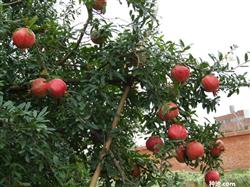
What common pests do pomegranate trees have? Please explain
Pomegranate trees have the following pests:
The Japanese wax scale, commonly known as scale insect, belongs to the order Homoptera, family Coccidae. Its nymphs attach themselves to leaves or new shoots to suck sap and secrete a sticky substance, which induces sooty mold, affects photosynthesis, weakens the tree, and causes heavy leaf drop and fruit drop; in severe cases it can cause complete crop loss or even death of the entire tree.
Control methods: (1) Chemical control. The period after nymph hatching and before wax shell formation is the favorable time for chemical control; in practice, during the nymph hatching period, spray with 25% phosmet 800-1000 times dilution, 50% malathion 1000-1500 times dilution, 50% carbaryl wettable powder 400-500 times dilution, or 50% dichlorvos emulsifiable concentrate 800-1000 times dilution, once every 7-10 days, for 2-3 consecutive sprays, to bring the infestation under control. (2) Protect and utilize natural enemies. The Japanese wax scale has many kinds of natural enemies, such as ladybugs, lacewings, parasitic wasps, etc., which should be protected and utilized.
The pomegranate stem window moth, also called the flower window moth, occurs in most pomegranate-producing areas in China. Its larvae bore into and damage new shoots and perennial branches, weakening the tree, affecting fruit yield and quality, and in severe cases can cause the death of the entire plant.
Control methods: (1) During the pomegranate growing season, inspect branches frequently; when damaged new shoots are found, promptly cut off the branch from below the last frass hole to kill the larvae inside. (2) Chemical control. At the peak of hatching, spray with 1000 times dilution of dimethoate-trichlorfon mixture, 1000 times dilution of dichlorvos emulsifiable concentrate, or 3000 times dilution of 2.5% deltamethrin, with good results. After the larvae bore into the branches, tools such as a discarded syringe can be used to inject 400-500 times dilution of dichlorvos into the larval tunnel, or a cotton ball dipped in undiluted dichlorvos can be inserted into the bore hole and sealed outside with yellow clay to fumigate and kill the larvae.
Click to get more pomegranate growing techniques
Click to get more fruit growing techniques