Control methods for underground pests in sugarcane cultivation
How to control underground pests in sugarcane cultivation? Please advise. Underground pests of sugarcane are a major group of important pests seriously harming sugarcane production in Yunnan, mainly including: sugarcane beetles, sugarcane weevils, stem-boring weevils, sugarcane termites, sugarcane root aphids, etc. Among them, sugarcane beetles, sugarcane weevils and stem-boring weevils are the most common and cause the most serious damage...
How to control underground pests in sugarcane cultivation? Please advise.
Underground pests of sugarcane are a major group of important pests seriously harming sugarcane production in Yunnan, mainly including: sugarcane beetles, sugarcane weevils, stem-boring weevils, sugarcane termites, sugarcane root aphids, etc. Among them, sugarcane beetles, sugarcane weevils and stem-boring weevils are the most common and cause the most serious damage. The pests and control methods are described below:
Sugarcane beetles
1. The main species are: (1) Holotrichia maxima (large gill chafer); (2) Exolontha serrulata (black-backed sugarcane chafer) and its light-backed form
2. Occurrence and damage
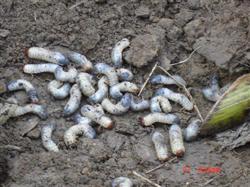
(1) Holotrichia maxima: Mostly distributed in fertile sandy loam areas, mainly damaging roots as larvae. The insect is large with a big appetite, and the damage period lasts as long as 6 months, from early June to mid-November. It can eat all the fibrous roots completely, leaving only a sugarcane stump stuck in the soil that can be pulled up by hand and falls over in the wind, causing entire blocks and whole fields to die, resulting in complete crop failure. It is a devastating pest species.
(2) Exolontha serrulata (black-backed and light-backed sugarcane chafers): Mostly distributed on gentle slopes or in river valley alluvial sandy loam. From April to May, adults mainly bite the base of sugarcane seedlings, causing dead hearts and death; in severe cases, the damage rate can reach more than 40%, causing gaps in the field and broken rows. From September to March, larvae mainly feed on the underground part of sugarcane stalks, boring the cane stumps into a hollow cave-like state and seriously affecting the sprouting of ratoon cane.
3. Control methods
(1) Agricultural control
(1) Deep plowing and sun-drying of soil: In sugarcane fields where sugarcane beetles cause serious damage and no ratoon crop is to be kept, the soil should be deeply plowed and frequently harrowed in time after the sugarcane harvest. Through mechanical action and manual collection, overwintering mature larvae and some pupae can be effectively removed.
(2) Flooding control method: Holotrichia maxima in July to August, and Exolontha serrulata in October to November, when sugarcane is in its peak growing season, is not afraid of flooding, while the sugarcane beetles are in the larval stage. Where conditions permit, water can be released to flood the sugarcane field, generally flooding above the ridge surface for about 7 days, which can drown the underground sugarcane beetles.
(3) Sugarcane-rice (upland-flooded) rotation: In seriously damaged sugarcane fields, rice can be rotated in. Through long-term flooding, residual sugarcane beetles in the soil can be eliminated, and damage can be reduced by about 80%.
(4) Avoid applying rotted organic fertilizer during the occurrence period of newly hatched larvae (May to June), creating an environment unfavorable for the survival of newly hatched larvae, controlling the occurrence of sugarcane beetles and reducing damage.
(2) Physical control
Taking advantage of the strong phototaxis of adult Exolontha serrulata (black-backed and light-backed sugarcane chafers), during the peak adult occurrence period (April to May), Jiaduo frequency-vibration insecticidal lamps are used to trap and kill adults.
(3) Biological control
For Holotrichia maxima at the end of May and early June, in conjunction with the major hilling of sugarcane; for Exolontha serrulata in early April when loosening the cane stumps and weeding the seedlings, select per mu 2% Beauveria bassiana or Metarhizium anisopliae powder-granule formulation at 2-3 kg, mix with 40 kg of dry fine soil or chemical fertilizer, and evenly broadcast at the base of sugarcane plants and cover with soil.
(4) Chemical control
For Holotrichia maxima at the end of May and early June, in conjunction with the major hilling of sugarcane; for Exolontha serrulata in early April when loosening the cane stumps and weeding the seedlings, select per mu 15% Lorsban granules at 1-1.2 kg, 3% carbofuran granules at 4-5 kg, or 8% Jinxianxin granules at 3-4 kg, mix with 40 kg of dry fine soil or chemical fertilizer, and evenly broadcast at the base of sugarcane plants and cover with soil; for Exolontha serrulata at the end of October, select per mu 48% Lorsban emulsifiable concentrate at 300-400 mL, 90% monosultap technical powder at 300 g, 50% phoxim emulsifiable concentrate at 500 mL, etc., dilute with water according to the per-mu dosage, and then evenly drench the base of sugarcane plants.
Sugarcane weevils
1. The main species are:
(1) Thin flat weevil
(2) Spotted weevil
2. Occurrence and damage
Mostly distributed in riverside flatlands and some low-lying wet sugarcane areas in the sugarcane region of southwestern Yunnan. Thin flat weevil: larvae and adults damage inside the cane stump; in mid-April, newly hatched larvae bore into the tender roots of sugarcane seedlings, bore upward and feed, enter the cane stump and cause damage, with a damage period of 8-10 months. Spotted weevil: larvae damage the cane stump, with a damage period from June of the current year to February-April of the following year; the entire larval stage damages inside the cane stump.
In damaged sugarcane plants, the lower leaves begin to turn yellow and withered in July, and small tunnels appear inside the cane stump. From October to December, the cane stump is severely damaged, sometimes bored into a pulverized state; one cane stump may contain 5-6 insects, or as many as 20-30. After damage, the loss is 0.5-3 tons of sugarcane per mu, and in severe cases there is no harvest; the field brix of sugarcane decreases by 4%-6%, and generally ratoon cane can only be kept for 1 year. In addition, damaged cane stumps are susceptible to red rot, which accelerates rotting, makes them prone to lodging, and causes even heavier losses.
3. Control methods
(1) Agricultural control
(1) Uproot and burn stumps: In seriously infested sugarcane fields where no ratoon crop is to be kept, harvest, plow up and turn over the cane stumps in time before mid-January, gather them to dry and burn them; this can kill large numbers of overwintering adults or mature larvae, reduce the insect population and control its large-scale spread.
(2) Shorten the ratoon period: In seriously infested sugarcane fields, do not keep second-year ratoon cane, so as to reduce the accumulation of weevil populations in the field and lower the damage rate.
(3) Sugarcane-rice rotation: Rotating sugarcane with rice, through long-term flooding, can eliminate residual weevils in the soil and greatly reduce the damage rate.
(4) Clear cane stumps from irrigation ditches: Do not pile insect-infested cane stumps dug out on ditch or river banks. If cane stumps are found in irrigation ditches, they should be picked out at any time, so that flowing water does not carry insect-infested cane stumps into insect-free sugarcane fields.
(5) Carefully remove wild host plants of weevils such as Saccharum spontaneum, Miscanthus floridulus, Neyraudia reynaudiana and Imperata cylindrica on field margins and ridges. It is best not to rotate with corn.
(6) Sugarcane weevils cannot fly. When introducing seed from infested areas, it is best to use half-stalks as seed. If whole stalks are used as seed, take care not to cut too close to the soil surface, so as to avoid long-distance spread of weevils along with the seed cane.
(2) Biological control
Select per mu 2% Beauveria bassiana or Metarhizium anisopliae powder-granule formulation at 2-3 kg, mix evenly with 40 kg of dry fine soil or chemical fertilizer, and for spring-planted sugarcane at planting, and for ratoon sugarcane in March-April when loosening stumps or in May-June during major hilling, evenly broadcast at the base of sugarcane plants and cover with soil in time.
(3) Chemical control
Select per mu 15% Lorsban granules at 1-1.2 kg, or 5% carbosulfan granules at 3-4 kg, 3% carbofuran granules at 4-5 kg, 8% Jinxianxin granules at 3-4 kg, 3% Miral granules at 4-5 kg, mix evenly with 40 kg of dry fine soil or chemical fertilizer, and for spring-planted sugarcane at planting, and for ratoon sugarcane in March-April when loosening stumps or in May-June during major hilling, evenly broadcast at the base of sugarcane plants and cover with soil; or select per mu 48% Lorsban emulsifiable concentrate at 300-400 mL, 90% monosultap technical powder at 300 g, etc., dilute with water according to the per-mu dosage, then evenly drench the base of sugarcane plants and cover with soil. The control effect can reach about 80%.
Sugarcane termites
1. Occurrence and damage
Sugarcane termites are important pests of sugarcane on hot and humid dry sloping land in Yunnan. In Yunnan sugarcane areas, the main species are: Odontotermes formosanus (black-winged subterranean termite) and Macrotermes barneyi (yellow-winged large termite). Sugarcane can be damaged by termites throughout the growing period, with the most severe damage during the germination stage after planting. They damage seed cane mostly by invading from the cut ends at both ends and boring and feeding on the internal tissues of the stalk, so that the seed cane cannot germinate. Newly reclaimed land suffers more damage than long-cultivated land. In severely affected sugarcane areas, the damage rate is as high as 30%-60%, causing large areas of missing seedlings and broken rows, and even total crop failure; in the middle and late stages, they bore in from underground cane stalks, making the stalks hollow, with leaves turning yellow or dried tips, and the whole plant dies.
2. Control methods
(1) Before planting, deeply plow and improve the soil, dig out and destroy termite nests, and eliminate termites before planting sugarcane.
(2) At planting, use 48% Lorsban emulsifiable concentrate, 50% phoxim emulsifiable concentrate, 5% fipronil emulsifiable concentrate, etc. at 300-400 times dilution to soak seed for 1 minute, or select per mu 15% Lorsban granules at 1-1.2 kg, or 3% isofenphos-methyl, 3% carbofuran, 5% carbosulfan and other granules at 3-5 kg, mix evenly with 40 kg of dry fine soil or chemical fertilizer, broadcast in the sugarcane planting furrow and cover with soil; seedling protection can last about 2 months.
(3) Use plants favored by termites, such as pine branches, eucalyptus branch bark and sugarcane residue, to set trap pits. When large numbers of termites are attracted into the pits, chemical agents such as mirex, Lorsban and phoxim can be sprayed to kill them.
Stem-boring weevil (large elephant beetle)
1. The main species is: the sugarcane ochreous bird-beak weevil
2. Occurrence and damage
The ochreous bird-beak weevil is a new pest that has developed in Yunnan sugarcane areas in recent years and seriously bores into sugarcane stalks. This pest has not yet been reported in other provinces and regions of China, and is a new record of sugarcane pests in China. In Yunnan, it is distributed in Menghai, Menglian, Mile, Jingdong and other areas, with Menghai suffering the most severe damage. Besides damaging sugarcane, this insect also damages bamboo, corn and Neyraudia reynaudiana, among which it most prefers sugarcane. Adults bite the tender stalks or unexpanded heart leaves of sugarcane, and larvae bore downward and feed on the sugarcane stalk. In damaged sugarcane plants, the heart leaves turn yellow, the internodes shorten and become thinner, and finally the whole plant dies. Generally, 1 larva damages 1 sugarcane plant, and some can successively transfer to damage 2-3 plants. The damaged plant rate is generally 26.2%-48.2%, with severe cases reaching 61.5%, and individual fields as high as about 90%. Ratoon sugarcane suffers even more serious yield loss due to uneven sprouting and gaps and broken rows.
3. Control methods
(1) Agricultural control
(1) Deep plowing: In seriously damaged sugarcane fields where no ratoon crop is to be kept, after the sugarcane harvest, deeply plow and frequently harrow in time to create an environment unfavorable for the survival of weevils; together with mechanical action and manual collection, this reduces overwintering adults.
(2) Shorten the ratoon period: In seriously infested sugarcane fields, do not keep 2-year ratoon cane, so as to reduce the accumulation of weevil populations in the field and lower the damage rate.
(3) Sugarcane-rice rotation: Rotating sugarcane with rice, through long-term flooding, can eliminate residual weevils in the soil and greatly reduce the damage rate.
(4) Rational variety layout: Increase planting of insect-resistant varieties; reduce planting of susceptible varieties; it is best not to rotate with corn.
(5) Manual killing: Emerged adults are most active on sunny days from 8-11 a.m. and 15-18 p.m., and the insect body is large, moves slowly and has a feigning-death habit. During the peak emergence period of adults in July-August, patrol the field and kill them to reduce egg numbers in the field; from August to September, larvae bore and feed, and large numbers of dead sugarcane plants appear. Before the larvae enter the soil, dead sugarcane plants can be cut manually to extract and kill the larvae, thereby reducing transfer damage and lowering insect density.
(6) Flooding control method: In early to mid-October, during the peak period when larvae enter the soil, sugarcane is growing vigorously and is not afraid of flooding, so water can be released to flood the sugarcane field. Generally flooding above the ridge surface for about 5 days can drown the underground weevils.
(2) Biological control
Select per mu 2% Beauveria bassiana or Metarhizium anisopliae powder-granule formulation at 2-3 kg, mix evenly with 40 kg of dry fine soil or chemical fertilizer, and broadcast at the base of sugarcane plants and cover with soil during hilling in mid-to-late June.
(3) Pesticide control
(1) Select per mu 15% Lorsban granules at 1.2-1.5 kg, or 5% carbosulfan granules at 3-4 kg, 3% carbofuran granules at 4-5 kg, 3% carbofuran-carbaryl granules at 4-5 kg, mix evenly with 40 kg of dry fine soil or chemical fertilizer, and broadcast at the base of sugarcane plants and cover with soil during hilling in mid-to-late June; then at the end of early July and the beginning of early August, in conjunction with the control of other pests such as sugarcane woolly aphid, select 40% isocarbophos emulsifiable concentrate, 48% Lorsban emulsifiable concentrate, 5% fipronil suspension concentrate, 40% omethoate emulsifiable concentrate, etc. at 800-1000 times dilution for foliar spraying.
(2) Before the peak egg-laying period of adults at the end of early July, select 40% isocarbophos emulsifiable concentrate, 48% Lorsban emulsifiable concentrate, 5% fipronil suspension concentrate, 40% omethoate emulsifiable concentrate, etc. at 600-800 times dilution for foliar spraying, once every 15 days, for 3 consecutive sprays.
(3) From September to October, during the peak period when larvae enter the soil to pupate, select 40% isocarbophos emulsifiable concentrate, 50% phoxim emulsifiable concentrate, 48% Lorsban emulsifiable concentrate, 5% fipronil suspension concentrate, 40% omethoate emulsifiable concentrate, etc., and drench the base of sugarcane plants with 200-300 times dilution.
Variety is the foundation, cultivation is the key, and pests and diseases are the greatest threat. Controlling sugarcane pests and diseases is an important part of the "double high" sugarcane cultivation technology. Practice has proved that doing a good job in pest and disease control can not only significantly improve the yield and quality of sugarcane, but also enable sugarcane production to obtain greater economic and social benefits. Sugarcane pest and disease control is a long-term, systematic and comprehensive project. Only when leaders at all levels attach great importance to it, sugar enterprises give strong support, and the broad masses of sugarcane farmers actively act, conscientiously implement the plant protection policy of "prevention first, integrated control", and, according to the occurrence and damage characteristics of underground pests, adopt integrated control measures based on agricultural control and physical control methods to reduce insect sources, with unified chemical control as the focus and scientific pesticide use at key periods as an important task, and carry out coordinated control of newly planted and ratoon sugarcane, can the spread and damage of sugarcane pests and diseases be effectively controlled and the sustained, stable and healthy development of sugarcane production be ensured.
Click to get more sugarcane cultivation techniques
Click to get more fruit cultivation techniques