How can thin-shelled walnuts be cultivated to achieve high yields?
How can thin-shelled walnuts be cultivated for high yields? Please explain and guide. Thin-shelled walnut cultivation can refer to the following planting methods: 1. Apply base fertilizer in autumn. After the walnuts are harvested that year (around September 20) and before leaf fall, apply base fertilizer. For trees in the initial fruiting stage, dig a strip ditch or ring ditch at the vertical projection of the canopy, with a ditch depth of 60cm and width of 50cm. For large trees in full fruiting stage...
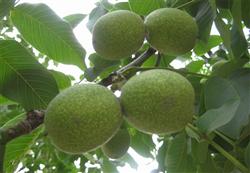
How can thin-shelled walnuts be cultivated for high yields? Please explain and guide.
Thin-shelled walnut cultivation can refer to the following planting methods:
1. Apply base fertilizer in autumn
After the walnuts are harvested that year (around September 20) and before leaf fall, apply base fertilizer. For trees in the initial fruiting stage, dig a strip ditch or ring ditch at the vertical projection of the canopy, with a ditch depth of 60cm and width of 50cm. For large trees in full fruiting stage, dig a strip ditch at the vertical projection of the tree row, with a ditch depth of 80cm and width of 50-60cm, pick out stones, and fertilize according to the principle of 1 kg fertilizer per 1 kg fruit (fresh fruit). For young trees in the initial fruiting stage, apply 50-100kg of high-quality barnyard manure per tree (raw or rotted both work); for trees in full fruiting stage, apply 150-200kg per tree along the ditch. After applying, fill in about 10cm of topsoil, then water. After leaf fall, combine with garden cleaning and sweep the fallen leaves into the ditch, cover with soil, and tread firm.
2. Pruning for tree shaping, branch spreading, and angle opening
Pruning for tree shaping should be carried out from bud break to leaf fall, and the best period is after fruit harvest and before the leaves turn yellow.
2.1 Selection and retention of scaffold branches. Regardless of which tree shape is adopted, scaffold branches should fully occupy the space, so that the internal and external, upper and lower spaces are evenly distributed, well arranged, and do not shade each other.
2.2 Selection and retention of auxiliary branches. When auxiliary branches do not conflict with scaffold branches, the auxiliary branches are not pruned; when auxiliary branches affect the growth of main and lateral branches, they should be removed or cut back; if there is space for branching, they can be transformed into fruiting branch groups.
2.3 Cultivation of fruiting branch groups. Large and medium auxiliary branches growing on scaffold branches are cut back and transformed into large and medium fruiting branch groups; strong vegetative branches occurring inside the canopy should have the strong removed and the weak retained, and the upright removed and the horizontal retained. For retained water sprouts, methods such as branch spreading to open the angle and heading back should be preferred to promote branching and form fruiting branch groups. Fruiting branch groups that have borne fruit for many years and are weakening in growth should have the horizontal removed and the upright retained, and the old removed and the new retained. When fruiting branch groups are distributed too densely and affect growth and light, part of the weak and poorly fruiting ones should be properly thinned out, and vigorous branches within the branch group should be controlled to prevent "trees growing on trees." For walnuts, fruiting mother branches about 10-20cm long and about 1cm thick have the best fruiting performance, and attention should be paid to cultivating and retaining them.
2.4 Renewal of fruiting branch groups. For large trees that have grown for many years without shaping or pruning, attention should be paid to opening skylights. For all upright growing branches, use propping, pulling, pushing, and hanging methods to pull them to 70-90 degrees. After the tree vigor is moderated, they can bear large amounts of fruit, so do not rush to thin them out. After 1-2 years of branch spreading and angle opening, then choose large branches with good orientation and balanced growth as main branches. Overly dense branches and large branches in poor positions should be removed. When shaping, prune according to the tree and shape according to the branches.
3. Soil tillage
Walnuts have well-developed root systems and densely distributed fibrous roots. Deep tillage of good soil by more than 20cm is beneficial to root respiration, promotes new root growth, thereby expanding the absorption area and increasing yield.
Soil tillage includes two types: whole-orchard tillage and digging around the tree base. For large trees in full fruiting stage, whole-orchard deep tillage is generally used; for young trees and trees in the initial fruiting stage, dig around the tree base. If it is a forest-crop intercropping system, also dig around the tree base. On average, till 2-3 times a year, once each in spring, summer, and autumn. For land returned from farmland to forest, the method of growing grass under the trees can be used.
4. Fertilizer and water management
Irrigate once each before and after bud break. For large trees in full fruiting stage, apply 1-2kg of diammonium phosphate or urea per tree in combination with watering. Topdress and irrigate once each before and after flower bud differentiation (before and after flowering), which is beneficial to flowering, fruit setting, and young fruit enlargement. During the young fruit enlargement stage, phosphorus and potassium fertilizers should be topdressed, and the amount of nitrogen fertilizer applied should be reduced. Watering after fruit harvest can effectively promote the decomposition of base fertilizer, increase nutrient reserves in the tree before overwintering, improve overwintering ability, and benefit sprouting and flowering the following year. Winter irrigation should be carried out after leaf fall and before the soil freezes, to prevent early spring freezing and drought.
Click to get more walnut cultivation techniques
Click to get more fruit cultivation techniques