What are the main pests and diseases of hickory? A detailed explanation
What are the main pests and diseases of hickory? How should they be prevented and controlled? Please advise. Hickory pests and diseases are important factors affecting hickory yield. Preventing and controlling pests and diseases can protect the forest, promote growth, and increase yield. Common hickory diseases include hickory branch blight and fruit tree rot. Common...
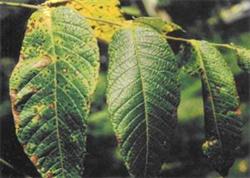
What are the main pests and diseases of hickory? How should they be prevented and controlled? Please advise
Hickory pests and diseases are important factors affecting hickory yield. Preventing and controlling pests and diseases can protect the forest, promote growth, and increase yield.
Common hickory diseases include hickory branch blight and fruit tree rot. Common insect pests include hickory locusts, hickory tussock moths, hickory aphids, walnut leopard moths, and longhorn beetles (mulberry longhorn beetle, wrinkled green longhorn beetle, etc.). In recent years, some new pests have also appeared, such as the eyed hook moth and the hickory flower bud gall midge.
(1) Hickory disease prevention and control:
1. Hickory branch blight:
Hickory branch blight is one of the important diseases of hickory. It damages 1-year-old shoots and 2-year-old side branches, and spreads downward, causing large branches to die, weakening tree vigor, and reducing yield. The disease begins in mid-to-late August, peaks from October to November, and no new disease occurs from early March to early August; all dead branches seen are old diseased dead branches left from the previous year. The pathogen overwinters as mycelium and conidia on diseased dead branches. Conidia spread within affected forests from April to May and from September to October, with wind and rain as the transmission agents.
Prevention and control methods:
(1) In May, spray branches with 70% thiophanate-methyl at 500-700 times dilution, or 1% Bordeaux mixture, once every 15 days, for 3 consecutive sprays.
(2) In spring and summer, prune out dead branches to prevent the disease from spreading downward in autumn and to reduce the source of the pathogen.
2. Hickory fruit tree rot:
This disease mostly occurs on the main trunk, main branches, and side branches, and sometimes the base of the main root is also affected.
Symptoms: The bark in the diseased area rots, and it mostly occurs on the sunny side of branches and trunks and at branch forks. In the early stage it is slightly raised, water-soaked, and sinks when pressed, with an oblong outline. The diseased tissue is soft and rotten, exudes black liquid, and gives off a sour mash odor, causing branch or trunk death.
Prevention and control methods:
(1) In May, promptly scrape off diseased spots or remove diseased branches. For main branches and side branches with early disease spots, promptly use a sharp scraper to scrape off the surface layer of diseased bark on the trunk, generally scraping off 1 mm of the surface living bark until white-green healthy bark is exposed. Be careful to scrape away all diseased tissue, and promptly saw off severe diseased branches or dying main trunks, take them out of the orchard, and burn them.
(2) For wounds where diseased tissue has been scraped off, apply fungicidal treatment. The agents may include: 5-10 degree lime sulfur mixture, or 45% crystalline lime sulfur at 20 times dilution, or Guofukang at 10-15 times dilution, applied to the diseased parts of the plant.
(2) Hickory insect pest prevention and control:
1. Hickory tussock moth:
The hickory tussock moth, also called the hickory green caterpillar, is a major pest that damages hickory leaves. This insect has four generations a year, overwinters as pupae on the soil surface, and emerges in mid-April of the following year to mate and lay eggs. The damage periods of the four generations are respectively early May to late June; mid-July to late July; early August to late August; and early September to early October.
Adults have strong phototaxis. The emergence periods of adults of each generation are respectively early April, late June, late July, and late August.
Prevention and control methods:
(1) Biological control: release Trichogramma wasps at the peak of the first-generation egg stage.
(2) Chemical control: A. Spray separately with 25% deltamethrin at 3700 times dilution and fenvalerate at 3000 times dilution. B. During the larval stage, use systemic pesticides such as omethoate and methamidophos for trunk injection by drilling holes.
(3) Dig for pupae manually during the pupal stage.
(4) Use light traps to kill adults during the adult stage.
2. Hickory aphid:
Aphids occur year-round in the hickory production areas of Lin'an. Nymphs cluster on hickory buds, young leaves, and tender shoots to suck sap, causing buds and leaves to shrivel, male flowers to die, female flowers not to open, and tree vigor to weaken. This seriously affects hickory yield in the current and following year.
This insect has four generations a year. Early to mid-April is the period of most severe damage, with generations 1-3 overlapping in damage. Damage to hickory during this period also has the greatest impact, as it coincides with hickory budding, spring shoot growth, and flowering, so control should focus on this period.
Prevention and control methods:
Around Qingming Festival, use 40% omethoate at a 1:0 or 1:1 concentration and inject it into holes drilled in the trunk to be effective.
3. Walnut leopard moth:
This insect occurs in all hickory production areas of Lin'an. In severe cases, the forest looks as if it has been burned, and hickory drops large amounts of fruit, reducing yield.
This insect has four generations a year and overwinters as pupae in cocoons on fallen hickory branches and leaves or in grass. Adults emerge in mid-May of the following year. The damage periods of the four larval generations are respectively late May to early July; late July to early August; late August to mid-September; and early October to mid-October. Adult emergence periods are respectively mid-May; mid-July; mid-August; and mid-September. Adults have strong phototaxis.
Prevention and control methods:
(1) Control during the larval stage: A. Spray fenvalerate at 3000 times dilution onto the canopy; B. Use omethoate at 1:1 concentration for hole injection; C. On windless or lightly windy mornings and evenings, in large contiguous affected forests, apply "Lindane BHC" smoke agent for fumigation.
(2) Use light traps to kill adults during the adult stage.
4. Rice grasshopper:
The rice grasshopper is a new pest that damages hickory leaves, commonly known as the grasshopper.
This insect has one generation a year and overwinters as eggs in the surface soil. In mid-May of the following year, the eggs hatch into nymphs, with the peak hatching period from late May to early June. Adults emerge in early August, mate and lay eggs in late August, and adults die in late October.
First-instar nymphs move on the ground surface and damage small shrubs and weeds; from the second instar onward, they climb trees to damage hickory leaves. When adults reach sexual maturity, they descend from the trees to the ground in large numbers to mate and lay eggs. Fresh human feces and urine water has a special attraction for adults.
Prevention and control methods:
(1) Control during the young nymph stage: fenvalerate at 1:1500-2000 times dilution can be sprayed on the ground. Because young nymphs mainly damage miscellaneous brush and weeds at the foot of the hills and on the ground surface and are distributed in clusters, concentrated ground spraying has a strong killing effect.
(2) Control during the adult stage: A. Trap-killing method: soak rice straw thoroughly with a solution containing 90% trichlorfon crystalline urine water, then pile it on forest land where grasshoppers are active, one pile every 10 m, 6-7 piles per mu (each pile of dry rice straw 1-1.5 kg, trichlorfon 0.2 kg, urine water 25 kg).
B. Spraying method: when grasshoppers descend to the ground to lay eggs after reaching sexual maturity, spray for control. In July-August, when large numbers of grasshoppers descend from trees to mate but have not yet laid eggs, spray fenvalerate at 1500 times dilution.
4. Green-legged grasshopper:
The green-legged grasshopper is another locust species that once broke out in hickory forest areas.
This insect has one generation a year and overwinters as eggs in the surface soil. Newly hatched nymphs appear in mid-April, adults emerge in early July, mating and egg-laying begin in mid-July, and adults begin to die in late August. Newly hatched nymphs feed on grasses and legumes on the ground surface, and from the second instar they climb trees to damage hickory leaves. Fresh human feces and urine water also has a special attraction for adults. When adults reach sexual maturity, they fly from the trees to the ground and to weed areas along roadsides to lay eggs.
Prevention and control methods:
(1) Ground spraying method: in late April, at the peak hatching period of eggs, spray fenvalerate at 1500-2000 times dilution on the ground for control.
(2) In July, use trap piles to lure and kill adults. The method is the same as that for rice grasshopper control.
Click to get more hickory cultivation techniques
Click to get more fruit cultivation techniques