How should apple trees be pruned after entering an "on" year?
How should apple trees be pruned in an "on" year? Please provide guidance on the pruning principles for "on" year trees. On the premise of ensuring the current year's yield, appropriately control the amount of flowers and fruits retained, reduce consumption, increase accumulation, and promote flower bud formation. The specific methods are: 1. "On" year trees have many flower buds. To reduce flower buds and improve ventilation and light conditions, thin out or cut back poorly positioned auxiliary branches and large scaffold branches; thin out overly dense fruiting branches or fruiting branch groups; the outer extension branches should be cut at a plump bud, and the one-year-old excessively long branches below them should be appropriately thinned; for one-year-old vegetative branches in the inner canopy, except for specially long ones that are cut back, generally prune lightly or not at all, so as to form a certain number of flower buds for the "off" year.
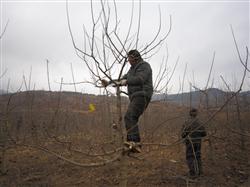
How should apple trees be pruned in an "on" year? Please provide guidance
Pruning principles for "on" year trees. On the premise of ensuring the current year's yield, appropriately control the amount of flowers and fruits retained, reduce consumption, increase accumulation, and promote flower bud formation. The specific methods are:
1. "On" year trees have many flower buds. To reduce flower buds and improve ventilation and light conditions, thin out or cut back poorly positioned auxiliary branches and large scaffold branches; thin out overly dense fruiting branches or fruiting branch groups; the outer extension branches should be cut at a plump bud, and the one-year-old excessively long branches below them should be appropriately thinned; for one-year-old vegetative branches in the inner canopy, except for specially long ones that are cut back, generally prune lightly or not at all, so as to form a certain number of flower buds for the "off" year.
2. Reduce flower buds and increase reserve branches. In winter, heavily prune fruiting branches, renew branch groups, cut back medium and long fruiting branches, increase the proportion of leaf buds, and "exchange flowers for flowers," so as to form sufficient flower buds for the following year. When there are too many flower buds, rejuvenate a batch of aged spur branches and branch groups. After pruning, keep the ratio of flower buds to leaf buds at about 1:3.
3. "On" year trees have relatively many flower buds, which are hard to distinguish in winter, so supplementary pruning can be carried out in spring when the flower buds swell. Thin out excess flower buds so that the "on" year is not too heavy.
4. For "on" year trees with relatively strong growth vigor, when too many fruits are retained, make 1 ring cut at the base of the central leader or some large branches from late May to early June to promote flower bud formation.
5. For robust one-year-old vegetative branches and varieties that easily form flowers, long shoots left unpruned can form flower buds in the same year, so leave more and cut less, laying the foundation for ensuring the following "off" year is not too light; for varieties that do not easily form flower buds, long shoots left unpruned do not easily form flower buds in the same year and generally need to be left unpruned for 2 consecutive years, only flowering and fruiting in the third year, so they can be cut back in the "on" year and then handled as appropriate the following year. Vigorous shoots that have already been left unpruned for one year in the "off" year should continue to be left unpruned to promote flower bud formation and bear fruit in the "off" year.
Click to get more apple tree cultivation techniques
Click to get more fruit cultivation techniques