Detailed Explanation of Pruning Techniques for Yali Pear Trees During the Fruiting Stage
How should Yali pear trees be pruned during the fruiting stage? Please provide guidance. During the fruiting stage, Yali pear trees can be pruned by referring to the following methods: 1. Pruning objectives: Maintain a strong tree vigor, regulate light distribution, and ensure the tree body is well ventilated and lighted, with light reaching every branch. Continuously renew branch groups to keep them robust and long-lived. Overcome alternate-year bearing and ensure...
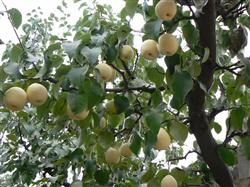
How should Yali pear trees be pruned during the fruiting stage? Please provide guidance.
During the fruiting stage, Yali pear trees can be pruned by referring to the following methods:
1. Pruning objectives
Maintain a strong tree vigor, regulate light distribution, and ensure the tree body is well ventilated and lighted, with light reaching every branch. Continuously renew branch groups to keep them robust and long-lived. Overcome alternate-year bearing and ensure consecutive years of high and abundant yields.
2. Pruning principles
(1) Use renewal pruning instead of thinning, combining renewal pruning with thinning. For large branches, use the renewal pruning method as much as possible, and generally do not remove them entirely from the base. (2) Control excessive vigor in the upper part of the tree, using thinning, leaving, and renewal pruning in combination. The spread of upper-layer branches must not exceed 1/2 of the spread of lower-layer branches. (3) Branch groups should be renewed in rotation to prevent bare areas. (4) In off years, create shoots; in on years, leave shoots; adjust flower quantity to prevent alternate-year bearing. Regulate the relationship between growth and fruiting so that the tree body achieves high and stable yields, extends the years of full fruiting, and delays the onset of senescence. (5) The canopy should be small at the top and large at the bottom, sparse outside and dense inside, with branch groups full and compact. The spacing between the two tiers of scaffold branches should reach about 150 cm. Thin and renewal-prune the auxiliary nurturing branches between the tiers to facilitate the growth of inner canopy branches in the lower layer and ventilation and light penetration.
3. Pruning methods
(1) For large and medium branches, use renewal pruning instead of thinning, combining heavy and light renewal pruning, with adjacent branches one long and one short. For large and medium branches, also pay attention to propping, pulling, and tying down, and arrange them reasonably. For large auxiliary nurturing branches between tiers, gradually thin and renewal-prune them year by year to open up the inter-tier spacing.
(2) For trees that are strong at the top, weak at the bottom, and hollow in the middle, lower the head to control height, thin branches, and open the branch angles. Combine thinning, leaving, and renewal pruning. When lowering the head, leave a root branch. Thin branches in stages, thin and renewal-prune the outer periphery, and consolidate inner canopy branch groups. The angles of lower-layer scaffold and secondary branches should be opened appropriately.
(3) Combine renewal pruning and leaving, renew in a timely manner, and especially pay attention to the renewal and rejuvenation of inner canopy branch groups.
(4) For spur groups (chicken-claw branches), remove the weak and keep the strong, remove the distant and keep the near, and remove the upright and keep the horizontal. Combine branch thinning with flower bud breaking, with both thinning and breaking. Combine branch thinning with collar-cut short pruning. In normal years, keep the amount of branch thinning at 20%-30% and flower bud breaking at 20%-30%; thin 25% on the outer periphery and break 25% of flower buds; thin about 30% in the inner canopy and break about 30% of flower buds. For weak branches that cannot form flower buds, cut at the collar scar to rejuvenate them.
(5) Whether in an on year or a normal year, prune one-year-old branches according to the principle of leaving them where there is space and thinning them where there is no space. For robust and plump chicken-claw branches adjacent to the branch, thin out the current-year shoots; for weak and thin ones, keep the current-year shoots, and for the retained current-year shoots, leave them long in on years and create shoots in off years.
(6) Pruning methods for adjusting alternate bearing. To adjust alternate bearing, start from the off year, retain as many flowers as possible, and pay attention to creating shoots. Creating shoots in an off year means cutting back more one-year-old branches in the off year so that they grow long branches in the on year, exchanging shoots for shoots and reducing the number of flower buds in the on year. Leaving shoots in an on year means leaving one-year-old branches unpruned and long in the on year to promote the formation of clustered flowering branches, thereby increasing the flower quantity in the off year. In an on year, thin more flower buds, ensure a reasonable load, and break more flower buds, exchanging flowers for flowers, to ensure that enough flower buds form in the off year. Thin flowers and thin fruit to ensure a reasonable load and consecutive years of high, stable yields and high quality.
(7) Distribution and retained amount of fruiting branches in the whole tree. According to experience, after pruning, the fruiting branches of Yali pear trees in the full fruiting stage should account for about 1/3 of the total branch amount, with about 40,000 branches retained per mu. When pruning, each tree's central leader, scaffold branches, and large and medium auxiliary nurturing branches can be regarded as independent fruiting units, and then the outer periphery (or upper part), middle part, and inner canopy (or lower part) of each main branch can be divided into three sections for consideration. Then, based on the characteristics of Yali pear, namely apical growth dominance, easy occurrence of strong outside and weak inside, strong top and weak bottom, and after tree vigor declines, easy formation of a canopy with no branch groups in the inner part and fruiting relying on the outer edge, the distribution and retained amount of fruiting branches in the whole tree from outside to inside and from top to bottom can be as follows: for a moderate-vigor tree (outer periphery new shoots 30-50 cm), the fruiting branches on the outer periphery (or upper part) of each large fruiting branch account for 50% of the total branch amount, the middle fruiting branches account for 30% of the total branch amount, and the inner canopy (or lower part) fruiting branches account for 20% of the total branch amount; for a vigorous tree (outer periphery new shoots above 50 cm), the outer periphery (or upper part) accounts for 60% of the total branch amount; the middle accounts for 40%; the inner canopy (or lower part) accounts for 30%; for a weak tree (outer periphery new shoots below 30 cm), the outer periphery (or upper part) accounts for 40% of the total branch amount; the middle accounts for 20%; the inner canopy (or lower part) accounts for 10%. In this way, fruit can suppress the canopy, and apical dominance can also be inhibited, which is beneficial for consolidating inner canopy branch groups and achieving consecutive years of high quality, high yield, and stable yield.
Click to get more pear tree planting techniques
Click to get more fruit planting techniques