What are the methods to prevent "sprout flushing" in longan?
How to prevent "sprout flushing" in longan? Please give guidance. When longan flower buds break dormancy, they must first sprout shoots, and then inflorescences differentiate and develop from the leaf axils of the compound leaf primordia of the new shoots, that is, transforming from a mixed leaf-flower structure into a pure inflorescence. When the inflorescence primordium is dormant or weak in building strength, it is very easy to form incomplete inflorescences with coexisting flowers and leaves (that is, flower clusters...
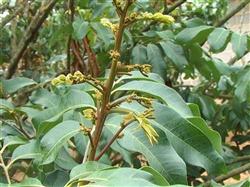
How to prevent "sprout flushing" in longan? Please give guidance
When longan flower buds break dormancy, they must first sprout shoots, and then inflorescences differentiate and develop from the leaf axils of the compound leaf primordia of the new shoots, that is, transforming from a mixed leaf-flower structure into a pure inflorescence. When the inflorescence primordium is dormant or weak in building strength, it is very easy to form incomplete inflorescences with coexisting flowers and leaves (that is, sprout flushing of flower clusters). During the spring germination period of longan, as the weather warms up and air humidity increases, "sprout flushing" is prone to occur, especially in young and vigorous trees that have just borne fruit. Sprout flushing mainly has two types: one is that a flower cluster has both leaves and flowers; the other is that the middle and lower parts of a flower cluster have a small number of flower buds, while the upper part sprouts vegetative branches. Preventing "sprout flushing" in longan is an important part of ensuring a bumper harvest of longan in that year. Our main practices are:
I. Do a good job of prevention
1. Apply flower-promoting fertilizer reasonably. Flower-promoting fertilizer should generally be used after flower clusters sprout and flowers are visible. For longan trees with dark green leaves and vigorous growth, fertilization should be even later, and the application of nitrogen fertilizer must be strictly controlled.
2. Remove the terminal bud. When the main inflorescence axis of the flower cluster has grown 10-12 cm long and red crab-eye points appear in the leaf axils, pinch the tip in time to break apical dominance and promote lateral buds to sprout and lateral inflorescences to grow rapidly.
II. When sprout flushing occurs, promptly take comprehensive technical measures according to different situations
1. Manually remove the small leaves on the flower clusters, once every 2-3 days, until a pure inflorescence forms. The disadvantage of this method is that it is labor-intensive and consumes tree nutrients. For large trees, operation is somewhat difficult.
2. When partial sprout flushing occurs in the orchard and the small leaves have unfolded and turned red but not yet turned green, use 40 mg of small-leaf shrinkage and abscission agent (an alkylated derivative of abscisic acid) plus 20 mL of amino acid sugar phosphonate ester, add 50 kg of water, and spray, mainly spraying the new shoots, spraying until the leaves drip, to promote the small leaves to turn yellow and fall off.
3. When the red points of the sprouted flower clusters degenerate and disappear and the small leaves have already unfolded and grown, within the appropriate phenological period, use 1 packet of tender-shoot contact-killing agent plus 50 kg of water, and spray directly on the new shoots from 6 to 10 a.m. on a sunny day, focusing on the undersides of young leaves, to quickly kill the tender shoots. After one week, use 20 mL of leaf bud dormancy agent plus 20 g of amino acid potassium, add 50 kg of water, and spray, once every 3-4 days, for three consecutive applications, to promote flower formation.
4. On the trunk or large branches, perform opposite alternating half-circle ring cutting, or tie 1-2 loops with No. 16 iron wire, so that the iron wire slightly sinks into the cortex. Once small red points appear on the flower clusters, remove the iron wire.
Click to get more longan planting techniques
Click to get more fruit planting techniques