Control Methods and Technical Key Points for Fruit Cracking in Wampee
How to plant and manage Ji Xin wampee (chicken-heart wampee)? Please advise. Ji Xin wampee is the highest-quality variety among all wampee strains, and is deeply welcomed by consumers for its "large fruit, thick flesh, and sweet taste." It is easy to cultivate and manage, and has strong adaptability to various climatic factors and soil conditions, making it very suitable for cultivation and production in this region. 200...
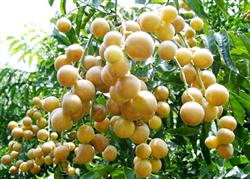 How to prevent and control fruit cracking in wampee? Please provide guidance.
The growth rate of wampee trees is slower than that of other common fruit trees, and their ability to send out new shoots each year is not strong either; generally, they send out about 3 flushes per year. If the plant has already set fruit, it sends out about 2 to 3 flushes per year: the 1st is the spring flush, and flower clusters are borne at the tips of the spring flush. Therefore, the spring flush is also regarded as the fruiting shoot. The 2nd is the summer flush. If the plant has already set fruit, summer flushes are generally very rarely sent out. Only plants with a small fruit load or no fruit set that year will sprout summer flushes. The 3rd is the autumn flush. Under good water and fertilizer management, 2 autumn flushes can be forced, that is, the following year spring flushes are sent out on the basis of last year's autumn flush and become the fruiting shoots for the following year. The flower bud differentiation period of wampee plants is generally from December to January of the following year after the autumn flush matures; therefore, the autumn flush is generally sent out after fruit harvest and before mid-October. Ji Xin wampee includes Da Ji Xin wampee, Xuanzhong Da Ji Xin wampee, or Chang Ji Xin wampee, and its fruit ripening period is about mid-July (the ripening period of the selected Ji Xin wampee variety is about early July).
. If you want the wampee to send out 2 autumn flushes, its water and fertilizer management should be relatively strict. For example, in early July before fruit harvest, pre-harvest fertilizer should be applied so that the plants can quickly recover their tree vigor after harvest. However, since your wampee plants did not set fruit this year, it is advisable to apply fertilizer in early July and prune in mid-July. This will allow the latent buds of the plants to be sent out as scheduled in early August. After the autumn flush sprouts, apply fertilizer again and spray foliar fertilizer on the canopy multiple times to promote the first autumn flush to mature as quickly as possible and then send out the second autumn flush again.
However, since it is now late July, if the first autumn flush is difficult to send out in early August, after entering September the temperature gradually turns cooler, and in autumn the rainfall decreases and humidity is relatively low. If, by any chance, the second autumn flush cannot be sent out as scheduled in late September to early October and is delayed until after mid-October, then because of the drop in temperature the second autumn flush will be difficult to mature and fill out in mid-to-late November, which will affect flower bud differentiation of the plants and thereby affect flower formation the following year. To put it another way, your wampee orchard has already sent out spring flushes this year, but the summer flushes are not very uniform, which indicates that the degree of tree vigor among the plants is not very even.
But if healthy autumn flushes are sent out on the basis of the spring and summer flushes, the normal growth of 3 flushes can basically accumulate the nutrients needed for flower formation next year. To put it another way, the root system of wampee trees is relatively shallow, which means that under normal winter drought conditions, the wampee root system is inhibited to a relatively large extent. Therefore, wampee plants generally do not easily send out winter flushes in winter and can enter flower bud differentiation relatively smoothly. Therefore, if the irrigation capacity of your orchard's irrigation system is not sufficient to reliably meet the plants' sufficient water supply needs during autumn drought, then it is not advisable to consider forcing 2 autumn flushes.
In addition, regarding the reference fertilizer amount and fertilizer types for forcing autumn flushes. It is recommended not to apply too much organic fertilizer for the autumn flush fertilizer; it is better to reserve the organic fertilizer for application around Great Cold next year. For each plant, consider using 0.2 kg of 15:15:15 compound fertilizer, adding 0.2 kg of urea to dilute manure water, opening a shallow furrow under the canopy drip line, drenching it, and then covering with soil. Starting when the autumn buds are forced out to about 3 to 5 mm, pay attention to spraying pesticide to control the citrus leafminer. The pesticide used should preferably be mixed with foliar fertilizer, such as humic acid Kangbao, or seaweed extract Wodebao, etc. For controlling the citrus leafminer, the pesticide options include: 50% Huhu emulsifiable concentrate (chlorpyrifos·fipronil) at 500 times dilution, or 3.2% JINJIAWEIYAN microemulsion (emamectin benzoate·chlorantraniliprole) at 5000 times dilution, or 20% Wanchongdi emulsifiable concentrate (chlorpyrifos) at 800 times dilution, alternating the pesticides every 7 days for control, spraying 3 to 4 times in succession.
Click to get more wampee cultivation techniques
Click to get more fruit cultivation techniques