What should be noted in plum tree cultivation?
What should be noted in plum tree cultivation? Please provide guidance. For cultivating plum trees, you can refer to the following planting methods: 1. Select suitable cultivars. Greenhouse cultivation should focus on early-maturing cultivars. The suitable cultivars mainly include the following: 1.1 Zaohong plum. Originally from Japan, the fruit is oval, with an average single fruit weight of 34g, maximum 65g; the fruit surface is bright red, the flesh is yellow, with radial red lines; the flesh is fine, crisp, with relatively many fine fibers, sweet and sour, juicy, slightly fragrant. The fruit ripens in mid-June, is a very early-maturing cultivar, and is relatively high-yielding.
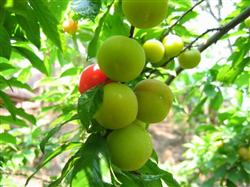
What should be noted in plum tree cultivation? Please provide guidance
For cultivating plum trees, you can refer to the following planting methods:
1 Select suitable cultivars
Greenhouse cultivation should focus on early-maturing cultivars. The suitable cultivars mainly include the following:
1.1 Zaohong plum. Originally from Japan, the fruit is oval, with an average single fruit weight of 34g, maximum 65g; the fruit surface is bright red, the flesh is yellow, with radial red lines; the flesh is fine, crisp, with relatively many fine fibers, sweet and sour, juicy, slightly fragrant. The fruit ripens in mid-June, is a very early-maturing cultivar, and is relatively high-yielding.
1.2 Japanese Zaomi plum. Originally from Japan, the fruit is short oval, with an average single fruit weight of 26-28g, maximum 35g. The fruit surface is yellow, with a few having a red blush on the sunny side. The flesh is pale yellow, soft and loose, sweet and juicy, with a strong fragrance and top-grade quality. It ripens in late June in Fuxin and is an excellent fresh-eating cultivar with strong productivity.
1.3 Methley plum. Originally from New Zealand, the fruit is nearly round, with an average single fruit weight of 50g; the fruit surface is smooth, purplish red, and the flesh is bright red. Most plants bloom in the same year after planting. It is extremely high-yielding and suitable for close planting, and is widely planted in many countries abroad. It ripens in early July in Fuxin.
1.4 Suilinghong. Originally from Heilongjiang, the fruit is oval, with an average single fruit weight of 34-46g, maximum 72g; the fruit surface is bright red, the flesh is pale yellow, fine in texture, dense and juicy, sweet in flavor, with a strong fragrance. It ripens in early July in Fuxin, belongs to fresh-eating and processing cultivars, and has strong productivity.
2 Build protected cultivation facilities
2.1 Selection of greenhouse site. Although the site conditions required for greenhouses are not strictly different from those for open-field cultivation, for intensive production, soil rich in humus must be selected, with a deep plow layer, and good drainage, water retention, and soil permeability.
2.2 Greenhouse structure. Although the greenhouses for planting plum trees are the same in form as vegetable greenhouses, their structures are not entirely the same. Plum tree greenhouses should be taller than vegetable greenhouses, because the tree height is generally about 2m, and there should still be about 1m of space above the canopy to the greenhouse surface, to facilitate manual pollination, pesticide spraying, fruit thinning, harvesting, and other operations. Therefore, the greenhouse should be of a tall, multi-span type. Regardless of what type of greenhouse is chosen, it must have the ability to withstand strong winds, snow accumulation, and other natural disasters.
2.3 Covering materials. The covering materials of the greenhouse are required to have good light transmission, heat preservation, and durability.
2.4 Ventilation equipment. The greenhouse has good sealing performance. Under conditions of sufficient sunlight, as the temperature rises, humidity also increases rapidly, which can easily cause physiological disorders and affect the growth and development of plum trees. Therefore, ventilation equipment must be provided, such as exhaust vents and ventilation windows, and the humidity inside the greenhouse should be adjusted at any time according to need.
2.5 Heating equipment. After covering in early spring, if the temperature drops and a late cold spell strikes, it is necessary to heat the greenhouse. The commonly used heating facility is heating by stove and flue; where conditions permit, warm-air heaters can be used to regulate the temperature inside the greenhouse.
2.6 Irrigation equipment. Because the temperature inside the greenhouse is relatively high, certain irrigation facilities are also needed to ensure normal tree growth. Underground pipes can be buried for seepage irrigation, or aboveground sprinkler irrigation can be used.
3 Key points of cultivation techniques
3.1 Management during the germination stage. The main cultivation goal at this stage is to break dormancy and promote root activity and sprouting. The film-covering period is determined according to the length of time until fruit ripening, and can be calculated backward from the number of days to fruit maturity. Generally, early-maturing cultivars enter the ripening stage 85d after full bloom. If the film is covered too early, the outside temperature is still low, and the cost of artificial heating is relatively high. Generally, film covering is mostly carried out 1 month before thawing in open fields.
3.2 Management during the flowering stage. After 3 weeks of film covering and heating, the tree begins to sprout, and after another 4-5d it can bloom. Plum pollen can germinate and grow at 5°C. The minimum temperature inside the greenhouse should be maintained at 7°C-8°C. In order to promote pollination and fertilization, the maximum daytime temperature inside the greenhouse must not exceed 25°C, and 18°C-22°C is preferable. At the same time, the soil in the greenhouse should maintain suitable moisture; do not wait until the surface soil dries before watering. To increase the fruit-setting rate, manual supplementary pollination can be carried out.
3.3 Management during the fruit enlargement stage. During the young fruit development period, the daytime temperature inside the greenhouse should be 25°C-28°C, and the nighttime temperature should be 10°C-15°C. At this stage, plum trees have relatively strict water requirements. Too much irrigation makes the soil too wet and can easily cause root disorders. One irrigation equivalent to 15-20mm of rainfall is sufficient. After irrigation, shallow tillage should be carried out in a timely manner to prevent soil compaction and maintain good root permeability.
3.4 Later-stage management. At this stage, new shoots grow relatively vigorously. All excessively vigorous shoots should be removed to ensure light inside the tree canopy and promote fruit coloring. At this time, the temperature inside the greenhouse should be reasonably regulated; the greater the day-night temperature difference, the better the fruit coloring. At this stage, skylights should be opened to lower the nighttime temperature. The daytime temperature should still be maintained at 15°C-28°C, and must not exceed 30°C, while maintaining a certain soil humidity.
3.5 Management after fruit harvest. After the fruit is harvested, the covering materials should be removed immediately so that the tree is exposed to the natural environment, in order to promote full development of the branches. To prevent discomfort to the tree caused by sudden environmental changes right after the covering materials are removed, the film should be removed on cloudy days to reduce the temperature difference inside and outside the greenhouse and the impact on tree growth.
Click to get more plum tree planting techniques
Click to get more fruit planting techniques