What methods are there to improve the fruit set rate of plum trees?
How can the fruit set rate of plums be improved? Please give an introduction to the methods. To improve the fruit set rate of plums, you can refer to the following methods: 1. Regulate tree vigor. For trees that are too vigorous, promptly remove buds and prune upright branches, and promptly open up the branch angles; you can also apply 3-5 g of 15% paclobutrazol per tree in autumn or spring, or spray 150-200 times paclobutrazol or PBO after petal fall...
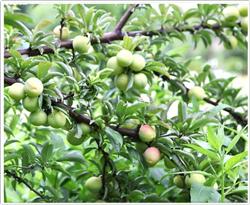
How can the fruit set rate of plums be improved? Please give an introduction to the methods
To improve the fruit set rate of plums, you can refer to the following methods:
1 Regulate tree vigor
For trees that are too vigorous, promptly remove buds and prune upright branches, and promptly open up the branch angles; you can also apply 3-5 g of 15% paclobutrazol per tree in autumn or spring, or spray 150-200 times paclobutrazol or PBO after petal fall. For trees that are too weak, apply base fertilizer after fruit harvest, and promptly apply topdressing and foliar fertilizer during the growing season.
2 Pollination
2.1 Arranging pollinizer trees. When establishing the orchard, rationally arrange pollinizer trees, especially for cultivars with low self-fruitfulness or low pollen production themselves; pollinizer trees must not be less than 30%.
2.2 Placing bees. Before flowering, release 1 box of honeybees per 0.1-0.2 hm2 of orchard, or release 200 horned mason bees per 666 m2.
2.3 Artificial supplementary pollination. At full bloom, use a feather duster or towel stick to gently roll between the flowers of the main cultivar and the pollinizer cultivars; or mix collected and prepared pollen with talcum powder at 1:1, put it into a cloth bag, and shake it over the trees of the main cultivar at full bloom for pollination; you can also insert flowering branches into a water bottle and hang it on the trees of the main cultivar.
In addition, spraying 300-500 times borax plus 100 times granulated sugar or brown sugar at flowering can improve the fruit set rate.
3 Prevent frost damage during the flowering period
3.1 Establish windbreak forests. Establish windbreak forests on the north and west sides of the orchard. It is best to use a mixed tree-shrub pattern for the windbreak forest, so that a dense windbreak wall is formed below 1 m to reduce frost damage.
3.2 Pay attention to orchard site selection. Low-lying land easily accumulates cold air, which will aggravate frost damage. Therefore, try not to establish an orchard in low-lying land.
3.3 Smoke heating. When flowering is approaching, pay attention to listening to (watching) the weather forecast. When frost damage is forecast at night, you can prepare firewood, grass, or smoke-generating agents in advance on the windward side of the orchard, placing 1 pile every 20 m, and begin smoking when the temperature drops below 0degC. Note that smoke piles should be more than 10 m away from the trees, and a dedicated person should watch over them to prevent open flames from burning the trees. Smoking is relatively effective for preventing advective frost.
3.4 Irrigation. If conditions permit, sprinkler irrigation facilities can be used to intermittently spray water onto the trees on nights when frost occurs. Or irrigate under the trees, which has a good effect on reducing radiation frost.
3.5 Delay the flowering period. First, during the flower bud swelling stage of plum trees, spray 500-2000 mg/L maleic hydrazide or 1%-2% limewater on the trees, which can delay flowering by 3-5 d. Second, in early spring in February, irrigate before the ice melts; after the surface soil freezes solid, cover the ground under the trees with wheat straw, which can also delay flowering by 3-5 d. In addition, increase the degree of pruning in winter, combined with summer pinching, to cultivate 2-3 secondary shoots to form fruiting branches; this can delay the flower bud germination period and avoid frost.
3.6 Close planting. Close-planting cultivation can increase the population's cold resistance. Because cold air sinks, flower buds below 1 m are prone to frost damage; therefore, leaving the trunk slightly taller can reduce frost damage to flower buds from lower-layer cold air.
3.7 Cultivar selection. Choose cultivars that flower later or are more frost-resistant.
4 Control the plum sawfly
At the end of full bloom, carefully spray the tree canopy once with 1500 times chlorpyrifos or 1500-2000 times fenvalerate, and spray once more after 1 week, which can basically control the damage. The plum sawfly occurs 1 generation per year and overwinters in the soil under the trees. At the end of full bloom, spray the ground with 500 times chlorpyrifos or scatter phoxim powder, then shallow hoe after scattering. Pick up all fallen infested fruits from the ground cleanly and transport them out of the orchard for destruction, which can eliminate most plum sawflies.
Click to get more plum tree planting techniques
Click to get more fruit planting techniques