Key management techniques for navel oranges in June-July
How should navel oranges be managed in June-July? Please provide an introduction to the management methods. Navel orange is one of the important varieties in citrus production, especially the preferred variety for processing orange juice. Therefore, in recent years, the planting area of navel oranges has shown an increasing trend. June-July is one of the key periods in high-quality, high-yield cultivation of navel oranges, and cultivation management must be effectively strengthened...
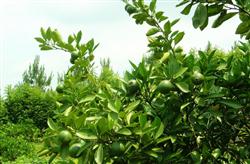
How should navel oranges be managed in June-July? Please provide an introduction to the management methods
Navel orange is one of the important varieties in citrus production, especially the preferred variety for processing orange juice. Therefore, in recent years, the planting area of navel oranges has shown an increasing trend. June-July is one of the key periods in high-quality, high-yield cultivation of navel oranges, and cultivation management must be effectively strengthened.
I. Cultivation management in June. Phenological period: summer shoots emerging, the 2nd physiological fruit drop stopping, early stage of young fruit enlargement; main cultivation management tasks: fruit retention, controlling summer shoots.
1. At the beginning of the month, strengthen the fertilizer and cultivation management of summer green manure; from the middle of the month, begin combining it with turning under green manure and weeds. Expand the planting holes and deep-turn to bury green manure, and cover the tree disk to retain moisture, prevent drought, and prevent high temperatures.
2. For vigorous fruiting trees, remove all summer shoots to retain fruit; for local spring and summer shoots that are too long, leave 20-30 cm and pinch off the tips; when young summer shoots grow to 20 cm, pinch off the tips to promote maturity; for mature full-bearing trees, cut back flower-dropping and fruit-dropping branches and declining branches; for aging trees, appropriately cut back, and after summer shoots emerge, promptly thin buds and set branches.
3. For fruiting trees with a large fruit load, press in green manure and apply heavy fertilizer to promote autumn shoots.
4. According to pest conditions, choose pesticides, focusing on controlling scale insects, leaf-rolling moths, longhorn beetles, psyllids, and swallowtail butterflies; combine anthracnose control with pesticide spraying, and apply 2-3 foliar fertilizer sprays.
II. Cultivation management in July. Phenological period: fruit enlargement period. Main cultivation management tasks: strengthening fruit, promoting autumn shoots.
1. For trees beginning to bear fruit, apply 1-1.5 kg of decomposed cake fertilizer or 10-15 kg of human and livestock manure and urine per tree; for mature trees with a per-tree yield of more than 50 kg, apply 4 kg of cake fertilizer plus 400 g of potassium sulfate per tree; for aging trees, apply heavy fertilizer to strengthen fruit and promote autumn shoots, applying 50 kg per tree plus 500 g of urea and 1.5 kg of phosphate fertilizer.
2. Summer pruning: thoroughly remove summer shoots that should be removed, pinch off overly long branches exceeding 30 cm, and thin out dense and weak branches.
3. In fruiting orchards, hoe weeds and loosen the soil throughout the orchard, and cover the tree disk with grass to retain moisture, lower temperature, and prevent drought. According to drought conditions, irrigate fertilizer water at the right time, in the right amount, and in the right position, focusing on drought prevention and fruit cracking prevention. In the middle and late ten days of the month, spray once each time a mixed solution of 2% quicklime plus 0.2% borax to prevent sunscald and fruit cracking.
4. According to pest conditions, choose the right pesticides, focusing on controlling citrus leafminer, longhorn beetles, cicadas, and rust mites.
Click to get more navel orange cultivation techniques
Click to get more fruit cultivation techniques