How to manage peach trees during the rainy season? Key technical points explained
How do you manage peach trees during the rainy season? Please give an introduction to the methods. During the rainy season, peach trees can be managed by referring to the following methods: 1. Drainage and waterlogging prevention. Peach trees are relatively sensitive to water and are drought-tolerant but afraid of waterlogging. If water accumulates, oxygen in the soil is insufficient, root respiration is blocked, and the tree vigor weakens; in severe cases the tree dies, so the water must be drained away promptly...
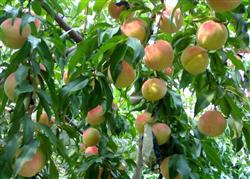
How do you manage peach trees during the rainy season? Please give an introduction to the methods
During the rainy season, peach trees can be managed by referring to the following methods:
1. Drainage and waterlogging prevention. Peach trees are relatively sensitive to water and are drought-tolerant but afraid of waterlogging. If water accumulates, oxygen in the soil is insufficient, root respiration is blocked, and the tree vigor weakens; in severe cases the tree dies, so the water must be drained away promptly. In hillside peach orchards, drainage ditches are dug along contour lines according to tree vigor. In flatland orchards, a drainage ditch is generally dug between every two rows of trees, and these ditches are connected to drain the water out of the orchard. If clay soil experiences short-term water accumulation, the roots should be aired (after drainage, clear away the soil under the tree so the main roots remain in a half-exposed state for a few days, then cover them back up).
2. Pest and disease control. The rainy season brings high temperatures and high humidity, making infection by diseases such as anthracnose, brown rot, fruit rot and soft rot very likely, and the diseases become even more serious especially when the fruit is nearly ripe. You can spray 80% thiophanate-methyl wettable powder at 1500 times dilution, or 50% carbendazim wettable powder at 600-800 times dilution, and alternate the medications. At the same time, pay attention to the control of various pests, such as red spider mites, red-necked longhorn beetles, leaf miners, tortricid moths and white-spotted flower chafers.
Pay attention to weather forecasts and spray promptly. If large-scale rainfall occurs 24 hours after spraying, respray immediately to ensure the effect of the spray.
3. Scientific fertilization. During the flood season, fertilization should be "small meals, many times", especially in riverbank fields and thin hilly land. Topdressing should use hole application or strip trench application, mainly potassium fertilizer, accounting for more than 40% of the total fertilizer amount, appropriately combined with nitrogen and phosphorus fertilizers. Foliar topdressing can also be carried out together with spraying, generally at concentrations of 0.4%-0.5% monopotassium phosphate, 0.5%-1% superphosphate, and 0.3%-0.5% urea.
4. Reasonable pruning. Early-maturing varieties can be pruned after harvest, mainly cutting out diseased and insect-damaged branches, water sprouts, crossing branches, overlapping branches and drooping branches within the canopy, so as to ensure every branch gets light and to favor flower bud differentiation. In peach orchards with a closed canopy, diseases are more severe; therefore, before the fruit ripens, excessively dense branches and water sprouts must be thinned out to make the canopy well ventilated and let light through, resist disease occurrence, and also favor coloring and ripening. However, pruning should not be too heavy, to avoid sunburn on the fruit. For young trees that have not yet borne fruit, the flood season is exactly a period of vigorous growth, so summer pruning should be done well to promote tree formation and branch maturity.
5. Prop up the main branches. For varieties with low and relatively spreading main branches and trunks, such as Okubo, after entering full fruiting age, because they bear more fruit, the branches and fruit droop and are close to the ground; when there is a lot of rainfall, affected by moisture evaporating from the ground, the fruit, branches and leaves are prone to disease infection. Before the flood season arrives, the main branches should be propped up, away from the ground, which can reduce disease occurrence.
6. Timely intertillage and weeding. The rainy season's high temperature and high humidity are very suitable for weed growth. If they are not removed and controlled in time, weeds can easily grow in dense masses and worsen pest and disease occurrence.
Click to get more peach tree cultivation techniques
Click to get more fruit cultivation techniques