A Detailed Guide to Golden Finger Grape Cultivation Techniques and Management Methods
How are Golden Finger grapes grown? What kind of environment suits Golden Finger grapes? How should they be managed well? We also ask experienced netizens to help share their knowledge. Zhongdi Network has compiled the growth habits and cultivation techniques of Golden Finger grapes, listed in detail below for netizens' reference. Growth habits of Golden Finger grapes: ...
 How are Golden Finger grapes grown? What kind of environment suits Golden Finger grapes? How should they be managed well? We also ask experienced netizens to help share their knowledge.
Zhongdi Network has compiled the growth habits and cultivation techniques of Golden Finger grapes, listed in detail below for netizens' reference.
Growth habits of Golden Finger grapes:
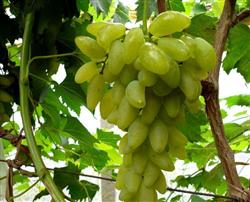
Golden Finger grape belongs to the European-American hybrid group. The clusters are enormous, long conical in shape, moderately loose or tight, with an average cluster weight of 750 grams and a maximum cluster weight of 1500 grams. The berries are uniquely shaped and attractive, long oval, slightly curved, bow-shaped, yellow-white in color, with an average berry weight of 10 grams; treated once with a swelling agent, the average berry weight is 13 grams, and the maximum berry weight is 20 grams. The skin is moderately thick, highly flexible, and does not split. The flesh is firm and can be sliced, stores and ships well, has a sugar content of 20%-22%, is sweet and refreshing, with a rich sugary taste and a milky flavor. The stalk attaches firmly to the berry; Pinching one berry can lift the entire cluster.
The Golden Finger grape variety has a well-developed root system and moderate to slightly vigorous growth. It ripens in mid-to-late July, 15-20 days earlier than Kyoho. It has strong cold resistance; mature canes can withstand low temperatures of about -18°C. It has strong disease resistance; following the conventional control methods for Kyoho-series varieties, no pests or diseases occur. It has strong resistance to waterlogging and drought, and does not have strict requirements for soil or environment. It can be cultivated in all grape-producing regions nationwide, and its economic benefits are very high.
Golden Finger grape starts bearing fruit early. In the second year after planting, the proportion of fruiting plants reaches over 90%, with strong fruiting capacity and a yield of about 1500 kilograms per mu. Three-year-old vines have an average budbreak rate of 85%, a fruiting cane rate of 98%, and an average of 1.8 clusters per fruiting cane. The fruiting capacity of secondary shoots is moderate. It buds on April 7, flowers on May 23, and the fruit ripens in early August, 10-15 days earlier than Kyoho, making it a mid-early ripening variety.
Stress resistance and adaptability of Golden Finger grape. It has strong cold resistance; mature canes can withstand low temperatures of about -18°C. It has strong disease resistance; following the conventional control methods for Kyoho-series varieties, no pests or diseases occur. It has strong resistance to waterlogging and drought, and does not have strict requirements for soil or environment. It can be cultivated in all grape-producing regions nationwide.
Key points for cultivation and management of Golden Finger grapes:
Golden Finger grapes are best cultivated using a Y-shaped trellis. The Y-shaped trellis uses wide and narrow row planting, with wide rows of 2.5-2.8 m, narrow rows of 0.2 m, and plant spacing of 1 m, planting 400-500 plants per mu.
Management point one, timely pinching:
Young Golden Finger grapevines are prone to excessive vegetative growth, and the flower clusters are relatively small, so pinching should be done early, heavily, and skillfully. When new shoots grow to 60-70 cm, pinch back to 50 cm. Three days later, remove the top secondary shoot; pinch the remaining secondary shoots leaving 1 leaf each, and at the same time remove the secondary shoots and winter buds above them. After 15 days, the top winter bud germinates; when it grows to about 80 cm, pinch back to 60 cm, remove all secondary shoots, and after the winter buds on it germinate, pinch repeatedly leaving 1 leaf each, while the top shoot is pinched repeatedly leaving 2 leaves each.
Management point two, scientific thinning of fruit:
In order to achieve the goal of producing high-quality and high-efficiency grapes, cluster trimming and berry thinning are an indispensable step. Remove secondary clusters before flowering, pinch off the cluster tip when flowers appear, and after physiological fruit drop, when berry sizes become distinct, carry out cluster trimming and berry thinning at the same time. Make the cluster shape neat, then thin out diseased berries, small berries, and overly dense berries.
Management point three, retaining clusters according to the vine:
Excessive yield not only affects quality and delays ripening, but also easily causes premature aging of the vine. In production, the vine's load must be strictly controlled. Under normal management conditions, vigorous fruiting canes can retain 1-2 clusters, moderate canes retain only 1 cluster, and weak canes retain no fruit.
Management point four, bagging the fruit clusters:
Bagging is one of the best ways to obtain fresh, high-quality, pollution-free fruit. It has become an indispensable step in producing premium grapes. Bagging fruit clusters can effectively reduce damage from fruit pests and diseases, reduce the number of pesticide applications, lower pesticide residues, improve fruit quality, and increase commercial value.
Management point five, pest and disease control:
Golden Finger grapes have relatively strong disease resistance, so the control methods for Kyoho grapes can be used as a reference. Because the sugar content is too high, attention should be paid to damage from birds and bees.
Click to get more grape cultivation techniques
Click to get more fruit cultivation techniques