Where can I find a complete guide to Summer Black grape growing techniques?
What are the advantages of Summer Black grapes? How do you manage Summer Black grapes well? Where is the complete guide to Summer Black grape growing techniques? I'd also like guidance from fellow growers. Summer Black grape, also known as Summer Black seedless and Oriental Black Pearl, is an excellent variety that combines many advantages: disease resistance, high yield, extremely early ripening, easy coloring, good storage and transport tolerance,...
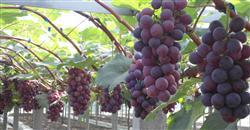 What are the advantages of Summer Black grapes? How do you manage Summer Black grapes well? Where is the complete guide to Summer Black grape growing techniques? I'd also like guidance from fellow growers.
Summer Black grape, also known as Summer Black seedless and Oriental Black Pearl, is an excellent variety that combines many advantages: disease resistance, high yield, extremely early ripening, easy coloring, good storage and transport tolerance, high sugar content and good flavor. Zhongdiwang has compiled the growing techniques and management methods for Summer Black grapes, listed below for fellow growers' reference.
Advantages of Summer Black grapes:
Advantage one:The clusters of Summer Black grapes are conical or cylindrical. After hormone treatment, clusters generally weigh 600-900 g, with a maximum weight of 1600 g. The berries are round, tightly set and neatly arranged, reaching 8-10 g after enlargement. With cluster thinning combined with sufficient fertilizer and water applied at the two enlargement stages, the average berry weight can reach 10-11 g.
Advantage two:Summer Black grapes have strong stress resistance and good storage and transport tolerance. Summer Black's growth habit is similar to Kyoho. Grown in the same vineyard as Kyoho, Fujiminori, Takatsuma and Giant Rose, its resistance is superior to those varieties but slightly inferior to Xiangyue. Summer Black has thick skin, so the berries are not easily split by compression during transport. Its sugar content is high, making it more tolerant of storage and transport than ordinary varieties. In addition, after the fruit ripens, it can remain on the vine for more than 60 days without cracking, berry drop or color change.
Advantage three:Summer Black grapes have good and stable flower bud differentiation, with a bud burst rate above 85%. Each fruiting shoot averages 1.5 clusters. If the vineyard is established in the first year, it can enter production in the second year, with a maximum yield of up to 2250 kg per 667 sq m.
Advantage four:Summer Black grapes are extremely early ripening, easy to color and high in sugar. Summer Black takes 100-105 days from bud break to full fruit maturity. Combined with spraying acidic pesticides, spray 3-5 applications of foliar fertilizer containing medium and trace elements. After the fruit begins to soften, spray once more with a grape early-ripening, sugar-increasing and coloring agent, and it will come to market 7-10 days earlier, greatly increasing its commercial value.
Many grape varieties delay harvest because coloring is difficult or uneven, which affects commercial value. Summer Black is different: once the berries soften, they color quickly and evenly. At present, early-ripening grapes mostly have a sugar content of 15-18 degrees, while those sold on the market, including Kyoho, are mostly 13-15 degrees with ordinary flavor. Under ordinary management, Summer Black can reach 20-22 degrees, with a maximum of 24 degrees. Many people call Summer Black "super sweet grape."
Key points for growing and managing Summer Black grapes:
Growing methods for Summer Black grapes:
Summer Black grapes are best grown on a trellis system with natural fan-shaped pruning, with row spacing of 1.7 m, plant spacing of 0.8 m, and 500 plants per 667 sq m. In areas requiring soil mounding for winter protection, row spacing can be 2 m, plant spacing 0.8 m, and 420 plants per 667 sq m.
In areas with frequent rain, the first wire above ground should be more than 80 cm above the ground to prevent rain-splashed mud and sand from contaminating the fruit surface. This trellis style helps make full use of land, wind and light, and is especially conducive to early high yields. Under ordinary management, the yield per 667 sq m can reach more than 2000 kg in the second year.
Management point one: timely cluster trimming and berry thinning:
Summer Black grape clusters are neat, mostly without shouldered branches, with occasional double clusters. It is recommended to remove one of any double clusters. For overly long clusters, pinch off 1/5-1/4 of the cluster tip 10 days before flowering. On average, leave only 1 cluster per fruiting shoot. In practice, follow the principle of "strong shoots two, medium shoots one, weak shoots none," that is, vigorous shoots at the upper end (front end) of the trellis may retain 2 clusters as appropriate, medium-vigor new shoots retain 1 cluster, and weak shoots and training shoots retain no fruit clusters. Leave a total of about 4000 clusters per 667 sq m.
Summer Black berries are tightly set, so berry thinning is recommended. Manual thinning takes too much time, so at full bloom and fruit set you may lightly irrigate with a small amount of water, or, when spraying fungicides, deliberately spray the clusters to encourage moderate flower and fruit drop. Alternatively, at full bloom and fruit set, gently shaking or striking the vine can also help thin flowers and fruit.
Management point two: timely enlargement treatment of the clusters:
Because consumers in the domestic grape market still prefer large berries. Enlarging grape berries helps increase yield and raise commercial value. Summer Black grapes grown naturally have small berries, which is common to seedless grapes, so enlargement treatment is recommended. That is, 15 days after petal fall, dip or spray the clusters with 45-50 mg/kg gibberellin solution, and repeat once after 12-15 days. Or, when the berries are the size of soybean grains, use 45 mg/kg gibberellin solution, with 10 ml of forchlorfenuron per 1-1.5 kg plus Gaoshou (a stem-hardening inhibitor) to spray or dip the clusters, once only.
Management point three: bagging the grape clusters:
Bagging grapes has many benefits: preventing disease, insect pests, bird damage and contamination, and protecting yield and quality. The berries produced are not only attractive but also good in flavor. Whether for field production or greenhouse cultivation, it is recommended to bag all clusters.
Management point four: fertilizing and watering Summer Black grapes:
In Summer Black grape production, it is recommended to apply heavy amounts of organic fertilizer. When establishing the planting site, apply 5000 kg of organic fertilizer per 667 sq m. Thereafter, every other year, extend outward along one side of the planting trench, open a trench and apply organic fertilizer once, applying 4000-5000 kg per 667 sq m.
In spring, apply 1 application of quick-acting nitrogen fertilizer to the grapes to promote bud break and encourage large clusters. Apply 1 application of a high-nitrogen three-element fertilizer as the enlargement fertilizer. Apply 1 application of potassium fertilizer before the fruit ripens. The amount of fertilizer cannot be generalized and should be determined according to soil fertility, yield and vine vigor.
Management point five: winter pruning:
Winter pruning is very important and directly affects the next year's grape yield. Summer Black grapes have good flower bud differentiation, a high bud burst rate and a high rate of fruiting shoots. Therefore, for ordinary vine vigor, mainly use short-cane pruning, while vigorous shoots may be pruned to medium canes. For mature vineyards trained in a natural fan shape on a trellis, it is recommended to leave 1500-1800 fruiting units per 667 sq m.
Click to get more grape growing techniques
Click to get more fruit growing techniques