Detailed Explanation of a New Method for Summer and Autumn Pruning of Apple Trees
I. Summer pruning methods. Summer pruning of apple trees mainly includes opening the branch angle, thinning branches, twisting shoots, bending and softening branches, ring cutting and ring barking, etc. Proper application of summer pruning measures is a prerequisite for high yield and quality of fruit trees. If used improperly, it will affect the growth and fruiting of the fruit trees. 1. Opening the angle: For scaffold branches with a relatively small angle...
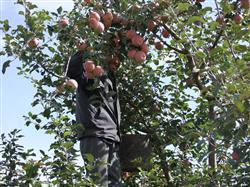 There are many methods for summer and autumn pruning of apple trees, but they are often rather complicated, making them difficult for fruit growers to master and apply. However, using the segmented branch-twisting technique instead of other traditional complicated techniques such as ring barking, ring cutting, branch pulling, and bud notching can also achieve the effect of keeping the apple tree's vigor moderate and robust, reducing pests and diseases, and producing strings of premium fruit year after year. The specific method is as follows:
I. The principle of branch twisting
By performing segmented twisting on strong or falsely vigorous branches, especially slanted branches on the upper side of limbs, the branch tissue structure is disrupted and the tree's supply of energy to the twisted branch is reduced, thereby inhibiting its vegetative growth. At the same time, the nutrients produced by photosynthesis are also effectively intercepted, forcing nutrient accumulation, which plays multiple roles in inhibiting vegetative growth, promoting reproductive growth, and balancing growth. This conforms to the growth and fruiting habits of fruit trees: branches extend, branches are robust, ventilation and light penetration are good, nutrition is balanced, and the produced fruit is large and brightly colored.
II. The effects of branch twisting
Using segmented twisting on strong vigorous shoots of the current year or secondary shoots on fruit spurs can replace complicated summer pruning techniques such as bud notching, pinching, and hat pruning. If carried out before mid-June, it also has the effect of forming high-quality flower buds in the same year and promoting fruit enlargement; for perennial branches, using segmented twisting at the 30-50 cm section at the base where strong and weak parts meet has the further effects of promoting branching at the base, forming flowers toward the rear, and reducing pests and diseases.
III. The results of branch twisting
Many years of production practice have shown that after the twisted branches bear fruit and droop, one can not only obtain the effects of early fruiting, high yield, and high quality, but also achieve the goal of simplified cultivation and the production of premium high-grade fruit, while also reducing premature leaf drop.
IV. The targets of branch twisting
Perennial branches that bear little fruit and whose branches do not easily droop after fruiting, as well as lignified vigorous shoots of the current year or vigorous secondary shoots on fruit spurs, can all be treated with the multi-segment branch-twisting method.
V. The timing of branch twisting
Roughly speaking, it can be done throughout the entire growing season. Strictly speaking, it is divided into three times, namely: before and after bud break, from May to mid-June, and from August to mid-September. Experiments have shown that as long as organic apple fertilization standards are strictly followed and Aiduoshou is sprayed on the trees for regulation, as long as each demonstration orchard continuously uses branch twisting for 1-2 years, afterward almost no branch twisting is needed, making it simple and highly efficient.
VI. The location and angle of branch twisting
Generally, branch twisting is performed at the junction where the branch transitions from strong to weak, twisting the vigorous branch 180 degrees.
VII. The method of branch twisting
1. For branches twisted from the base, twist toward whichever side has space; for upright branches or side branches that are too thick, you can first loosen the branch from the base, then use the left thumb to press upward along the branch on the outer side of the branch being twisted, with the other four fingers tightly gripping the base. At a position about 33 cm from the base, use the right thumb to press downward along the branch, facing the direction of the left thumb tip, with the other fingers tightly gripping the middle of the branch being twisted. Both hands apply force simultaneously, rotating in the same direction, pressing downward while rotating clockwise. The downward-pressing angle is 90-120 degrees, and the rotation angle is always 180 degrees. In this way, an upright vigorous branch on the upper side of a limb can be turned into a semi-lateral drooping state. When twisting from the base, the effect should be that the base cracks but does not break. During the twisting process, when a crisp "pop" sound is heard and a 3-5 cm crack along the branch appears at the base, the branch-twisting effect has been achieved.
2. For slanted vigorous branches, starting from 15-25 cm above the base, perform branch twisting once every 15-20 cm, twisting to a semi-lateral or semi-drooping state.
3. For lateral branches that are strong at the front and weak at the rear, twist at the junction where strong and weak parts meet, twisting until the sunny and shady sides are swapped in position.