How to cultivate large cherries for early high yield and quality? Detailed explanation of key technical points
For a long time, people have generally believed that large cherries bear fruit late and have low yields, and that they cannot be cultivated for early high yield like other fruit trees. In fact, this is merely an illusion caused by the long-term use of traditional cultivation and management techniques. Since the late 1990s, our county has adopted the free spindle training system, combined with spring bud notching, autumn branch bending,...
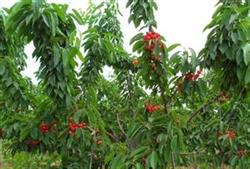
For a long time, people have generally believed that large cherries bear fruit late and have low yields, and that they cannot be cultivated for early high yield like other fruit trees. In fact, this is merely an illusion caused by the long-term use of traditional cultivation and management techniques. Since the late 1990s, our county has adopted the free spindle training system, combined with spring bud notching, autumn branch bending, summer girdling, growth inhibitor application, heavy pinching of young shoots, increased application of phosphorus and potassium fertilizers and other measures, making early high yield of large cherries a reality: fruit set in the 3rd year after planting, a yield of 500 kg per 667 sq m in the 4th year, and an average yield of 2050 kg per 667 sq m in the 6th year. The key cultivation techniques are summarized as follows.
1 Selection of nursery stock and planting
1.1 Selection of nursery stock Select 2-year-old seedlings with a basal diameter of no less than 1 cm and an intact root system. The ratio of main cultivars to pollinator cultivars shall be no less than 7:3.
1.2 Planting density Under normal circumstances, where the soil layer is deep and soil fertility is relatively high, a spacing of 3 m x 4 m or 4 m x 5 m between plants and rows is appropriate; for plots with a thinner soil layer and poorer fertility, the planting density may be appropriately increased.
1.3 Planting technique Before planting, dig large holes 1 m square and 0.6-1 m deep. When backfilling, apply 25-50 kg of farmyard manure and 0.5 kg of compound fertilizer specially for fruit trees per hole, mix evenly and fill into the bottom of the hole. Within the 30 cm soil layer from the ground surface, fill only with topsoil, then irrigate thoroughly to settle the soil. When planting, dig a small hole, hold the seedling upright, and spread the root system out, then firm the soil and water. Cover with 1 sq m of plastic film.
2 Soil, fertilizer and water management
2.1 Deep plowing and inter-row cultivation and weeding Deep plowing is carried out in combination with autumn application of base fertilizer, to a depth of about 60 cm. For trees that have already set fruit, the area of a single deep plowing should not be too large; it should be widened and deepened year by year. Carry out inter-row cultivation and weeding 3-4 times each year.
2.2 Rational fertilization For young trees and trees in the initial fruiting stage, apply 30-60 kg of organic fertilizer per tree per year, mixed with 0.1-0.5 kg of ternary compound fertilizer per tree; for trees entering the full fruiting stage, calculate the application rate at a ratio of 3 kg of organic fertilizer per 1 kg of fruit produced, mixed with 1-1.5 kg of ternary compound fertilizer per tree. During the fruit enlargement stage and new shoot growth stage, spray 0.5% urea + 0.5% monopotassium phosphate.
2.3 Watering Water 3-5 times each year, namely pre-bloom water, fruit-forcing water, post-harvest water and freeze-up water. Each watering is carried out in combination with topdressing. For dryland orchards, 1-2 additional waterings may be given as appropriate. Pay attention to drainage during the rainy season.
3 Flower-promoting techniques
3.1 Bud notching Before bud break (March 8-25), use a small saw blade to make a horizontal cut half a circle around the bud at 0.2-0.5 cm above it, reaching the xylem. If too shallow, it has little effect on bud break; if too deep, healing is slow, gumming is likely, and after healing it is easily broken by wind.
3.2 Girdling May 6 to May 25 is the most suitable period. If girdling is too late, gumming is likely and the flower-forming effect is poor; if too early, it easily causes tree decline and a low fruit-setting rate. The girdling site should be at the base of a primary branch; the central leader must not be girdled, otherwise the tree is likely to die. The girdling width should be less than 0.5 cm, with 0.1-0.2 cm being appropriate.
3.3 Branch bending The suitable time for branch bending is from mid-August to mid-to-late September. The suitable angle for branch bending is 80-85 degrees; if too large, branches tend to droop after fruiting; if too small, it is not conducive to moderating tree vigor and flower formation. Autumn branch bending can both moderate tree vigor and promote short shoots, and also promote flower formation.
3.4 Multiple pinching Mainly carried out on young vigorous trees, the purpose is to control excessive shoot growth, increase branching order and shoot number, promote the transformation of shoot types, and accelerate crown expansion. If pinching is not done, when there are many long shoots on a primary branch, the leaf cluster shoots produced by bud notching at the rear will die in large numbers. For long shoots, carry out the first pinching in early-to-mid May when they grow to more than 10 cm, leaving 5-6 cm; for the secondary and tertiary shoots that subsequently sprout, pinch continuously each time leaving 4-5 leaves until growth stops.
3.5 Application of paclobutrazol Apply paclobutrazol to young vigorous cherry trees to control growth and promote flowering. The number of sprays depends on the tree's growth and development status; for vigorous-growing trees, spray 1-2 times: after mid-May, spray the new shoots on the outer periphery of the crown once with a 200-fold solution, and spray again half a month later. The first soil application may be carried out in mid-to-late March, or in September-October, generally applying 2-3 g of 15% paclobutrazol per tree. The application site is at the vertical projection of the new shoots on the outer periphery of the crown, applying it in a ring-shaped trench.
4 Flower and fruit management
4.1 Artificial pollination Either hand pollination or pollination with a pollinator can be used. For hand pollination, dip a brush or rubber tip in pollen and dab it onto the stigma of the flower. Generally, the 1st-2nd day after the flower opens is best.
4.2 Insect pollination The pollinating insect most used at present is the honeybee. In recent years, bumblebees have been used for pollination with excellent results, especially in protected cherry orchards. When bumblebees pollinate protected cherries, they can increase the fruit-setting rate, enlarge fruit size, and promote earlier fruit ripening.
4.3 Flower and fruit thinning Flower thinning is generally carried out before blooming, mainly removing small flower buds and deformed flower buds on weak slender branches, retaining 2-3 plump, healthy flower buds. Fruit thinning is generally carried out after the physiological fruit drop in mid-April. The degree of fruit thinning depends on tree vigor and fruit set. Generally, leaving 3-4 fruits per flower cluster bearing branch is sufficient, with a maximum of 4-5. When thinning fruit, remove small fruits, deformed fruits and poorly colored drooping fruits.
5 Pest and disease control
In our area, the main diseases of large cherries are gummosis, shot hole disease and leaf spot disease, and the main insect pests are spider mites, fruit tree leaf rollers, slug moths, caterpillars, and peach fruit moths.
Before bud break in spring, spray 1-2 times with 3-5 degree lime sulfur mixture. For spider mites, use nissol, saomangjing, azocyclotin, etc., used alternately. For shot hole disease, use mancozeb mixed with agricultural streptomycin for control. For fruit tree leaf rollers, peach fruit moths, slug moths, caterpillars, etc., spray pyrethroid pesticides for control. For slug moths, caterpillars and similar pests, remove and destroy the eggs (or insects) during the egg stage and before the larvae disperse.