How to scientifically prevent and control strawberry pests and diseases? A full analysis of methods and techniques
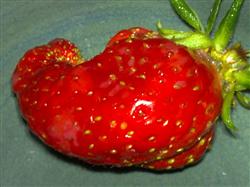
Under normal growth management of greenhouse-cultivated strawberries, deformed fruit accounts for 10%-20%. However, when varieties are improperly selected or the ecological environment does not meet the growth needs of strawberries, the proportion of deformed fruit often increases, sometimes reaching as high as about 50%, resulting in reduced yield and low returns. Common deformed fruits include crooked and flat fruit, plump fruit, aggregate fruit, protruding...
 Currently, it is a critical period for the growth of strawberry seedlings in the Beijing suburbs, and also a period when pests and diseases are prone to occur and break out frequently. To ensure the breeding of healthy seedlings free of pests and diseases, it is necessary to carry out monitoring and investigation of pest and disease occurrence at seedling breeding bases and to promptly carry out scientific prevention and control.
Investigations show that due to relatively high humidity inside the facilities, powdery mildew occurs widely in greenhouse strawberry seedling plots; due to recent continuous rainfall, strawberry anthracnose in open fields is in its initial stage and tends to develop further. In the prevention and control of powdery mildew at the strawberry seedling stage, because of the current situation of resistance to kresoxim-methyl, it is recommended that while paying attention to ventilation and humidity reduction, use 50% sulfur suspension concentrate at 200 times dilution, or 2% wuyiencin aqueous solution at 200 times dilution, or 30% triflumizole wettable powder at 2000 times dilution for foliar spraying, so as to avoid seedlings carrying pathogens as much as possible. In the prevention and control of strawberry anthracnose, it is recommended that where conditions permit, seedling fields can be covered with a shed and film for rain sheltering to reduce humidity, and shade nets can be used during high-temperature periods to lower the temperature. At the early stage of disease occurrence, 75% chlorothalonil wettable powder at 500 times dilution, or 50% prochloraz wettable powder at 1500 times dilution, or 70% mancozeb wettable powder at 500 times dilution can be selected for spraying or root drenching for prevention and control, spraying once about every 7 days for 3 to 4 consecutive sprays, and the chemicals should be used in rotation.