Detailed Explanation of Grapevine Cutting Propagation Techniques
Cutting propagation is the direct use of grapevine canes for cutting to cultivate seedlings. According to the different types of canes, cutting propagation can be divided into hardwood cuttings and green cuttings; hardwood cuttings are commonly used in production. (1) The principle of rooting from cuttings: The nodes or internodes of grapevine canes can all produce roots, and this kind of root is called an adventitious root. On grapevine canes...
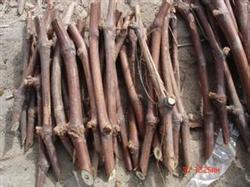
Cutting propagation is the direct use of grapevine canes for cutting to cultivate seedlings. According to the different types of canes, cutting propagation can be divided into hardwood cuttings and green cuttings; hardwood cuttings are commonly used in production.
(1) The principle of rooting from cuttings: The nodes or internodes of grapevine canes can all produce roots, and this kind of root is called an adventitious root. The occurrence of adventitious roots on grapevine canes is formed by the division of the central axis sheath cells at the junction of the cortex below the cane and the pith rays, rather than being produced from callus tissue. Therefore, in the practice of cutting propagation, it is often seen that the base of grape cuttings has not grown callus tissue, yet roots have emerged at the internodes or nodes. Although the formation of callus tissue has no direct relationship with the production of adventitious roots, the formation of callus tissue plays an important role in preventing pathogen invasion, protecting the cut from rotting, and preventing the loss of nutrients, and it creates conditions for root development.
There are more roots at the nodes of grapevine canes. This is because there are more nutrients stored in the diaphragm within the node, while rooting at the relatively diaphragm-less internodes is poorer. From the perspective of cane age, annual canes and young shoots root better, while perennial canes root poorly.
The internodes of grapevine canes cannot produce adventitious buds, so a cutting must have one plump bud. The roots of grapes cannot produce adventitious buds, so grapes cannot be propagated by root cuttings.
Grapevine canes sprout new shoots at their morphological apex and new roots at their morphological base. This phenomenon is called "polarity," and special attention must be paid during cutting to avoid inserting them upside down.
Different grape species have different abilities to regenerate adventitious roots. European grapes and American grapes root more easily than Amur grapes and muscadine grapes. Within the same species, different varieties also differ in how easily they root from cuttings. For example, among Kyoho-line varieties, Fujiminori is a variety that roots relatively poorly from cuttings.
The amount of stored nutrients in grapevine canes is closely related to rooting. Among nutrients, carbohydrates play an important role in root development (experiments have proven that when starch content in grape cuttings is high, rooting is good). Next, nitrogen compounds are also indispensable nutrients for root development. An appropriate amount of nitrogen nutrition is beneficial to cutting rooting, so fully matured and robust canes are the primary condition for good rooting.
(2) Collection and storage of cuttings. Cuttings should be collected from excellent plants (mother trees) that have already borne fruit and have pure varietal characteristics. Cuttings should not be collected from young trees that perform poorly, are severely damaged by diseases and pests, or have not yet borne fruit, in order to prevent deterioration of seedling quality and variety degeneration.
The collection of cuttings is generally carried out together with winter pruning. Select annual canes that are well developed, well matured, have short internodes, normal color, plump buds, and no damage from diseases or pests as cuttings. Cut them into cane sections 7-8 nodes long (about 50 cm), tie every 50-100 cuttings into 1 bundle, label the variety name and collection location, and place them in a storage trench for sand storage. The storage trench is set in a shady place with high, dry terrain. The trench depth is 60-80 cm, and the length and width depend on the number of stored canes. Before storage, first spread a layer of wet sand 10-15 cm thick on the bottom of the trench. Cuttings can be placed flat or upright, but each layer of canes should be covered with a layer of sand to reduce heat generated by cane respiration. If there is no sand, soil can also be used; the soil moisture should be about 10 percent, and fine soil should be used to fill between bundles. The number of layers of placed cuttings should preferably be 3; too many layers make inspection and management inconvenient and easily cause heating and mildew. In the middle of the cuttings, every about 2 m, erect an upright straw bundle to facilitate ventilation from top to bottom. After the canes are arranged, a layer of straw can be covered on top, and finally 20-30 cm of soil should be covered. In the cold regions of Northeast and North China, the thickness of the covering soil should be appropriately increased. During the storage period of cuttings, inspections should be made frequently to keep the temperature in the sand storage trench at about 1°C. Generally, it should not be higher than 5°C or lower than -3°C. If the temperature is too high, cane respiration increases, more nutrients are consumed, and mildew easily occurs; if the temperature is too low, the buds are susceptible to freezing damage. The humidity in the storage trench should also be suitable. If excessive humidity is found and the canes become moldy, promptly turn and air them, then store them again.