Applying phosphate fertilizer early and sufficient potassium fertilizer to pomelo trees can achieve high yields
Pomelo, also known as honey pomelo, has branches, leaves and fruits that are thicker, wider and larger than those of citrus. It has high yields per mu and requires large amounts of fertilizer, making it the "big eater" of the citrus family. The main pomelo production areas are mainly in South China, where the soil is severely deficient in potassium, and the application rate of potassium fertilizer is roughly the same as that of nitrogen fertilizer. For balanced fertilization of nitrogen, phosphorus and potassium in pomelo, it is necessary to control nitrogen fertilizer, apply phosphate fertilizer early, and apply...
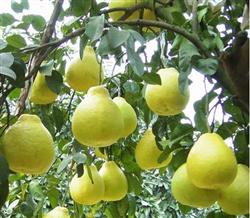
Pomelo, also known as honey pomelo, has branches, leaves and fruits that are thicker, wider and larger than those of citrus. It has high yields per mu and requires large amounts of fertilizer, making it the "big eater" of the citrus family. The main pomelo production areas are mainly in South China, where the soil is severely deficient in potassium, and the application rate of potassium fertilizer is roughly the same as that of nitrogen fertilizer. For balanced fertilization of nitrogen, phosphorus and potassium in pomelo, it is necessary to control nitrogen fertilizer, apply phosphate fertilizer early, and apply sufficient potassium fertilizer, which plays an important role in the taste of the product and high yields. In recent years, pomelo cultivation in China has developed rapidly, with planting plots using farmland and newly reclaimed sloping land. Newly reclaimed sloping land needs increased application of organic fertilizer and phosphorus-potassium fertilizer, and yields will only increase significantly after 2 to 3 years.
The annual yield per mu in the main pomelo production areas is generally 3500 to 4500 kg. At this yield level, the recommended fertilizer application rate per mu is: 1) Post-fruit fertilizer: compound fertilizer (15%-15%-15%) 75 to 100 kg, high-quality organic fertilizer 150 to 250 kg or farmyard manure 2 to 4 tons, applied in 2 to 3 split applications; 2) Pre-flowering fertilizer: urea 30 to 35 kg; 3) Fruit-swelling fertilizer: urea 25 to 30 kg, potassium chloride 35 to 40 kg, applied in 1 to 2 split applications. For higher yields, take the upper limit of fertilizer application; for lower yields, take the lower limit. There are mainly 5 fertilization periods for pomelo: post-fruit fertilizer, pre-shoot fertilizer, fruit-setting fertilizer, fruit expansion fertilizer, and fruit-swelling fertilizer. For sandy soil, apply 5 to 6 times; for clayey soil, apply 4 to 5 times. Too few fertilizer applications for pomelo can save labor, but it is prone to fertilizer deficiency; if the growth is weak, additional fruit expansion fertilizer can be applied.
For fertilizing pomelo trees on sloping land, use ring-shaped hole application or trench application near the drip line of the outer canopy; for flatland orchards, use strip application. The depth of the trenches is all about 30 cm, and the fertilizer should be kept at a distance of about 5 cm from the root system. After fertilization, backfill with soil and water promptly to avoid damaging the roots. For magnesium deficiency in pomelo trees, apply magnesium sulfate or potassium magnesium sulfate; for calcium deficiency, apply gypsum or lime, at 15 to 20 kg per mu. Boron deficiency in pomelo trees often causes leaf stalks to crack easily and flowers to fail to set fruit. In the early growth stage, spray 0.2% boric acid solution 2 to 3 times per mu, with each application 10 to 15 days apart. Pruning and girdling techniques for pomelo trees should be done well; please consult experienced fruit growers or fruit tree technicians to ensure tree safety and fertilization effectiveness.