Secrets to Increasing Apricot Yields: Getting These Management Practices Right Is Key
"Yunda Whole-Tree Fruit" is a new special growth promoter for fruit trees and fruiting vegetables (such as tomatoes, eggplants, melons, etc.) that balances the shift from vegetative growth to reproductive growth. Its main features are: ① No phytotoxicity, leaving no residue in the fruit, achieving a pollution-free product and becoming a green, trusted product. ② Fast flower promotion, able to quickly...
"Yunda Whole-Tree Fruit" is a new special growth promoter for fruit trees and fruiting vegetables (such as tomatoes, eggplants, melons, etc.) that balances the shift from vegetative growth to reproductive growth. Its main features are: ① No phytotoxicity, leaving no residue in the fruit, achieving a pollution-free product and becoming a green, trusted product. ② Fast flower promotion, able to quickly reach the ideal yield. ③ Simple to use, can be applied alone or mixed with other pesticides. ④ Overall benefits are significantly improved, it can greatly save labor, and can reach the full-bearing period earlier, thereby achieving high and stable yields.
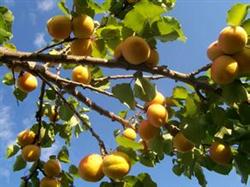
This year, a comparative trial of "Yunda Whole-Tree Fruit" was first carried out on apricot trees, with obvious results. For several years, apricot trees in Shenxian County have commonly shown late flowering, few fruit set, flowers all over the tree but only half a tree's worth of fruit, or even flowering without fruiting, which has seriously dampened farmers' enthusiasm for fruit tree production. Through research and analysis, the causes of this phenomenon are many. In addition to being related to the local microclimate and the level of cultivation techniques, the pollination step was neglected, leading to a serious imbalance between reproductive growth and vegetative growth. In addition, apricots flower early and are prone to frost damage, which affects pollination, and the proportion of complete flowers capable of pollination and fruiting in apricots is small. Many varieties cannot set fruit by self-pollination, and their flower organs and young fruit are extremely sensitive to damage from late spring cold and late frost. To solve the technical problem in the pollination step for apricot trees, we applied Yunda Technology Whole-Tree Fruit to apricot trees. On April 24, a trial was conducted in an apricot orchard in Suoding Village, Zhanglu Town. The weather was clear. From 8:30 to 10 a.m., Whole-Tree Fruit liquid was diluted with water to 1500 times and sprayed over the whole tree. In early May, fruit thinning was carried out once. In early June, the measured yield was 2600 kg/mu. In mid-June, after the whole orchard was harvested, the yield was 2390 kg/mu, the average single fruit weight was 106 g, the largest fruit was 161 g, and the output value per mu reached more than 4000 yuan. Practice has proved that Whole-Tree Fruit is indeed a good product for protecting flowers and fruit. Not only is the fruit set significantly increased, but the fruit is also large, sweet and fragrant, and of high quality. The fundamental reason why using Whole-Tree Fruit increases yield and quality is that the product regulates nutrient balance, causing vegetative growth and reproductive growth to balance, and can regulate the plant to actively shift toward the most active growing points (flowers and fruit), making flower buds develop robustly, reducing flower and fruit drop, and increasing the fruit-setting rate by 20%-30%.
The method of use is as follows:
1. In windless weather, spraying is generally best at 10 a.m. or after 4 p.m. If it rains within 6 hours after spraying, spray again.
2. For apricots, spray once with a 1500-times liquid at the flower bud stage, spray once at the same dilution at full bloom, with an interval of 7-10 days, spray once during fruit enlargement, and spray once about 20 days before harvest, with the same dosage as above.