Detailed Explanation of Key Techniques for High-Yield Cultivation of Quince
Quince is a plant of the genus Cydonia in the Rosaceae family and is an ancient local variety of Linyi. Its fruit is rich in nutrients and has high medicinal value. In 2003, Caozhuang Township introduced 1000 mu of quince, mainly varieties Luofu and Changjun. At present, the growth is good. Now China Agriculture Network introduces the key techniques for high-yield field cultivation of quince as follows...
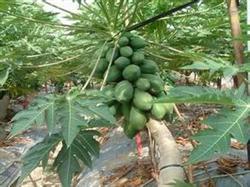
Quince is a plant of the genus Cydonia in the Rosaceae family and is an ancient local variety of Linyi. Its fruit is rich in nutrients and has high medicinal value. In 2003, Caozhuang Township introduced 1000 mu of quince, mainly varieties Luofu and Changjun. At present, the growth is good. Now China Agriculture Network introduces the key techniques for high-yield field cultivation of quince as follows:
1 Planting
Quince is suitable for close planting. On thin mountainous and hilly land, the spacing is generally 1.5-2 m x 3 m; on flat land with good fertilizer and water conditions, the spacing is preferably 2-3 m x 4-5 m; when intercropped with grain and vegetables, the spacing is preferably 3-5 m x 5-6 m. Quince can be planted in spring or autumn. After planting, the trunk can be headed at 70-80 cm above ground. During bud break, promptly remove root suckers and sprouts within 50 cm of the trunk base, and appropriately thin out overly dense new shoots.
2 Soil, Fertilizer and Water Management
Quince has strong adaptability, is not strict about site soil requirements, tolerates poor soil, is relatively tolerant of saline-alkali soil, and is not tolerant of waterlogging. In quince orchards, base fertilizer is mostly applied in autumn, and the amount of base fertilizer accounts for about 70% of the total annual application. Topdressing should be carried out during the period of maximum fertilizer efficiency according to the growth and fruiting status of the quince trees. Trees in full fruit period should be topdressed in time with pre-flowering fertilizer, post-flowering fertilizer, and fruit-swelling fertilizer. Before flowering, apply 0.2-0.3 kg of special fruit tree fertilizer per plant. At ordinary times, spray 0.2% urea and 0.2% potassium dihydrogen phosphate in combination with pest and disease control. During the fruit-swelling period, mainly apply phosphorus and potassium fertilizers. When applying base fertilizer in autumn, apply 10-15 kg of organic fertilizer per fruiting tree, mixed with 0.5-1.0 kg of ternary compound fertilizer; the fertilizer amount for young trees should be reduced accordingly. After fertilizing, irrigate thoroughly once, and pay attention to water control during the flowering period. In arid areas, after planting, the tree disk should be covered with plastic film or grass to preserve soil moisture.
3 Flower and Fruit Management
Quince has a high self-pollination fruit-setting rate and sets fruit easily. Releasing bees or artificial pollination during the flowering period can increase the fruit-setting rate. Quince fruit has a self-thinning phenomenon, and poorly pollinated fruit will drop automatically. Therefore, after fruit setting in early May each year, it is only necessary to thin small fruit and deformed fruit.
4 Training and Pruning
Grafted quince trees have a relatively upright central leader, and after slight pruning they can be trained into a cup shape, cylindrical shape, or slender spindle shape, mainly the slender spindle shape. Tree height is 2.1-2.3 m, crown diameter is 1.2-1.8 m, trunk height is 0.5-0.6 m. The trunk bears 8-12 alternately arranged main branches, with 20-30 cm between adjacent main branches, and each main branch bears 1-3 fruiting branch groups. Main branches should be gently laid out to promote the growth of medium and short branches. Pruning is mainly thinning. During the growing season, pay attention to cutting out competing branches with the central leader, upright vigorous water sprouts within the crown, overly dense branches, thin and weak branches, and pest- and disease-damaged branches. At positions lacking branches, leave 1-2 buds for heavy heading to promote branching. Aged fruiting branch groups should be retracted and renewed in time.
5 Pest and Disease Control
The main pests and diseases of quince include: leaf spot, ring rot, anthracnose, dry rot, aphids, red spiders, quince stem borer, peach fruit borer, pear psylla, slug moths, etc. Control methods: in early March, spray 3000-fold imidacloprid emulsifiable concentrate; in late May to early June and in early July, spray once each a mixture of 500-fold 30% Taoxiaoling emulsifiable concentrate and 600-800-fold 50% carbendazim wettable powder to control quince stem borer, slug moths, peach fruit borer, leaf spot, etc.; from late July to before leaf fall, at intervals of 20-25 days, alternately spray 800-fold 70% mancozeb solution, 600-800-fold 50% carbendazim wettable powder, equal-amount Bordeaux mixture, and other fungicides, for a total of 3-4 sprays. At the same time, pay attention to controlling various caterpillars, pear psylla, and other pests. After winter begins, clean up the orchard, sweep up fallen leaves, mummified fruit, and pest- and disease-damaged branches, and burn them in a centralized manner.