Detailed Explanation of Key Techniques for Papaya Cultivation and Management
1. Select excellent varieties. Varieties suitable for the local area include Yizhou papaya, Yipinhong papaya, etc., and they can pollinate each other. 2. Establish the orchard by planting. It is advisable to choose deep, fertile soil with good drainage, neutral or slightly alkaline loam or sandy loam. Plant spacing is 2.5 m x 4 m. Before planting, dig a planting hole 1 m long, 1 m wide, and 0.8 m deep...
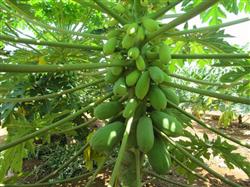
1. Select excellent varieties. Varieties suitable for the local area include Yizhou papaya, Yipinhong papaya, etc., and they can pollinate each other.
2. Establish the orchard by planting. It is advisable to choose deep, fertile soil with good drainage, neutral or slightly alkaline loam or sandy loam. Plant spacing is 2.5 m x 4 m. Before planting, dig a planting hole 1 m long, 1 m wide, and 0.8 m deep, and apply 10 kg of decomposed organic fertilizer per hole. Before planting, select strong 2-3 year old superior seedlings. Both spring and autumn planting are acceptable. Spring planting is best before the seedlings sprout, and autumn planting is carried out from leaf fall until the soil freezes. Autumn planting makes root wounds heal easily, gives a high survival rate, and produces good growth. When planting, select grafted seedlings with a height above 1.2 m, a graft union thickness above 1 cm, and good callusing at the graft union. The root system should be intact. The planting depth should be such that after planting and watering, the root crown junction is level with the ground surface, and cover the tree with 1 sq m of plastic film.
3. Fertilizer and water management. Apply base fertilizer in late September when deep digging the orchard, mainly farmyard manure and human feces and urine, mixed with quick-acting N fertilizer. Apply 15-30 kg of base fertilizer per young tree and 30-50 kg per mature tree.
Topdressing: before bud break (late March to early April), apply 130 g of urea and 400 g of ternary compound fertilizer per tree in holes or trenches. At 2 weeks before and after flowering, spray once each time a mixture of 0.3% urea, 1% superphosphate, and 0.3% potassium sulfate to promote fruit cell division. At full bloom, spray 0.2% boric acid or 0.3% borax to help fruit set. In mid-to-late May, apply 100-250 g of urea per fruiting tree as topdressing, either by ring broadcasting or by trench application. After fruit harvest, apply compound fertilizer mainly based on nitrogen fertilizer, 0.5 kg per tree.
Water management. Generally, irrigate once thoroughly before and after flower bud sprouting. During fruit enlargement and new shoot growth, irrigate appropriately. Before winter, irrigate once with anti-freezing water together with base fertilizer application. At the same time, papaya fears waterlogging, so drain water in a timely manner.
4. Training and pruning. For the natural round-headed form, the trunk height is set at 70-80 cm. From the new shoots it produces, select and retain 3-4 as main branches. The main branches should be arranged in 3-4 different directions, with 10-20 cm spacing between branches. Each main branch then produces 2-3 secondary branches, and from the outer side of the secondary branches, small secondary branches or fruiting mother branches and fruiting branch groups are produced.
Summer pruning: mainly adopt measures such as bud removal, pinching, and branch bending. Bud removal: promptly remove buds below the training zone, as well as upright buds on the upper side of main branches and competitive shoots on the tips of extension branches. Pinching: when the extension shoot of a main branch grows to 50-60 cm, pinch it to promote secondary shoots and train the main branch. For new shoots in other parts that are vigorous, upright, overlapping with main branches, or crossing, pinch when they reach 20 cm to promote secondary shoots. Branch bending: generally in late August and early September, bend flat the branches not retained as main branches and keep them as auxiliary nurturing branches.
Winter pruning: for young papaya trees, the purpose is shaping and expanding the canopy. In the first year's winter pruning, shorten the branches retained as main branches, preferably leaving 30-40 cm. For young trees, light pruning is the main approach, mainly thinning out overly dense branches, competitive branches, crossing branches, and overlapping branches. For branches with available space, shorten them, preferably leaving 20-30 cm. When they grow to 40 cm the next year, pinch them promptly to form fruiting branch groups.
5. Flower and fruit management. In order to obtain high and stable yields, suitable pollinizer trees need to be planted when establishing the orchard. The ratio of main cultivars to pollinizer cultivars is 4:1. Poor papaya management can lead to alternate bearing, so attention should be paid to flower and fruit management, and flowers and fruits should be thinned during the flowering period. Thinning flowers and fruits is especially important in an on-year. When thinning fruits, first remove tip fruits, deformed fruits, and crossing fruits, and generally retain basal fruits and middle fruits on the branches, with a fruit spacing of about 20 cm, so as to ensure large fruits, high yield, and stable yield.
6. Pest and disease control. Papaya has very few diseases, mainly insect pests. The main insect pests include aphids, papaya borers, and red spiders.
(1) In May, for pests such as aphids, spray 10% imidacloprid at 5000-6000 times dilution, once every 15 days, for 2-3 consecutive times. (2) In mid-June and late July, use Taoxiaoling or Taoxiao Yicijing at 1500-2000 times dilution to control papaya borers. (3) For red spiders, use 2000 times dilution of mie-saoli for control.