How to carry out soil testing and formulated fertilization for mango
The flowering and fruit-setting period of mango is an extremely critical period in mango production management. The management measures during its flowering and fruit-setting period include the following aspects: 1. Training of flowering branches and shoots. About 2 months before flower bud differentiation, remove overly dense branches, shaded weak branches, and diseased and pest-infested branches, leaving only 1-2 shoots per branch, which can increase the tree canopy's...
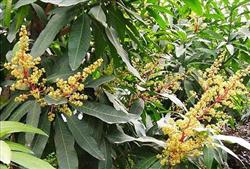 For every 1000 kg of fresh mango produced, 1.74 kg of N, 0.23 kg of P2O5, and 2.0 kg of K2O are required. The greatest demand is for potassium, followed by nitrogen and phosphorus. In production, nitrogen, phosphorus, and potassium fertilizers are generally applied according to N:P2O5:K2O = 1:0.5:0.5-1, but for mango trees of different tree ages, in different regions, and at different yield levels, the recommended fertilizer rates often vary greatly. The following is only a general description, and it should be appropriately adjusted according to local actual conditions when applied.
1. Fertilization for young trees
Fertilization for young mango trees focuses on promoting vegetative growth, making the root system well developed, increasing the number of branches, and expanding the canopy area, so as to create conditions for early fruiting and early high yield. Fertilization is mainly based on nitrogen and phosphorus, with appropriate application of potassium fertilizer, and as much organic fertilizer as possible, strengthening soil fertility building, and paying attention to the improvement of orchard soil, so as to lay the foundation for fruiting.
(1) Planting fertilizer
Planting fertilizer is mainly organic fertilizer, combined with a small amount of phosphate fertilizer, and applied into the planting hole. When the soil acidity is relatively high, lime should also be applied. Before fertilization, spread the lime evenly into the soil, then turn the soil so that the lime fully reacts with the soil. After an interval of 10-15 days, dig the holes, then apply organic fertilizer and plant.
(2) Topdressing
After young trees survive planting, topdressing should be applied in a timely manner. Topdressing is mainly based on quick-acting nitrogen and phosphorus fertilizers to promote early new root growth and the emergence of branches and shoots. After mango planting, new shoots begin to emerge after 1-2 months, and thereafter about 1 round of shoots emerges every 2 months. After each round of shoots, topdressing can be applied once. Within 1-2 years after planting, fertilization should be frequent and light. Each time, use 20 grams of urea per plant diluted in water or 5 kg of dilute manure water for drenching. As the tree age increases, the fertilization rate can be increased. Each time, use 40 grams of urea per plant diluted in water or 10 kg of dilute manure water for drenching. In the autumn of the second year after planting, in combination with hole expansion, apply organic fertilizer once, with 25-50 kg of organic fertilizer and 0.5-1 kg of phosphate fertilizer per plant, or 0.5 kg of compound fertilizer per plant. Thereafter, for each round of shoots, apply 0.1-0.15 kg of urea per plant and 0.2-0.3 kg of compound fertilizer per plant, either drenched with water or applied in shallow furrows.
2. Fertilization for fruiting trees
The purpose of fertilizing fruiting trees is to promote fruiting, increase yield and fruit quality, pay attention to adjusting tree nutrition, and maintain soil fertility. The amount, type, and timing of fertilizer application are all different from those for young trees.
Mango trees generally begin to bear fruit in the third year after planting and officially enter production in the fourth year. The recommended chemical fertilizer rate for fruiting mango trees is: in the 4th-5th year, apply per plant per year 0.4-0.5 kg of N (equivalent to 0.9-1.1 kg of urea), 0.25-0.3 kg of P2O5 (equivalent to 1.6-1.8 kg of calcium magnesium phosphate fertilizer), and 0.36-0.4 kg of K2O (equivalent to 0.6-0.7 kg of potassium chloride). After the tree is 6 years old, appropriately increase the application rates of N, P2O5, and K2O according to the yield per plant.
Fertilization for fruiting mango trees is mainly carried out in four periods.
(1) Flower-promoting fertilizer
The period 1 month before flowering is the flower bud differentiation period of mango. In Guangxi, the flower bud differentiation period of mango is generally in December. Fertilization before flower bud differentiation can promote flower bud differentiation. The fertilizer should be mainly quick-acting nitrogen and potassium fertilizers, with an amount of about 20% of the annual amount, applying 0.1-0.2 kg each of urea and potassium chloride per plant. (If phosphate fertilizer is applied as a single-element phosphate fertilizer, it can be applied together with this fertilization, generally 1.6-1.8 kg of calcium magnesium phosphate fertilizer per plant.) Foliar fertilization can also be combined, spraying with a 0.2-0.3% potassium dihydrogen phosphate solution until the leaf surface is covered with water droplets that are about to drip but have not yet dripped, for 2-3 consecutive sprays, with an interval of 7-10 days between each spray.
(2) Flower-strengthening fertilizer.
Mango trees have a large flowering quantity and consume much nutrition, so a topdressing of quick-acting nitrogen fertilizer should be applied once during the flowering period. The fertilization time depends on the tree vigor, plant condition, and weather. However, it must be applied at the right time, and it is suitable to begin fertilization when 50% of the terminal shoots of the plant show flower buds. Otherwise, if the tree is vigorous, the temperature rises, and fertilization is too early, it may induce the emergence of too many vegetative shoots or mixed flower shoots, reducing the number of flowers. For flower-strengthening fertilizer, urea or compound fertilizer can be selected, applying 0.1-0.15 kg of urea or compound fertilizer per plant, and foliar spraying of 0.1% borax and 0.2%-0.3% potassium dihydrogen phosphate solution can be combined.
If the flower-promoting fertilizer is applied sufficiently and the plant grows vigorously, this fertilization may be omitted.
(3) Fruit-strengthening fertilizer. About 30 days after flower drop is the period of rapid fruit growth and development. During the rapid enlargement of young fruit, fruit-strengthening fertilizer must be applied to meet the nutrient needs of fruit development. Generally, apply 0.3-0.4 kg of urea and 0.2-0.3 kg of potassium chloride per plant. (If phosphate fertilizer was not applied together with the flower-promoting fertilizer, 1.6-1.8 kg of calcium magnesium phosphate fertilizer can be applied together this time.) Foliar fertilization can be combined, spraying with a 0.2%-0.3% urea plus potassium dihydrogen phosphate solution until the leaf surface is covered with water droplets that are about to drip but have not yet dripped, for 2-3 consecutive sprays, with an interval of 7-10 days between each spray.
(4) Shoot-promoting and shoot-strengthening fertilizer before and after fruit harvest
Mango has a large fruit load and consumes much nutrition. If fertilizer is not supplied in time as a supplement, it will be difficult to restore tree vigor and affect the emergence of autumn shoots. Fertilization before and after fruit harvest is very critical, and it is better to apply it in two times. The first time, before and after fruit harvest, apply 0.2-0.3 kg of urea and 0.1-0.2 kg of potassium chloride per plant to promote the restoration of tree vigor and the emergence of autumn shoots as soon as possible. The second fertilization is when the last round of shoots begins to turn green. In combination with turning the soil and burying weeds, apply 25-50 kg of organic fertilizer and 0.5 kg of ternary compound fertilizer per plant. Foliar spraying of 0.3% potassium dihydrogen phosphate solution can be combined 1-2 times.
3. Fertilization methods
Soil fertilization mainly uses the ring trench and strip trench methods, with soil covering after application. (1) Ring trench fertilization: dig a ring-shaped or semi-ring-shaped trench outside the drip line of the canopy, 15-20 cm wide and deep. (2) Strip trench fertilization: each year, alternately dig two parallel strip trenches symmetrically outside the drip line of the canopy, 20-30 cm wide and deep, and when expanding holes and improving soil, the trench depth should be more than 60 cm.