Cultivation Techniques for Early Fruiting and High Yield of Navel Orange in the Third Year After Planting
Navel orange fertilization includes soil fertilization and foliar topdressing, with soil fertilization being the main method. (1) Soil fertilization: Soil fertilization should not only help the root system absorb nutrients as quickly as possible, but also prevent the root system from suffering fertilizer damage. Therefore, fertilization should be adapted to the time, the tree, and the fertilizer. Adhere to shallow application for shallow roots, deep application for deep roots, shallow application in spring and summer, and in autumn and winter...
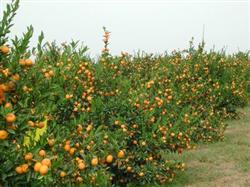 Before planting, navel orange seedlings must undergo careful land preparation, with large holes dug or trenches drawn, and sufficient base fertilizer applied. After the planted seedlings survive, the following measures are mainly used to promote fruiting and high yield in the third year.
Scientific fertilization. Navel orange seedlings planted in the current year generally survive in half a month. After survival, apply a quick-acting fertilizer once every half month, watering with dilute manure water or 0.5% urea. Alternatively, after rain, apply 25 grams of urea per plant under the tree base, then loosen the base to facilitate root absorption. After August, quick-acting fertilizer should no longer be applied, so as to avoid the emergence of late autumn shoots. In the second year, topdress 3 times, with heavy application of spring, summer, and autumn shoot fertilizers. Spring fertilizer in early February, summer fertilizer in early to mid-May, and autumn fertilizer in mid-to-late July, applying 0.2-0.4 jin of urea per plant each time. After the autumn shoots mature, expand the holes and heavily apply base fertilizer, applying 10-20 jin of barnyard manure, 2 jin of superphosphate, and 1 jin of compound fertilizer per plant. In the third year, as young trees begin to bear fruit, increase the application of phosphorus and potassium fertilizers and organic fertilizers to meet the needs of flower and fruit development. In early February, apply 0.4 jin of urea per plant as a bud-promoting fertilizer. At the same time, from April until early August, carry out foliar topdressing once about every 20 days, mainly with a mixture of 0.2% monopotassium phosphate + 0.3% urea + 0.2% borax + zinc sulfate, or a special microelement fertilizer. In early July, apply 2 jin of compound fertilizer per plant as a fruit-strengthening fertilizer, and in autumn apply a restorative fertilizer, gradually cultivating and managing according to the conventional fertilization methods for adult trees.
Reasonable shaping and pruning. Young trees must be trained into a good tree shape, and pruning shears should not be used indiscriminately. Generally, methods such as bud rubbing, shoot thinning, and heading back are used to promote the growth of more branches. Specific operation methods: In the first year, in principle, do not use pruning shears, only remove diseased and insect-damaged branches and dead branches. In the second year, leave a trunk of about 25 cm for the seedlings, and cultivate 3-4 evenly distributed main branches within the shaping zone above the trunk. Do two summer pruning operations. The first is in mid-May, cutting back one-third of the mature spring shoots on the outer canopy to promote vigorous summer shoots. The second is in mid-July, lightly pinching the mature summer shoots on the outer canopy. In mid-June, pinch the summer shoots after leaving 6-8 leaves, continuing until mid-July. For drooping branches and inner canopy branches, retain them as much as possible. For trees with a relatively dense canopy or one-sided excessive growth, use ropes to pull apart 2-4 main branches. In the second year, if there are flower buds, remove them promptly. In the third year, focus on flower thinning, thinning out leafless flowers and deformed flowers, cutting off diseased and dead branches, and at the same time adopting some fruit-preserving measures. The yield per plant is generally controlled at about 5 kg to 8 kg, and excess fruit should be removed.
Auxiliary management. After young seedlings are planted, rice and wheat straw should be used to cover the tree base in the current year, playing a role in moisture conservation and seedling protection. In winter, before the cold wave arrives, large convenient bags can be used to cover the seedlings, or rice straw can be used to cover the branches and a whitewashing agent applied to the trunk. Orchards are encouraged to intercrop leguminous crops or adopt orchard grass-growing methods. Pest and disease control is basically the same as for adult trees. In the third year, corresponding flower-thinning and fruit-preserving measures should be taken to ensure early high yield in that year.