Detailed Explanation of the Key Techniques for Skillful Lowering of Cherry Tomato Vines
Key points of early-stage management: Control watering before lowering the vines to reduce the water content in the stems and vines and enhance their toughness. Vine lowering should be done in the afternoon on a clear, warm day, when the stems and vines have low water content and soft tissues, making them easy to handle and avoiding and reducing stem damage during lowering. When lowering the vines, remove the old yellow leaves and diseased leaves on the lower part of the stems and vines, and take...
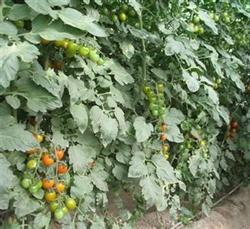
Key points of early-stage management
Control watering before lowering the vines to reduce the water content in the stems and vines and enhance their toughness. Vine lowering should be done in the afternoon on a clear, warm day, when the stems and vines have low water content and soft tissues, making them easy to handle and avoiding and reducing stem damage during lowering. When lowering the vines, remove the old yellow leaves and diseased leaves on the lower part of the stems and vines and take them outside the greenhouse or shed to be buried deeply or burned. All the fruit in that part should also be harvested to prevent the leaves and fruit from developing disease on the damp ground after vine lowering and forming a disease center. When the first inflorescence opens, begin trellising the vines. After the fruit of the first truss is completely harvested, when the first fruit of the second truss swells rapidly and the third truss has set, carry out the first vine lowering. After that, lower the vines once after each truss is harvested.
Use the method of cross-lowering vines between plants, that is, untie the plant from the string, remove the lower old leaves, gently twist the plant to the position of a nearby plant, and then trellis it again. Vine lowering should be done in an orderly manner in the same direction, gradually coiling along both sides of the cultivation ridge. When coiling the stems and vines, bend them along their natural curve; do not force bending or bend them in the opposite direction, so as to avoid twisting, cracking, or breaking the stems and vines. After each vine lowering, keep the leafy stems and vines about 15 cm from the ridge surface, and keep more than 20 functional leaves per plant. Pay attention that the tops of the stems of the front-row plants must not exceed those of the back rows, so as to avoid shading. Ensure the leaves are evenly distributed, always in the best position for three-dimensional light interception and in the best state of leaf area, with the leaf area coefficient maintained at 3-4. Lower the vines 5-6 times throughout the whole growth period.
Management after vine lowering
1. Temperature In the few days after pruning and vine lowering, appropriately raise the temperature inside the greenhouse or shed to promote healing of the wounds on the injured stems and vines. The daytime temperature should be kept at 20-25°C, and at about 15°C at night.
2. Spraying To prevent pathogens from invading through wounds on the stems, vines, and leaves, according to the common diseases of cherry tomatoes, after pruning and vine lowering, spray agents such as procymidone, gray mold control agent, chlorothalonil, and mancozeb to control leaf mold, gray mold, and early and late blight. When spraying, add Shiyu 101 foliar fertilizer to the pesticide, which can both prevent disease and increase yield.
3. Fertilizer and water management Although vine lowering can lower the fruiting position of the plant, it cannot shorten the actual distance between the fruiting part and the root system. In addition, as the vegetative mass becomes larger and larger, if the supply of fertilizer and water is insufficient, problems such as increasingly poor fruit quality and increasingly smaller fruit will occur. Therefore, sufficient fertilizer and water should be supplied to meet the growth needs of the plant. Topdressing should mainly be potassium fertilizer such as potassium sulfate, with 15-20 kg applied per mu each time, and watering should be carried out at the same time.
4. Removing side shoots and picking old leaves Train to a single stem, and remove other side shoots in time. After the fruit of each truss is picked, remove all the leaves below the truss. Leaves above the truss must not be removed, so as to ensure good development of the upper-layer fruit. Removing side shoots and picking old leaves should be done on sunny days to facilitate wound healing. When removing side shoots, the hand that breaks off the shoots should only touch the shoot and not the whole stem, so as to avoid spreading tobacco mosaic virus. When picking leaves, remove the leaves as close as possible to the branch or stem, and be careful not to leave the petiole, so as to avoid gray mold.