What are the methods for dragon fruit cultivation and management
The dragon fruit plant is currently entering its period of concentrated flowering. Its flowers generally begin to open 1 to 1.5 hours before sunset, and after daybreak the corolla gradually closes, withering after the sun rises. During this period, the flowers complete the process of self-fertilization. However, at present there is continuous heavy rain and torrential rain, and less sunlight; these factors have an effect on dragon fruit...
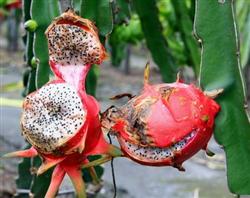 Dragon fruit is, in terms of consumer concept, a green and environmentally friendly fruit and a health food with certain therapeutic effects. In recent years, dragon fruit production in our city has developed very rapidly; by the end of 2007, the city's dragon fruit growing area had already reached 4500 mu. It can be foreseen that the dragon fruit industry will be a new type of modern agricultural project with comprehensive utilization, long market advantages and sustainable development. The dragon fruit cultivation techniques are introduced as follows:
1. Variety selection. Choose seedlings with pure variety characteristics (preferably the red-skin red-flesh type), with thick fleshy stems that have already grown a new stem segment full of flesh, with a complete and well-developed root system, free of pests and diseases, and with a seedling height of 40 cm or more for planting.
When planting the red-skin red-flesh type dragon fruit variety, a certain pollinating variety of the red-skin white-flesh type should be arranged, with the ratio of pollinating variety to main planted variety being 1:8.
2. Planting spacing and season. Before planting the seedlings, per mu, according to a plant and row spacing of 2 m x 3 m, erect 110 cement square posts of 10 x 10 x 200 cm, with the cement posts buried 50 cm into the soil, to support the dragon fruit branches as they climb; place a cement ring 50 to 60 cm in diameter on each cement post to support the branches. On each of two opposite sides of the cement post, dig one planting hole 10 cm deep and 20 cm long and wide; apply decomposed organic fertilizer mixed evenly with soil in the hole, and plant 4 plants beside each cement post.
Dragon fruit can be planted throughout the year; it is best to plant as early as possible and when there is time for growth and recovery after planting, generally from March to November is good, with a depth of 3 to 5 cm being suitable. Calculating 4 fruit seedlings planted beside each post, 440 plants can be planted per mu. In the early stage of planting, the soil should be kept moist; during continuous rainy weather, drainage should be carried out in time to avoid infection by pathogens causing stem flesh rot.
3. Field cultivation management. After planting, dragon fruit can flower and bear fruit after 16 months, and can flower 10 to 12 batches per year, with June to November being the fruiting period. In the third year after planting it enters the full fruiting period, and with a relatively high level of management the yield per mu can reach more than 2000 kg. Field cultivation management is divided into the following points:
1. Water and fertilizer management. In the early stage of dragon fruit planting, the soil should be kept moist, otherwise growth will be unfavorable. The dragon fruit root system is relatively shallow, so fertilizer should be applied in small amounts and many times to prevent root burn and root rot. After the planted seedlings sprout, fertilize 5 to 6 times per year, mainly with nitrogen fertilizer, specifically: apply dilute human and animal manure into the planting hole about 10 cm from the seedling, about 1 kg per plant; thereafter, at each sprouting, apply once human and animal manure with 0.3% urea and 0.1% potassium chloride added, until the dragon fruit flowers. In addition, in winter spread one application of decomposed organic fertilizer, about 10 kg per plant, to enhance the plant's heat preservation and cold resistance. After flowering and fruiting, fertilize 3 times per year, namely the pre-flowering fertilizer in April, the fruit-swelling fertilizer in August and the overwintering fertilizer in December, mainly with decomposed organic fertilizer and ternary compound fertilizer. In addition, during the flowering and fruiting period, increase the application of potassium fertilizer and magnesium fertilizer to promote sugar accumulation in the fruit and improve quality.
2. Pruning branches. Before the branches climb to the top of the cement post, let them maintain single-branch growth; when they grow to the top of the post (1.3 to 1.4 m), the growing tip should be pinched off to promote branching, and let the branches hang down naturally, accumulate nutrients, and flower and fruit earlier. Branches that have already borne relatively many fruits are less likely to form flowers again next year; through thinning and pruning, leave the large and strong branch at the base of that branch to ensure the fruiting yield of the coming year.
3. Interplanting and artificial pollination. When planting the red-flesh type dragon fruit, about 10% of the white-flesh type dragon fruit should be interplanted. Mutual pollination between varieties can significantly increase the fruit-setting rate. In rainy weather, artificial pollination should be carried out; pollination can be done in the evening when the flowers are open or in the early morning before the flowers have closed, using a writing brush to directly apply pollen onto the stigma of the female flower to increase the fruit-setting rate.
4. Flower thinning and fruit thinning. Dragon fruit has a long flowering period and strong flowering ability, and will flower from May to October. After normal pollination and fertilization, the withered flowers can be cut off by the ring-cutting method (keeping the stigma and the sepals below the ovary). When the young fruit reaches a transverse diameter of about 2 cm, begin fruit thinning, leaving one young fruit per branch that is plump, bright green in color, free of damage and deformity, and has a certain amount of growing space, and thinning out the rest, so as to concentrate nutrients and promote fruit growth.
5. Fruit bagging. Before the peel changes color, bag the fruit with old newspaper or kraft paper bags to keep the peel evenly colored, and prevent pecking by birds and yellow wasps as well as wind damage and direct sunlight exposure, improving commercial value.
6. Pest control. Dragon fruit basically has no special pests, occasionally there are nematodes in the roots and red spider mites on the stems and leaves, which can be controlled in time; during the seedling stage it is susceptible to harm by snails, which can be controlled with insecticides such as snail-killing agents; in hot and humid seasons it is susceptible to disease infection, with partial necrosis of the branch plant tissue and mildew spots appearing. Therefore, during continuous rainy weather, drainage should be carried out in time to avoid infection by pathogens causing stem flesh rot; using fungicidal pesticides can achieve good results.
7. Timely harvesting. Dragon fruit can generally be harvested about 45 days after flowering. Harvesting too late will not only cause fruit cracking, but also cause the peel to partially turn black, affecting commercial value. For fruit intended for long-distance transport or long storage, it should be harvested before the fruit softens and the color darkens.
Click to see more dragon fruit cultivation techniques
Click to see more fruit cultivation techniques