Pitaya Greenhouse Cultivation Methods and Key Technical Points
Pitaya, also known as cactus honey fruit, red dragon fruit, etc., is a perennial climbing succulent fruit. Pitaya originated in the tropical rainforests of the Americas and was later introduced to China. Greenhouse cultivation of pitaya has made "growing southern fruit in the north" a success. The following covers cutting propagation and seedling raising, management during growth and development stages, and greenhouse...
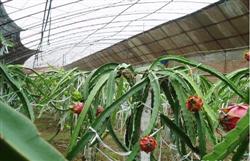 I. Construction of the Greenhouse
The greenhouse can use the "Langfang Type 40 Solar Greenhouse," which features high light transmittance, strong insulation, and low construction cost.
The greenhouse occupies 80 m east-west and 18 m north-south. A south-facing orientation with a 5° to 100° west deviation is favorable for light collection. The back wall of the greenhouse is 2.8 m high, 4.5 m wide at the base, 2 m wide at the top, with a 0.7 m base setback; the highest point of the east and west gable walls is 3.5 m, the wall thickness is 2 to 3 m, and the internal span of the greenhouse is 7.25 m. Wall construction can be done with machinery: after each 40 to 50 cm layer of soil is added, it is rolled 6 to 8 times, for about 4 to 5 layers of soil, then manually trimmed so that the inner wall is straight and level, the outer wall has a gentle slope, and the structure is solid and firm. Every 1.5 m, an iron arch beam is placed; the arch beams are mainly supported by the central post and front and rear anchor posts, with the rear roof projecting 0.8 m and an inclination angle of 45°. On the east and west sides of the greenhouse, 1.2 m deep anchor trenches are dug, with 23 anchors on each side; 23 runs of No. 8 galvanized wire are used front and back to form a harp-string-style tension line, of which 16 runs are on the front slope and 7 runs on the rear slope. The rear slope is covered with 30 cm of corn stalks, and 30 cm of soil is placed over the corn stalks. On the front slope, 7 m bamboo poles are fixed on the harp-string tension lines as arch rods, then covered with polyvinyl chloride drip-free film, then pressed tight with film-pressing lines. In early winter, 4 cm thick straw mats are laid, with a coverage rate of 150%; in January and February, 4 layers of kraft paper are added, with a coverage rate of 110%. On snowy days, an additional layer of old film should be placed over the straw mats to prevent the mats from becoming too wet and affecting insulation.
II. Seedling Planting
Pitaya belongs to the climbing cactus family, and when cultivated artificially it must be provided with a trellis to climb on. First, inside the greenhouse, at a plant spacing of 1.2 m and row spacing of 1.5 m, 305 cement posts 1.3 m high are set, and 2 pitaya seedlings are planted at each cement post. Before planting, each greenhouse is applied with 12 cubic meters of coarse manure and 50 kg of diammonium phosphate as base fertilizer, and after planting, sufficient planting water is applied.
III. Cultivation Management
1. Watering
Pitaya is a drought-tolerant plant. Generally, normal growth can occur when the relative soil moisture content reaches 70% to 80%, but it has poor waterlogging tolerance. If water accumulates at the roots for a long time, it will cause root rot, leading to reduced yield or death. When watering, grasp the principle of not watering if the soil is not dry, and watering thoroughly once you do. In addition, during the growth process, do not water before the fruit has set; wait until the fruit grows to the size of an egg before watering. Under normal circumstances, watering once every 15 to 20 d is appropriate.
2. Fertilizing
Because pitaya grows vigorously and fruits year-round, it requires more fertilizer. To ensure fruit quality and yield, fertilization must adhere to the principle of mainly organic fertilizer, supplemented by chemical fertilizer.
When sufficient base fertilizer has been applied, after entering the fruiting stage, apply a top dressing once every 15 to 20 d, paying attention to alternating organic fertilizer and chemical fertilizer. Pay attention to balanced fertilization, ensuring complete nutrients and fully meeting the plant's needs for various nutrients. There are many top-dressing methods, including ring-shaped top dressing, radial top dressing, irrigation-type top dressing, and foliar top dressing.
The root system of pitaya differs from that of other fruit trees. It does not have a strong main root but is a fibrous root system, and the roots are very shallow, basically distributed in the surface layer of the soil. Therefore, when applying top dressing, special care should be taken not to damage the roots.
3. Pruning
After pitaya seedlings are planted, they can sprout and grow rapidly in about 15 to 20 d. During growth, many buds will emerge, forming disorderly side branches. If not pruned in time, this will affect the normal growth of the plant.
When pruning pitaya, keep only 1 main stem and cut off all other side branches to ensure the normal growth of the main stem. When the main stem reaches 1.3 to 1.5 m high (when cultivated as a potted flower, the main stem height should be about 1 m), top it to force it to produce side branches; these side branches are the fruiting branches. According to the plant's growth condition and environmental conditions, about 20 fruiting branches can be kept per plant. It is appropriate to keep 3 fruits per fruiting branch. If the fruit-setting distance is less than 15 cm, one weak fruit can be removed to ensure the normal growth of the other fruits. After entering the full fruiting stage, all branches that have already borne fruit should be cut off to reduce nutrient consumption.
IV. Pest and Disease Control
Pitaya is in a wild state in its place of origin and has strong resistance to pests and diseases. After being introduced to China for cultivation, no serious pests or diseases have been found, but snails and slugs often gnaw on its tender branches, affecting pitaya growth. Generally, spreading lime can be used for control; if the pest density is high, poison bait can also be used to trap and kill them.
When the fruit ripens, fruit flies often lay eggs inside the fruit skin, causing fruit cracking and rotting. The control method is to hang flypaper on the branches and trunk to trap and kill adult flies, or use the biological pesticide "Qianchongke" 800-fold solution spray, which also has a relatively ideal effect.
Click to see more pitaya cultivation techniques
Click to see more fruit cultivation techniques