How to cultivate dragon fruit for high yield? Key planting techniques
Dragon fruit, also known as red dragon fruit and cactus honey fruit, is a plant of the genus Hylocereus in the cactus family, native to Mexico and other Central American regions. It is now widely cultivated in Taiwan, China and the mainland region of China. Dragon fruit is brightly colored and rich in nutrients, containing multiple vitamins, amino acids and minerals. Eating its fruit has obvious effects such as lowering blood pressure, lowering blood lipids...
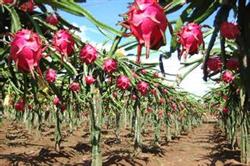
Dragon fruit, also known as red dragon fruit and cactus honey fruit, is a plant of the genus Hylocereus in the cactus family, native to Mexico and other Central American regions. It is now widely cultivated in Taiwan, China and the mainland region of China. Dragon fruit is brightly colored and rich in nutrients, containing multiple vitamins, amino acids and minerals. Eating its fruit has obvious effects such as lowering blood pressure, lowering blood lipids, promoting diuresis and reducing internal heat. It is one of the few nutritious and health-promoting green foods on the market today.
I. Growth habits of dragon fruit
The best period for natural growth and sprouting of dragon fruit plants is from October each year to May of the following year, but cuttings can be taken throughout the year. Seedlings planted in January that have already rooted and sprouted will flower and fruit by July to August as long as the roots and stems are vigorous enough. Under normal temperature conditions, flowering and fruiting generally begin in mid-April each year and the production period ends in November. More than 8 batches of fruit can be produced per year, with a maximum of four large batches, and an annual yield of more than 2500 kg per mu.
II. Production conditions for dragon fruit
1. Temperature: Dragon fruit originates from tropical and subtropical regions and is not cold-tolerant. If the temperature stays below 5°C for a long time, the leaves will be frostbitten, but this does not affect growth. Therefore, it is not suitable for planting in high-altitude cold mountainous areas and areas where frost occurs frequently.
2. Water: Dragon fruit is drought-tolerant and afraid of moisture. During cultivation, long-term water accumulation in the soil should be avoided, otherwise root rot and seedling death easily occur. Although it will not die from dew alone even during long droughts without rain, it cannot lack water during the growing period. Keeping the soil moist and breathable is beneficial to its growth.
3. Soil: Dragon fruit does not have high requirements for soil quality. It can be planted on flat land, hillside land, paddy fields and dry land. Sandy loam soil with good breathability and rich organic matter is most suitable.
III. Key cultivation techniques for dragon fruit
1. Variety selection: According to flesh color, dragon fruit varieties include red skin with white flesh, red skin with red flesh, and yellow skin with white flesh. For seedlings, branches that have already fruited with stable traits and high self-pollination fruit set, or rooted seedlings from cuttings, are preferable. In this region, red skin with white flesh is mainly planted.
2. Bed preparation and pillar erection: The bed width should be 3 m, bed height 0.3 m, and ditch depth 0.3 m. Reinforced concrete pillars or stone strips of 0.1 m x 0.1 m x 2.5 m should be used for the climbing vine branches. Stone pillars should be inserted 50 cm into the soil. Generally, the plant and row spacing for two stone pillars is 2.0 m x 3.0 m.
3. Planting density and method: When planting, plant 4-8 seedlings around the stone pillar, with the seedlings inserted slightly diagonally into the soil about 5 cm from the stone pillar to facilitate branch climbing. When planting, dig a ring ditch about 5 cm deep around the pillar, first broadcast 150 g of ternary compound fertilizer and mix it evenly with the soil, or apply decomposed human and animal manure, then place the seedlings in and cover with thin soil and press firmly, and finally water thoroughly to settle the roots.
4. Support at the top of the stone pillar: At the top of the concrete, steel bars with a diameter of 0.8 cm and a length of 85 cm can be welded at both ends, bent into hooks facing inward to form a cross support and fixed. Place a discarded bicycle tire on the cross frame to support more branches for extension, which is beneficial for flowering and fruiting.
5. Water management: After planting, water once every 3-5 days. After the plants survive, adjust the watering frequency according to actual needs. After the seedlings are established, regularly divert water for irrigation. Especially before topdressing, the whole orchard should be irrigated to keep the soil moist throughout the orchard.
6. Fertilizer management: After planting, fertilizer can be applied once the seedlings have survived. At the seedling stage, water-soluble fertilizer is better, applied thinly and frequently, twice a month, with the amount gradually increased. For mature plants (especially fruiting plants), heavy fertilizer should be applied in May each year, mainly phosphorus fertilizer supplemented by nitrogen fertilizer. Before each fruit harvest, phosphorus and potassium should also be the main nutrients. Generally, each application should be controlled at 40-50 kg of potassium sulfate per mu, 30-40 kg of calcium magnesium phosphate or superphosphate, applied by diverting water for irrigation and then broadcasting fertilizer on the bed surface. During the flowering and fruiting period, special attention should be paid to the supply of fertilizer and water, which is beneficial for large fruit and continuous flowering and fruiting.
7. Integrated control of pests, diseases and weeds: The orchard has shallow roots, so weeding is generally not carried out. Rice straw can be used as mulch to suppress weed growth. Pests and diseases rarely occur, so spraying is generally not needed. Only at the seedling stage should ants and snails be prevented, and lime can be broadcast on the ground surface for control.
8. Harvesting: For flowers that have been successfully pollinated, the fruit ovary noticeably enlarges on the 5th day, the fruit begins to turn red by the 25th day, and after another 5 days, when the fruit becomes glossy, it can be harvested. From flowering to fruit maturity generally takes 30-35 days, but in October, as the temperature decreases, the maturity period can be extended to about 40 days.
9. Branch pruning: After the production period ends each year, the fruiting branches of that year should be pruned off. Older branches and weak branches that are relatively shaded should also be pruned in time, which is beneficial for new branches to become more robust and lays a solid foundation for a high yield the following year. Pruning is suitable when the seedlings reach 1.2 m in height; the top of each plant should be pinched, and all other auxiliary branches should be removed. After 1.2 m, allow new branches to climb naturally. For branches with buds, depending on their strength, select and retain 2-3 strong flower buds in different directions. Five days after flowering, retain 1-2 fruits per branch and prune off all others. When the aerial roots of the branches are still young and weak and are easily blown away from the stone pillar by strong wind and rain, causing them to droop and break, the branches should be tied to the stone pillar in time with coarse cloth strips or plastic string.
Click to see more dragon fruit cultivation techniques
Click to see more fruit cultivation techniques