Introduction to Pitaya Cultivation Experience and Techniques
Meixian is a nationally famous hometown of golden pomelo, while pitaya is rarely grown in the region, making it scarce on the market and high in price. Developing pitaya cultivation has great potential, helps change the structure of the planting industry, and increases farmers' income. A farmer in Bingcun Town, Meixian, trial-planted 5 mu of pitaya in 2003, and the plants grew very well, with some bearing fruit that same year...
Meixian is a nationally famous hometown of golden pomelo, while pitaya is rarely grown in the region, making it scarce on the market and high in price. Developing pitaya cultivation has great potential, helps change the structure of the planting industry, and increases farmers' income.
A farmer in Bingcun Town, Meixian, trial-planted 5 mu of pitaya in 2003, and the plants grew very well, with some bearing fruit that same year. The cultivation techniques and management experience are summarized below.
1. Site selection and soil requirements:
The suitable growing temperature for pitaya is 25-35°C, and it can be planted anywhere south of the Tropic of Cancer. Planting requires selecting loose, fertile sandy loam soil with good aggregate structure, a pH value of 6-7.5, and good drainage.
2. Planting and support:
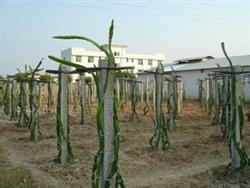
Pitaya can be planted in all four seasons of the year, but March to November is preferable. In terms of variety selection, excellent varieties such as Baiyulongguo and Zhulong can be chosen for the Meixian area, and grafted seedlings should be used. Interplanting two varieties can increase the fruit-setting rate. Before planting, cement poles must be erected as support for pitaya growth. The specifications of the cement poles are 10 cm x 10 cm x 210 cm, with steel bars inside the pole body and a pair of symmetrical small holes at the top for future use in setting up supports. The row spacing specifications for erecting cement poles are 2 m x 3 m, with 110 poles erected per mu. Each cement pole is buried 50 cm underground, with 160 cm above ground. Each mu of orchard is planted with 440 seedlings, with 1 seedling planted around each cement pole. After the fruit seedlings grow, they are tied to the cement poles to make them grow upward.
3. Fertilizer, water and soil management:
The root system of pitaya grows relatively shallow, and the roots 2-5 cm below the soil surface grow most actively, so fertilizer and water management and soil management should be carried out according to this characteristic. Pitaya is relatively drought-tolerant and intolerant of waterlogging, but its rapid growth still requires sufficient water, so it should be watered adequately by watering the roots, not by spraying the whole plant or flooding the field, as flooding can cause root oxygen deprivation and death. Fertilization is mainly based on decomposed farmyard manure, and the best formula is a 1:2:7 ratio of oil cake residue, chicken manure, and pig manure. The amount of fertilizer applied depends on the growth situation and soil fertility. During the stages of new branch growth and flowering and fruiting, quick-acting nitrogen, phosphorus, and potassium fertilizers can be applied as a supplementary dressing, mostly by drenching. After fruit setting, plants are generally fertilized 4 times in spring, summer, autumn, and winter, with the effects being promoting sprouting, promoting spring shoot growth, flowering and fruiting, and restoring vigor after harvest, respectively. The soil should be kept loose, and loosening the soil can be done together with fertilization and weeding, without damaging the root system. For the aerial roots on the aboveground part, measures such as guiding and tying can be used to lead them to the ground and allow them to take root in the soil, enhancing the plant's absorption function and promoting growth.
4. Training and pruning:
During the seedling stage of pitaya, one main branch is retained to grow upward, and other side branches are removed. After the fruit seedling grows along the cement pole to a height of 1.5 m, the top branches spread out in all directions in an umbrella shape. A steel wire is tied into a circle at the top of the cement pole for guiding, fixing, and supporting the plant. After the fruit seedlings grow vigorously, 2/3 of the branches are selected and guided downward as fruiting branches, while 1/3 of the branches grow upward as vegetative branches and backup fruiting branches. Old branches that have already borne fruit are gradually thinned out.
5. Pest and disease control:
Pitaya has relatively few pests and diseases and is an environmentally friendly green food. The main pests and diseases include: rot disease, termites, red and yellow spider mites, scale insects, etc. Among them, the more threatening one is rot disease, which is mainly caused by insect wounds or mechanical injuries. The treatment method is to cut off the diseased part with a knife or cut open the diseased part for drainage on a hot sunny day. For other pests and diseases, targeted pesticides can be selected for spraying control.
6. Harvest:
After the top branches droop and mature, the plant will bloom and bear fruit from April to November each year. After fruit setting, the fruit can mature and be picked in 35-45 days. The branches, fresh flowers, dried flowers, and fruits of pitaya can all be supplied to the market as commercial products.
Click to view more pitaya cultivation techniques
Click to view more fruit cultivation techniques