What are the control methods for the mango stem borer (Rhytidodera simulans)?
Distribution and damage: it occurs both domestically and abroad, with varying degrees of occurrence in Yunnan, Guangdong, Guangxi, Fujian and other areas of China. The larvae bore into and feed on the branches of fruit trees such as mango and cashew, usually entering through young branches and gradually boring downward into larger branches and the trunk, seriously affecting the growth vigor of the plant and ultimately causing the death of the entire plant....
Distribution and damage: it occurs both domestically and abroad, with varying degrees of occurrence in Yunnan, Guangdong, Guangxi, Fujian and other areas of China. The larvae bore into and feed on the branches of fruit trees such as mango and cashew, usually entering through young branches and gradually boring downward into larger branches and the trunk, seriously affecting the growth vigor of the plant and ultimately causing the death of the entire plant.
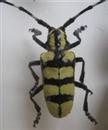
Morphological characteristics: the adult is about 33 mm long and about 8 mm wide, chestnut or chestnut-black in color, with a narrow, elongated body and parallel sides; between the antennae, around the compound eyes and on the top of the head there is dense golden-yellow pubescence; the antennae are relatively long, about 1/2 to 3/4 of the body length; the pronotum has 19 raised longitudinal ridges, and the deep grooves between the ridges are densely covered with pale yellow pubescence. The surface of the elytra is densely covered with punctures, the punctures at the base being coarser and densely wrinkled; in addition to grayish-white short hairs, there are also long markings composed of golden-yellow hairs arranged in five longitudinal rows; the underside of the body and the legs are densely covered with gray or grayish-brown pubescence.
Life habits: one generation occurs per year; adults appear from April to July, and emerge in large numbers in May and June. Adults often lay eggs at the broken ends or in the crevices near the tips of young branches, one egg per site; the hatched larvae then bore into the pith of the branch to feed. The tunnel is simple, forming a cylinder up and down, and white gelatinous material often accumulates at the end of the tunnel. When the branch is shaken, the larvae can move rapidly upward or downward. On the outside of the damaged branch, at certain intervals, there are frass expulsion holes. The frass is discharged from these holes as a viscous black liquid, which is a prominent sign of damage by this pest.
After the larvae mature, they pupate within the tunnel; after eclosion, the adult remains in the pupal chamber for a period before gnawing the frass expulsion hole wider and emerging to feed on young tender branches, buds and the bark of tender shoots as supplementary nutrition, then mating and laying eggs.
Control measures
1. Clean the orchard: in winter and spring, in conjunction with orchard pruning, cut off the damaged branches and burn them in a central location.
2. Manual capture of adults: newly eclosed adults are easy to capture manually during the supplementary feeding stage.
3. Spraying the canopy: use spraying during the adult supplementary feeding stage to kill them. Some low-toxicity pesticides can be selected for spraying. For example: 25% or 30% jule mixture emulsifiable concentrate at 1500-2000 times dilution, or 20% guofengling wettable powder at 800-1000 times dilution, or 30% shachongling emulsifiable concentrate at 1000-1500 times dilution. Use any one of the above pesticides, alternating them; spray once every 7-10 days during the adult occurrence period, for 2-3 consecutive sprays.
4. Injection into borer holes: use 40% dimethoate emulsifiable concentrate at 50 times dilution, or 2.5% deltamethrin emulsifiable concentrate at 200 times dilution, or 80% dichlorvos emulsifiable concentrate at 100 times dilution; choose any one, inject the solution directly into the borer hole with a syringe or insert absorbent cotton dipped in the solution into the borer hole, then seal the hole with wet mud. Note: before applying the pesticide, choose holes from which fresh frass is being expelled for injection or for inserting the medicated cotton. Then seal all frass expulsion holes on the entire tree with wet mud, so that the pesticide can fumigate and kill the larvae in the tunnels.
Click to get more mango cultivation techniques
Click to get more fruit cultivation techniques