What are some practical tips for controlling walnut pests and diseases?
What are the key secrets to controlling walnut pests and diseases? Please advise. The following introduces several key tips for controlling walnut pests and diseases for reference: Variety selection is the root cause. Nowadays, walnut cultivation is being developed in many places, all rushing in like a swarm, some planting seedling trees, some planting grafted seedlings. The problems brought by rushing ahead are many. For example, it leads to mixed walnut varieties, and serious cross-infection of pathogens.
What are the key secrets to controlling walnut pests and diseases? Please advise.
The following introduces several key tips for controlling walnut pests and diseases for reference:
Variety selection is the root cause
Nowadays, walnut cultivation is being developed in many places, all rushing in like a swarm, some planting seedling trees, some planting grafted seedlings. The problems brought by rushing ahead are many. For example, it leads to mixed walnut varieties, and serious cross-infection of pathogens.
Variety selection must be done with caution. First, variety selection should suit local conditions, choosing varieties suited to the local climate and soil conditions, choosing early-fruiting, thin-shelled varieties that grow vigorously, have strong stress resistance, good quality and high yield. Second, orchard establishment must also be scientific. When using grafted seedlings to establish an orchard, note that the walnut is a monoecious plant with separate male and female flowers, wind-pollinated, with a relatively long pollination distance. Therefore, when establishing an orchard, select 2 to 3 main cultivars with similar or complementary male and female flowering periods, or configure suitable pollinator varieties. The ratio of main cultivars to pollinator varieties is preferably 6:1. Main varieties can include Xiangling, Chandler, Liaohe No. 1, Yuanfeng, the Luguo series, etc.
Many causes of fruit drop
Regarding the phenomenon of walnut fruit drop, Xu Mingju analyzed that walnuts encounter rain or low temperatures during the flowering period, leading to poor pollination. Young fruits that are not well pollinated generally drop 20 days after flowering. Walnut fruit drop in many places this year is mainly due to this reason. In some places, walnuts grow to the size of an egg yolk without any visible symptoms, yet still drop, which is greatly related to the low temperatures during this year's flowering period. If you don't believe it, cut open the walnut and you will find the seed has already turned black or shriveled in development.
The severity of fruit drop also depends on the variety; different varieties have different severity. Varieties like Chandler have very light fruit drop.
Taking a close look at walnut fruit rot
Many fruit growers believe that walnuts do not have strict requirements for fertilizer and water; this view is incorrect. Due to insufficient fertilizer, and because walnuts consume a large amount of nutrients during the flowering period, it is very easy to form a nutrient deficit, leading to weaker tree vigor, which also easily leads to fruit drop.
Although some fruit growers pay attention to fertilizing, they favor excessive nitrogen fertilizer; using too much nitrogen fertilizer will also make the tree vigor excessively vigorous, causing the walnut tree's vegetative growth and reproductive growth to lose balance, not only making the canopy dense and poorly ventilated and lit, but also causing flower and fruit drop.
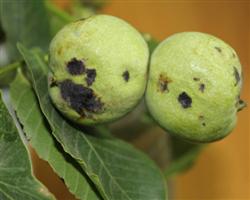
In addition, diseases causing walnut black fruit and fruit rot are also very serious. Xu Mingju states that bacterial black spot disease and anthracnose are the root causes of walnut fruit blackening, empty shells, fruit rot, kernel rot and fruit drop, so controlling these two major diseases is the key to high yield.
Treat the cause before applying the remedy
Bacterial black spot disease, also known as "walnut black", is caused by the fungus Colletotrichum gloeosporioides. It infects plants with a damage rate of 60-80%, a fruit damage rate of 20-40%, and in severe cases can reach over 65%. The pathogenic bacteria of black spot disease can infect all tissues of the leaves, causing the entire fruit to turn black, early dropping, shriveled kernels, and branches gradually turning black and necrotic. Anthracnose mainly harms walnut fruits, leaves, buds and young shoots. In affected plants, the fruit damage rate is generally 20%-40%, and in severe cases can reach over 90%. It causes walnuts to turn black and rot when nearly ripe, and kernels to shrivel.
The timing and severity of walnut anthracnose are closely related to high temperature and high humidity. If rain comes early and is abundant, and humidity is high, the disease occurs early and severely. If plant row spacing is small and ventilation and light penetration are poor, the disease is severe. Due to abundant rain, the disease manifests early, so control work must be done well. Before and after budding and during the leaf expansion period, spraying copper-containing preparations can also be used for prevention.
Before walnut germination, farmers can uniformly spray the ground and underground once with 5-degree lime sulfur mixture to kill overwintering pathogens and insect eggs. During the walnut leaf expansion period, spraying 1:0.5:200 Bordeaux mixture can also effectively prevent bacterial black spot disease and anthracnose. In the early stage of disease onset, use agricultural streptomycin soluble powder 3000 times liquid plus 70% thiophanate-methyl 1000 times liquid, or 20% tebuconazole 3000 times liquid plus 2% ningnanmycin 1000 times liquid; entering the rainy season, then use 1:0.5:200 Bordeaux mixture, used alternately, for better control effect. In areas with severe pest problems, especially when the walnut shoot borer occurs severely, farmers should also control pests in a timely manner, and when applying fungicides, add insecticides such as beta-cypermethrin to reduce wounds and vectors carrying pathogens.
Click to get more walnut cultivation techniques
Click to get more fruit cultivation techniques