What are the control methods for scale insects on apricot trees?
How do you control scale insects on apricot trees? When do scale insects on apricot trees appear? What methods can be used for control? Please explain. As the apricot tree area expands year by year, the number of scale insect pest species on apricot trees increases and the affected area expands, and the damage is becoming increasingly serious. At present, scale insects have become one of the main factors affecting apricot production in our county...
How do you control scale insects on apricot trees? When do scale insects on apricot trees appear? What methods can be used for control? Please explain.
As the apricot tree area expands year by year, the number of scale insect pest species on apricot trees increases and the affected area expands, and the damage is becoming increasingly serious. At present, scale insects have become one of the main factors affecting apricot production in our county.
I. Species occurring
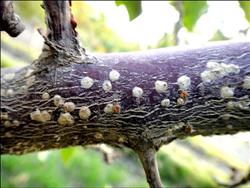
l. White peach scale (Pseudaulacaspis pentagona): Nymphs and adults cluster and fix themselves on branches and trunks, piercing and sucking the sap of apricot trees. In severe cases, the branches are completely covered by the insect bodies, appearing as if densely overlapped by a layer of grayish-white waxy material on the branches.
2. Apricot globular scale (Eulecanium sp.): This insect uses female adults and nymphs to pierce and suck the sap of plant branches and trunks. In severe cases, the honeydew excreted by the female bodies can induce sooty mold and attract ants onto the tree, thereby weakening tree vigor and affecting photosynthesis.
3. Korean globular scale (Rhodococcus sariuoni): Female adults and nymphs pierce and suck the sap of branches, trunks, leaves and fruits. The female bodies can likewise excrete honeydew, affecting tree growth.
4. Japanese wax scale (Ceroplastes japonicus): Adults and nymphs parasitize plant branches and trunks. On leaves, they use their piercing-sucking mouthparts to absorb tissue sap, and in severe cases can cause sooty mold.
After damage by the above scale insects, apricot trees may be delayed in sprouting and flowering may be affected. Buds and flower buds at the damaged sites, because nutrient supply is blocked, become shriveled and cannot sprout or bloom, or some flowers form buds but do not open. In severe cases, branches or entire limbs die.
II. Occurrence patterns
White peach scale has two generations per year and overwinters as fertilized female adults on branches. It begins to cause damage the following year after sap flow starts. It begins laying eggs in late April, nymphs begin hatching in early May, and late May is the peak period of first-generation nymphs. Mid-to-late June is the peak period of second-generation eggs, late July is the beginning of second-generation nymphs, and early August is the peak period of nymphs, mostly concentrated at the base of one-year-old branches where they fix and cause damage. After mating in late August, males die, while females continue to cause damage. By late September, as temperatures drop, they begin overwintering.
Apricot globular scale has one generation per year and overwinters as second-instar nymphs clustered on 1-2 year-old branches. The following year, after sap flow begins, they become active and cause damage. In mid-March, active nymphs move along branches and trunks and mostly fix and cause damage at cracked bark, branch forks and other such places. The female bodies begin to swell, and in late April they enter the egg stage. Mid-May is the nymph hatching period, late May is the peak nymph period, and from mid-to-late July to mid-August nymphs secrete white waxy powder and cluster to oversummer. In late August, as temperatures drop, nymphs molt and emerge from their shells and remain active causing damage until November, when their dorsal surface becomes covered with wax and they fix themselves to overwinter.
Korean globular scale has one generation per year and overwinters as second-instar nymphs on 1-2 year-old branches. Compared with apricot globular scale on the same branch, its overwintering site is lower. In spring, when sap flow begins, it starts to emerge from dormancy and remains active at the original site causing damage. In mid-March the female body begins to swell, and mid-April is the peak swelling period. Male adults are first seen in mid-April, and damage is most severe from early April to early May. Late May is the peak nymph period. Nymphs crawl along branches to the upper or lower surface of leaves, fix themselves and cause damage, with a few moving to the fruit cavity to cause damage. After fixing, the nymph's dorsal surface secretes a very thin waxy covering while it causes damage. From late September to October, it molts to the second instar, then moves back to branches, fixes itself and causes damage until late October or early November, when it overwinters.
Japanese wax scale has one generation per year and mainly overwinters as fertilized but not fully developed female adults on one-year-old branches; those on the same branch as globular scales mostly overwinter on two-year-old branches. In mid-May female adults begin laying eggs, early June is the peak egg period, the egg stage lasts about 20 days, and late June is the peak hatching period. After hatching, nymphs move to leaves, and after fixing themselves their dorsal surface is covered by a white wax shell. They fix and cause damage until mid-August to mid-September. After females and males mate, male adults die, and female adults gradually return to the branches. Mid-September is the peak period of returning to branches, and after returning they remain fixed and cause damage, entering overwintering as temperatures drop. Newly hatched scale nymphs can spread long distances with the wind.
III. Control. For scale insect control, the optimal control timing must be selected, and unified prevention and unified control with integrated management must be adopted.
1. Manual control. In combination with pruning, cut off severely damaged branches with insects. In winter and spring, use a stiff-bristled brush or steel brush to manually brush off and crush the insect bodies on branches and trunks.
2. Biological control. The main approach is to protect natural enemies. During the female body swelling period and the peak nymph hatching period of scale insects, choose biological pesticides and use broad-spectrum insecticides as little as possible or not at all, to reduce harm to natural enemies such as ladybugs, parasitic wasps and lacewings, and to make full use of the control capacity of natural enemies.
3. Chemical control. In spring during the tree budbreak period, before sprouting, use 5 degrees Baume lime sulfur mixture (when the temperature reaches 10°C or above) or spray with 40% Supusha at 500-700 times dilution, which also controls several scale insects. During the nymph occurrence period, before the newly hatched nymphs are covered with wax, use 25% diflubenzuron No. 3 or 25% Youlede at 1000-1500 times dilution. In severe occurrences, pyrethroid pesticides such as 4.5% beta-cypermethrin can be added.
4. Shaded application. In spring, in combination with irrigation, apply high-efficiency low-toxicity organophosphorus pesticides. After fruit harvest or before Japanese wax scale and globular scale return to branches, use omethoate and other high-efficiency low-toxicity systemic pesticides at 1:2 or 1:3 to smear the trunk, which both controls several scale insects and protects natural enemies.
IV. Precautions
1. Lime sulfur mixture is sensitive to certain varieties, and after use it easily delays ripening. In severe cases use a spray gun for spraying; otherwise it will cause phytotoxicity.
2. Diflubenzuron No. 3 and Youleguode are slow-acting pesticides and must be used before newly hatched nymphs become waxy.
3. Methidathion is an organophosphorus pesticide and can only be sprayed after harvest or in spring; it is prohibited during the fruit growth period.
4. Stop using beta-cypermethrin 15 days before harvest. It should not be used continuously multiple times, to avoid resistance.
5. Spraying must be meticulous and careful, so that the tree body is fully and evenly covered with the pesticide.
Click to get more apricot tree cultivation techniques
Click to get more fruit cultivation techniques