How to plant chestnut trees for high yields? These techniques must be mastered
How to plant chestnut trees for high yields? Please give an introduction. To achieve high yields when planting chestnut trees, you can refer to the following cultivation model: 1. Select improved varieties. Using improved varieties in chestnut cultivation is the foundation for achieving high yields over large areas. The basic criteria for selecting improved chestnut varieties are: ① strong adaptability to local climate and soil conditions...
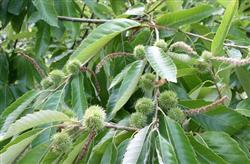
How to plant chestnut trees for high yields? Please give an introduction
To achieve high yields when planting chestnut trees, you can refer to the following cultivation model:
1. Select improved varieties. Using improved varieties in chestnut cultivation is the foundation for achieving high yields over large areas. The basic criteria for selecting improved chestnut varieties are: ① strong adaptability to local climate and soil conditions; ② early bearing, high yield, stable yield, and excellent quality; ③ strong resistance to pests and diseases. The main improved chestnut varieties native to Hubei Province include: Daguo Zhongchi Li, Liuyue Bao, Qiansi Daban Li, Qingmao Zao, Hongmao Zao, Wuke Li, Yangmao Li, Guihuaxiang, and others.
2. Reasonable close planting. Close planting is a major way to increase yield per unit area in fruit tree cultivation. The chestnut tree is a strongly heliophilous species with a very strong characteristic of bearing fruit on the outer layer of the canopy, and it has strict requirements for light and ventilation. If the planting density is too high, the chestnut orchard will close its rows too early, and the orchard will show flat-plane fruiting, causing yield to decline rapidly; if the density is too low, it is not conducive to making full use of the land area to achieve early high yield. Taking multiple factors into account, for orchard establishment on gentle slopes, a density of 3 x 4 m, 56 trees per mu, is relatively reasonable; for orchard establishment on flat land, the row spacing should be appropriately increased, and a density of 3 x 5 m, 44 trees per mu, is relatively reasonable.
3. Establish the orchard to high standards. The quality standards of three key links must be grasped well:
First, site selection. For orchard establishment in hilly and low mountain areas, the site is generally required to be at an altitude below 700 m, and slope aspects facing east, south, and west are better; the site is required to have good drainage and irrigation conditions, with the groundwater level below 2 m and the water level in the rainy season not exceeding 1 m; the soil should be acidic, with a pH of about 6.5, within a range not exceeding 4.9-7.5, and sandy soil with good permeability or gravelly loam developed from sandstone or granite is best.
Second, land preparation quality. For orchard establishment on gentle slopes, the land must first be terraced into belt-shaped terraces. The belt terraces should run along the contour lines, be more than 2 m wide, and have a 5-6° reverse-slope shape, lower on the inner side and higher on the outer side, with a drainage ditch 20-30 cm deep and 20-30 cm wide dug on the inner side, and then large holes 1 m square should be dug on the belt terraces at fixed points according to density. After land preparation is completed and weathering has occurred, backfilling is generally done about 1 month before planting seedlings. First, 5-10 jin of superphosphate per tree mixed with organic fertilizer is buried at the bottom of the hole as base fertilizer, then topsoil is backfilled, followed by subsoil. The backfill height should be 20 to 30 cm above the belt surface.
Third, seedlings. For orchard establishment, grafted seedlings can be used, or seedlings can be planted and then grafted one year later. The seedlings are required to have complete lateral roots, well-developed fibrous roots, and no pests or diseases. Grafted seedlings should be 2-1 years old, with a ground diameter greater than 1 cm, a seedling height of 60-120 cm, and plump buds; seedlings should be 1 to 2 years old, with a height greater than 1 m and a ground diameter greater than 1 cm. Seedlings have a short transplanting recovery period when planted on hills, strong tolerance to poor soil, a high orchard establishment rate, and relatively lower orchard establishment costs. Advancing the planting time to late autumn or early winter of the previous year helps improve the survival rate.
4. Cultivation instead of tending. Implementing early intercropping in chestnut orchards, using cultivation instead of tending, is beneficial to the growth of chestnut trees. At the same time, intercropping short-cycle crops can also increase the orchard's economic income and achieve short-term returns supporting long-term development. Commonly used intercropping models in production include: chestnut-bean, chestnut-wheat-bean, chestnut-peanut, chestnut-medicinal herbs, chestnut-mulberry, chestnut-forage grass, and others.
5. Dwarfing and training. For chestnut tree training, the target tree form is a dwarfed natural open-center shape (with the height of the first branch controlled at about 40 cm). In training methods, the traditional simple pruning should be changed to a combination of pruning, branch bending, pinching, and bud removal. In timing, training should be changed from winter or early spring to all four seasons. The specific operation points for training are: after the trunk is headed (trunk height generally set at about 60 cm), the chestnut tree will sprout multiple new shoots. Early on, select and retain 3-4 shoots evenly distributed in all directions with an opening angle of 50-60° to cultivate as main branches, and remove the rest. In summer, after the shoots grow to more than 40 cm, pinch them to promote secondary shoots, and then select and retain 2 shoots on each scaffold branch to cultivate the first layer of lateral branches; before spring of the following year, cut the first layer of lateral branches back to 40 cm to promote the second layer of lateral branches. For first-layer lateral branches less than 40 cm long, only remove the terminal bud without cutting back; in summer, following the previous year's method, cultivate the third layer of lateral branches on the basis of the second layer of lateral branches, and by winter, prune appropriately to form the basic crown shape. During the training process, topdressing should be applied in time to promote branch and shoot growth, reaching the growth speed required for rapid training so as to shorten the training period.
6. Formula fertilization. That is, according to the nutrient requirements of chestnut at different production stages and in different seasons, as well as the abundance or deficiency of soil nutrients in the orchard, fertilizers are selected and applied in a targeted and matched way. For chestnut orchards that have not yet borne fruit, emphasis should be placed on supplementing nitrogen fertilizer to promote vegetative growth and form the canopy; after entering the fruiting stage, emphasis should be placed on applying phosphorus and boron fertilizers to promote fruiting. In terms of seasonal fertilization arrangements, it mainly includes applying sprouting fertilizer in spring, flower- and fruit-promoting fertilizer in summer, fruit-strengthening fertilizer in autumn, and base fertilizer in winter; fertilization methods can combine root application with foliar application. At present, the fertilization method of vigorously promoting the summer "three sprays" for chestnut (that is, spraying once each at the leaf expansion stage, full flowering stage, and young fruit swelling stage with a mixed solution of 3‰ borax, 3‰ urea, and 3‰ potassium dihydrogen phosphate) has a significant effect on increasing the fruit-setting rate and reducing the empty bur rate.
7. Integrated pest and disease control. Pest and disease control in the production process should adhere to the principle of giving priority to prevention, combining prevention and control, and combining manual control, chemical control, and biological control. At present, the main chestnut pests include: chestnut gall wasp, twig-cutting weevil, chestnut weevil, chestnut giant aphid, star longhorn beetle, mulberry longhorn beetle, peach fruit borer, scarab beetle, chestnut caterpillar, and others; the main diseases include rough bark disease, dry rot, plaster disease, and brown rot.
Click to get more chestnut tree planting techniques
Click to get more fruit planting techniques