Detailed Explanation of the Fertilizer Requirements of Chestnut Trees: What Nutrients Are Needed for Growth?
What are the fertilizer requirements of chestnut trees? Please explain. Chestnut, like other fruit trees, differs in its fertilizer needs in that, besides requiring sufficient amounts of the three major elements nitrogen, phosphorus and potassium, it is particularly sensitive to the secondary element magnesium and the trace elements manganese and boron. If these are lacking or insufficient, serious physiological disorders occur that affect growth and development. According to measurements, ...
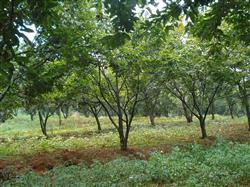
What are the fertilizer requirements of chestnut trees? Please explain.
In its fertilizer needs, chestnut is like other fruit trees, except that besides requiring sufficient amounts of the three major elements nitrogen, phosphorus and potassium, it is particularly sensitive to the secondary element magnesium and the trace elements manganese and boron. If these are lacking or insufficient, serious physiological disorders occur that affect growth and development. According to measurements, chestnut is a fruit tree with a high manganese requirement; the leaves of normally growing trees contain 1000-2500 mg/kg of manganese, and if the level falls below 1000 mg/kg, leaf yellowing appears and growth is hindered. If magnesium is deficient or supplied in insufficient amounts, interveinal chlorosis appears, and the faded parts gradually turn brown and die. Because boron is an important element for promoting pollen germination, pollen tube growth and ovary development, boron deficiency in the soil leads to empty burs. According to surveys, chestnut orchards with a soil available boron content of 0.56-0.87 mg/kg bore fruit normally, with an empty bur rate of only 3%-6.9%; orchards with a content of 0.2-0.4 mg/kg had very low yields, with the empty bur rate reaching as high as 44%-81%. Duan Xugen of Meiyuan Village, Dongling Township, Jianchuan County, mixed 100 g of borax into the base fertilizer per tree when planting chestnuts, and after planting sprayed a 350-fold borax solution once each June; the trees began flowering and bearing fruit in three years, two years earlier than those not given boron fertilizer or boron spray.
The demand for nitrogen, phosphorus and potassium is large, and the absorption periods differ. Nitrogen is absorbed in large amounts and over a long period, from bud break continuously until before fruit harvest, with the greatest absorption during the period of rapid fruit enlargement, and it gradually decreases only after harvest. Phosphorus absorption is relatively stable from after flowering until before harvest, but the amount absorbed is small, and the absorption period is shorter than that of nitrogen and potassium. However, phosphorus is extremely important for the fruiting performance and yield of chestnut. According to measurements, in high-yield orchards of trees in full bearing, the soil available phosphorus content reached as high as 20.18-27.00 mg/kg, and the phosphorus content in new shoots reached 2420 mg/kg; in low-yield orchards, the soil phosphorus content was only 1-9 mg/kg, and the phosphorus content in new shoots was as low as 1360 mg/kg. This shows how great a role phosphorus plays in yield. Phosphorus is an important substance for promoting flower bud differentiation, fruit development, seed maturation and improving quality. Potassium begins to be absorbed in small amounts before flowering, gradually increases after flowering, is absorbed most during the fruit enlargement period, and then sharply decreases after harvest. This proves that in the annual growth cycle, from the differentiation of male flowers in early spring to flowering and fruit set, nitrogen is needed most, followed by potassium, with less phosphorus; from after flowering to the fruit enlargement period, phosphorus is needed most, followed by nitrogen and potassium; and from the fruit enlargement period to harvest, potassium is needed most, followed by nitrogen, with less phosphorus.
Click to get more chestnut tree cultivation techniques
Click to get more fruit cultivation techniques