What are the methods to prevent empty burrs in chestnuts?
How do you prevent empty burrs in chestnuts? Please explain the methods. Apart from varietal characteristics, the main causes of empty burrs in chestnuts are nutritional deficiency or boron deficiency. The comprehensive control measures are as follows: 1. Improve varieties: For inferior seedling trees of mountain chestnuts with a high rate of empty burrs and low yields, top-graft them to change the variety. ...
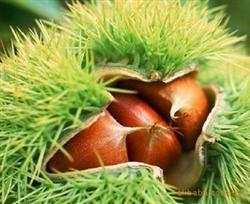
How do you prevent empty burrs in chestnuts? Please explain the methods.
Apart from varietal characteristics, the main causes of empty burrs in chestnuts are nutritional deficiency or boron deficiency. The comprehensive control measures are as follows:
1. Improve varieties: For inferior seedling trees of mountain chestnuts with a high rate of empty burrs and low yields, top-graft them to change the variety.
2. Concentrated pruning: For trees that produce empty burrs due to weak tree vigor, keep 1 to 2 fruiting mother branches at the tip during pruning, and thin out all other weak branches; promptly thin or cut back crossing, overlapping, overly dense and non-fruiting branches. If the fruiting mother branch at the tip of a branch is too weak, it should also be cut back promptly.
3. Apply more organic fertilizer: Apply organic fertilizer after harvest in autumn to promote plump and well-filled differentiated flower buds. The application rate should be kept at 100 kg per tree, along with 0.5 kg to 1 kg of urea and 250 g of biological potassium; if organic fertilizer is insufficient, chestnut-specific fertilizer can be used instead, at 4 kg to 5 kg per tree. Apply by trenching, with trenches 30 cm wide and 50 cm deep. Be sure to mix the fertilizer thoroughly with soil before putting it into the trench, then cover with soil.
4. Press green manure: For mountain chestnut trees with a high rate of empty burrs and insufficient organic fertilizer sources, press green manure from late July to early August. For large fruiting trees, press about 50 kg per tree. The method is to spread the green manure evenly within the tree basin, then cover the green manure with 5 cm to 10 cm of soil. If mountain surface soil can be collected nearby for covering, the effect will be even better. Pressing green manure can also conserve soil moisture.
5. Use boron fertilizer skillfully
① Soil application of boron: Combined with autumn application of organic fertilizer, apply 100 g to 200 g of borax per large fruiting tree, applying boron once every other year. For trees with severe empty burrs, in spring dig 8 to 20 fertilization holes 30 cm deep around the outer edge of the canopy, scatter 100 g to 200 g of borax into the holes, then pour in a small amount of water, and cover with soil after the water seeps in.
② Foliar boron spraying: Spray 0.3% borax solution 1 to 2 times during the flowering period, which can significantly reduce the rate of empty burrs, but the effect is not as good as soil application of boron. Generally, using these two methods together gives very good results.
③ Trunk boron infusion: At the early flowering stage, drill a small hole slanting downward in the trunk about 1 m above the ground, deep to the pith, then dilute 0.5 g of fast-acting boron to 0.5x10(to the upper right -6), put it in an infusion bottle and hang it upside down on the trunk, then use an infusion tube to slowly drip it into the tree through the small hole in the trunk. The advantages of this method are water saving and quick results.
6. Thin out male flowers: The time for thinning male flowers is when the mixed inflorescences at the tips of fruiting branches become visible and the basal male inflorescences are 4 cm to 7 cm long. Manual removal of male flowers can keep only the inflorescences at the tips of fruiting branches and remove all the rest (including male inflorescences on the lower part of fruiting branches and on male flower branches). For chemical thinning of male flowers, 1000-fold chestnut male-flower-thinning alcohol solution can be sprayed on the canopy in late May, which can advance male flower drop by 30 days to 40 days, with a male flower thinning rate of more than 80%.
Click to get more chestnut tree cultivation techniques
Click to get more fruit cultivation techniques